The Correct Understanding of So-Called "Corpse-Nursing Grounds"
Originally published on the WeChat official account "Daoist Yinfu Culture."
In common parlance, those places where burial can keep a corpse from rotting are called corpse-nursing grounds.
Online, some people, based on the form features recorded in certain ancient feng shui books—such as the dead-cow-belly acupoint, dog-brain-shell acupoint, hard-wood spearhead, broken-face Wen Qu, and earth-that-is-not-earth—call such places corpse-nursing grounds.
These claims have given novelists a great deal of inspiration and produced many works.
However, this is only one side of the matter; they know the first but not the second.
In ordinary secret feng shui geographical manuals, when corpse-nursing is mentioned, it is mostly vague and seldom clearly states whether it is auspicious or inauspicious; among the folk, most understand it as inauspicious.
This is because such landforms are not the complete condition for producing an uncorrupted corpse; they merely cause the coffin to be invaded by rainwater, so that after burial for a few years, opening the coffin reveals a blackened, rotten corpse.
Naturally, in the eyes of folk feng shui masters, these places are generally greatly inauspicious ground.
In fact, among burial methods there is a dedicated corpse-nursing burial method; if it succeeds, it is greatly auspicious.
This is just as a corpse that does not rot after a person dies is not regarded as an ill omen—indeed, some religions with corpse-veneration customs will even fashion such a body into a sacred statue for worship.
Of course, these matters of auspiciousness and balefulness ultimately rest with people.
Generally speaking, the essence is that other necessary conditions were lacking, causing corpse-nursing to fail—so it instead became inauspicious ground.
There are some tombs where, after the coffin is opened, the corpse remains intact and the flesh still has elasticity; these can truly be called successful corpse-nursing.
So how does such a phenomenon form? This requires starting from the principle of non-decay of corpses.
Uncorrupted corpses, as commonly spoken of, can be divided into two kinds: wet corpses and dry corpses.
First setting aside the concept of corpse: whether human or animal, after death the body is essentially a mass of meat; and the reason meat rots is mainly the decomposition of protein by microorganisms and enzymes. As for the microbial community, one must either inhibit its proliferation or build a microbial community that does not decompose the flesh; as for enzyme production, one must also be able to inhibit it.
When encountering a sufficiently dry environment, if there is also ventilation, dry corpses can result—think of cured meat; this is relatively easy to understand.
Relatively more complex is the wet corpse. Usually under non-acidic conditions, the rate at which a corpse decays in water differs from that in soil, because soil can absorb part of the moisture and the corpse dries more easily; so in soil the corpse decays half as fast as in water.
If the place is excessively humid, the soil's acid-alkaline balance must be very uneven—especially acidic soil. If the location is again low-lying and damp, over time liquid will seep into the coffin and soak the corpse; if the acidity is high enough, the liquid itself can inhibit microbial growth.
So if the environment where the coffin is buried is relatively closed, one may simply understand the corpse in the coffin or burial pit as having become canned food: as long as the seal is good, combined with higher acidity, microbial growth can be effectively inhibited.
Another situation is that the corpse is not soaked by liquid, but lack of oxygen inside the coffin causes the decay rate to drop sharply—so that after a few years the coffin is opened and the bones still carry quite a few half-decayed pieces of flesh. In folk custom this is usually treated as an inauspicious omen.
There is yet another situation: for example, the corpse was seriously ill in life and took large amounts of medicine, or so much preservative was injected into the body that the decay rate of the bones and flesh was greatly slowed.
Ancient times also saw similar preservation operations—for example in Buddhism, after an eminent monk died, a flesh-body Buddha was often made: the living were usually asked to keep swallowing medicines such as cinnabar before death, or the corpse was salted or waxed, thus producing the so-called uncorrupted golden body.
Modern treatment techniques also plastinate excavated archaeological remains for preservation.
But these after all involve secondary treatment; under natural conditions, what can meet the conditions for producing a wet corpse that lasts for years without decaying depends on soil and climate.
Roughly speaking, because most southern Chinese soils are acidic and rainfall is abundant—and, unlike today, ancient climates often alternated between southern-flood/northern-drought and northern-flood/southern-drought patterns—non-decay was more common in the south than in the north.
Add to that a warm climate favors the growth of corpse hair, so the phenomenon of hairy jiangshi also appears more easily; descriptions of jiangshi in the south differ greatly from those in the north.
Usually ancient texts often link jiangshi with the drought-demon Hanba; in fact this is because northern cultural influence was mainstream. In folk understanding, the south generally treats jiangshi as a kind of spirit-monster that can harm people but can also be subdued; in the north, jiangshi is mainly believed to cause drought, and its main function is to be dug up and burned to pray for rain.
Soils that can keep corpses from rotting are mostly red—these are acidic soils—and another kind is black, neutral-to-slightly-acidic; when severely imbalanced they also become acidic.
At the same time one may note: in the traditional funeral date-selection customs, Red Sand Day and Black Sand Day are deliberately avoided. The common saying is that burial on these days brings disaster; in other places there are legends that burial on these two kinds of days into the corresponding soil makes the corpse even less likely to decay and grow hair.
In fact, a corpse growing hair and becoming a hairy jiangshi is not really very strange, because meat itself carries many mucor, rhizopus, and cladosporium molds that often form white and gray flakes; developing to a certain stage they cover the entire corpse—this is the origin of the corpse growing hair.
The source of this fear originally came from red and black sand grounds that might keep corpses uncorrupted. Because the practice of burning hairy jiangshi once prevailed, a newly buried corpse if ordered to have its tomb opened and the body burned was of course no good thing.
It should be noted: although here we speak of not rotting, the standard is actually quite broad—not all cases mean completely intact, like a living person sleeping. Anyone who has seen a corpse understands that this itself is unrealistic.
So usually after a tomb is opened, those not decayed cleanly enough are also treated as uncorrupted. In places where burning corpses is common, naturally a fire is unavoidable; but in regions with bone-gathering customs this is even more commonplace—specialists who gather bones are hired to strip rotting flesh from the bones and burn it.
Possibly because women's bodies have relatively more fat, female corpses form uncorruption more easily than male ones—this is why legendary stories often say that underage females or pregnant women who die accidentally more easily become jiangshi.
However, in reality, are tombs where the bones do not decay really greatly inauspicious ground?
Quite the opposite: in feng shui art it is held that if burial leaves the bones unchanged, it is in fact related to the burial methods of secret feng shui arts.
In some mountain forms, because the incoming vein is coarse and blunt, and when the vein descends the acupoint star mountain is drawn out very long, the qi-mechanism of such mountain forms is heavy. In the eyes of ordinary earth masters, such places are usually thought to have no dragon acupoints, or to be false ground where burial does not flourish.
In fact, the vast majority of so-called false ground in the world is not truly false—this is the so-called sacred things concealing themselves, great earth hard for vulgar eyes to recognize. This is also why many people, after reading many of those faked feng shui geographical books, when looking at tombs built by ancient national masters and famous hands, easily feel at a loss.
Corpse-nursing ground is one such case: the mountain peak leans round—that is, the so-called Metal Star—and what it forms is further divided into yin and yang. What can constitute corpse-nursing ground is the Solar Metal Star: its mountain form has a round head and fat body—standing it is like a giant cauldron, lying like a great flatbread, large like a jeweled canopy, small like a bell; the large and round ones are the Solar Metal Star.
Like most acupoint-seeking methods, such places will have a small stretch of flat ground appear—but it is usually flat yet not flat, like a skirt laid open, or as if dotted with pancake shapes, or swollen and uneven. Where qi breathes forth and opens the pincers, the form is like a Y, or like a tiger's mouth—and likewise.
Such places constitute corpse-nursing ground because: vegetation is sparse and the soil texture is loose, not easily clumping—these are all features of relatively acidic soil.
Because the vein drags long and the earth qi sinks, the key to this burial method is: to receive the vein's qi one must bury deep; and in burial the pit must be warmed—by putting in grass and wood and lighting them—so that the tomb lacks oxygen, and because it is deep, it can be sealed from air underground. So when rainwater seeps through the acidic soil into the coffin and soaks the corpse, the phenomenon of non-decay forms. Of course, another case is that the coffin is tightly sealed, with water surrounding and isolating air—this can also keep the corpse from easily rotting.
Usually when water soaks up to the coffin lid or the corpse, the ground surface shows a feature: it becomes much flatter. This is also because rainwater seeps downward; the gaps in the soil are uneven, enlarge when wet, and after gradually losing moisture become uniform and dense.
Such tombs most taboo opening. If already opened and the corpse found uncorrupted, it is basically ruined—reburial on the spot is too late; after burial the corpse will still rot quickly. The ancients believed this was because a mass of yang qi had been vented.
Modern understanding can reverse the explanation: underground the temperature was lower, favoring preservation; after opening the temperature rises and microorganisms re-activate rapidly—so subsequent rapid decay is not hard to understand.
Think of an opened can of food.
All the above refers to corpse-nursing grounds under general conditions; as environmental conditions strengthen, the remains can be preserved even longer.
Usually it is said that water and ants invading the coffin indicate the descendants will grow cold and decline—but this is a special case. If the dragon configuration is proper and the peaks and waters are clearly received, if the bones and flesh remain warm and uncorrupted, it is still auspicious ground. From ancient feng shui art this can indicate flourishing literary and examination success and favor official fortune.
If dead-cow-belly, dead-fish-belly ground, diamond-belly ground—fully round and bulging, with no yin and yang in the acupoint—all suffer cold water invading the coffin. If human-back, yellow-ox-back, turtle-back, boat-bottom-back—and wind cannot be hidden—all indicate bones rotting. If goose-head, Lu Cun-head—all indicate mud slurry invading the coffin. If Wen Qu without a pearl, falling straight into the incoming head—it is broken face; loach emerge from the tomb. If spearhead, mud and water will surely turn to slurry. All the above indicate mud and water invading. But if the acupoint star opens a broad face, opening yang level and full, or the star falls and breaks and surges upward, one may dwell shallow at the summit and flourish in wealth and rank; or obtaining a vein of sunk qi, bury deep—and obtaining a corpse that does not decay is auspicious. Burial Verses
Naturally, worldly matters are not absolute. In one place, a young provincial-level cadre with a limitless future once took the lead in digging up his family's ancestral grave; a snake was seen guarding the coffin, and the ancestor's bones were uncorrupted as if in life. After digging them up he was quite astonished; later he quickly relocated the burial. For more than ten years he has never again been promoted.
There are naturally many factors behind this—but one can also see: though it is said this can flourish official fortune, rising to provincial level while still young is indeed reasonable. But his digging up his own ancestral grave seems also that in the unseen world there is a fixed destiny; worldly reckoning has its own standard. One can see that although feng shui has its power it cannot be treated as the main decisive factor.
Put filial piety first: find a good resting place for the ancestors, then use feng shui art to select the ground; through filiality receive the ancestors' blessing and protection—this is the correct way. If it is merely to seek fame and fortune, to use feng shui for transformation and opportunistic gains, virtue unequal to position—this greatly loses the sages' purport.
The above burial without decay, in real feng shui art, is not something to pursue: because keeping an uncorrupted corpse after burial is not easy; once achieved for a hundred years, years later it can instead become a rotten corpse (commonly called douhua corpse). From the feng shui point of view this is instead a dangerous sign; the measure is hard to grasp.
In traditional feng shui it is held that after the ancestor's bones and flesh buried have fully decayed, if the bones turn golden yellow or carry red, both are auspicious responses; if they turn black, that is very bad.
Some may wonder: ordinarily, in most cases, once a person's corpse is buried it is not opened again—so where do these teachings come from?
In fact, for historical reasons many places have the custom of picking up gold (bone reburial): years after burial, the ancestor's bones are exhumed, washed one by one, and reinterred. This custom is seen relatively often among the Hakka, and in Taiwan and elsewhere it is still retained.
Bone gathering and reburial has a long history. As early as the Warring States Liezi and the Suishu and other histories, secondary bone-gathering burial customs of the ancient Baiyue peoples were recorded. Across broad southern China it was once relatively common; and today among the Zhuang of southern China, Taiwan, Ryukyu, parts of Southeast Asia, the Malagasy of Madagascar, and farther still the Americas and East Africa, it is still practiced.
Its original source is very likely that amid war or other factors, when groups migrated they needed to take their ancestors' bones along for sacrifice.
In actual burial practice, unless one is a feng shui master thoroughly versed in burial, it is better to seek, after the bones are buried, for the flesh to decay fully leaving clean white bones—that is, when burying, if the burial place is not sandy soil, do not bury with the original soil, but instead line the bottom with sandy soil and cover with it; as long as rainwater at the burial place percolates down through the sand layer, there is no standing water in the tomb, and the bones can be clean and white.
Back to the main topic: every place legendary for an uncorrupted corpse must show at least several of the following features:
1. Acidic soil, mostly not by field edges.
2. Low terrain where rainwater easily settles, rain invading the coffin.
3. If there is a little clay, mud slurry easily forms and enters the coffin.
4. If there are faint black mildew spots on the grave mound, rain has mostly invaded the coffin.
5. White dew on the grave at noon is mostly water vapor steaming from within.
6. White hair growing around the grave.
7. Underground must be sufficiently cold.
Other conditions also exist, not listed one by one here.
However, the above is only theory—can it be verified?
Take Lady Xin Zhui of Mawangdui: the first layer of her tomb was sealed earth closing the chamber; the second was a rammed-earth layer sixteen meters thick; the third used white kaolin clay as the main material; the last layer was filled with over thirty centimeters of charcoal—together forming a sealed environment. And Han tombs used mountains as burial mounds, dug extremely deep; many people feel the coolness inside Han tombs—and sealed underground it is naturally cold enough.
At the same time, of the mountain form where Lady Xin Zhui of the Mawangdui Han tomb was excavated—browsing historical film materials one can see it like this:
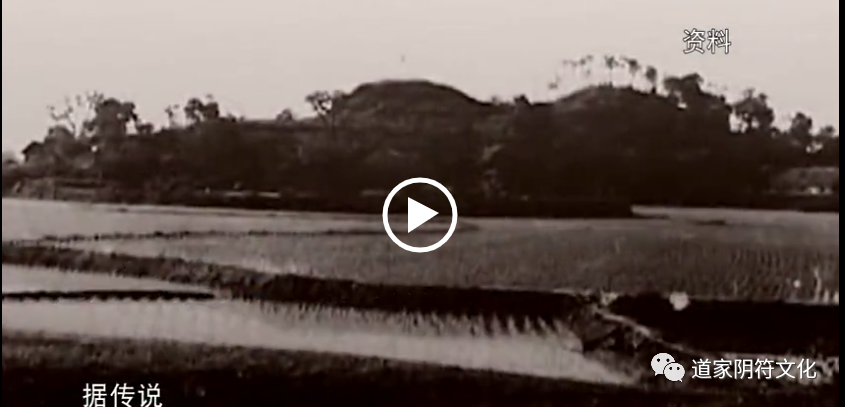
Obviously, the two features of deep burial and the Solar Metal Star are both quite clear.
And from the Mawangdui sand-table maps online and related video materials, one can view the full landscape.
However, uncorrupted is uncorrupted—from the biological point of view, human and animal flesh composition is still ordinary meat; whether it rots depends on microbial communities and enzymes decomposing protein. Even if under special conditions decay is inhibited, it is not enough for the jiangshi phenomenon of corpses freely moving about as widely rumored among the folk.
Yet legends of jiangshi are everywhere—not as if from empty rumor. So how exactly did it arise, and what secrets lie behind it?
Wait for the next section to unfold.