Latest notes
The First Person to Resist Modern Cultural Aggression
In 1723, the Yongzheng Emperor ordered Catholicism banned: “Recently in Fujian, certain Westerners have harassed my people and despised my laws. The Fujian officials have memorialized me; I shall curb these disorders. This is my state’s affair, and I am responsible for its enforcement… You wish all Chinese to become converts — I know your demand. But consider: if that came to pass, what would we become? Would we not become subjects of your emperor? Converts know only you alone. Once trouble arises on the borders, the people will obey only your orders. Though we need not worry of this now, if thousands of warships should come to our shores, the disaster would be great.” In 1842, during the First Opium War, Britain…
 Recommended Reading
The Relationship Between Illness and Month of Birth
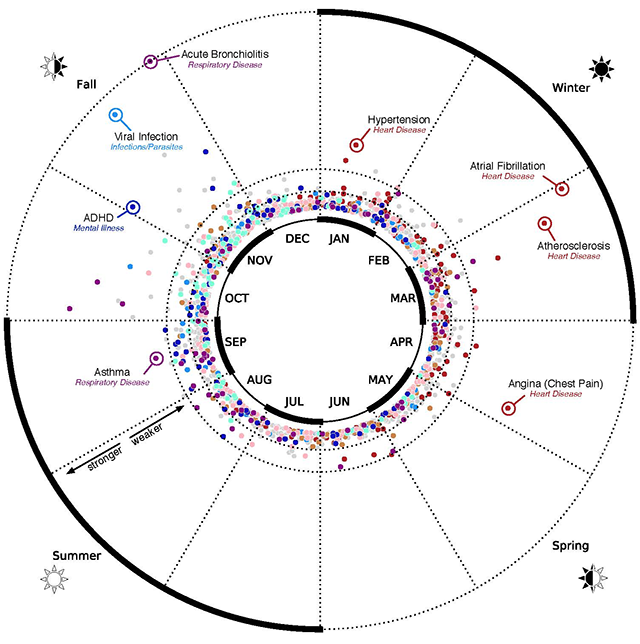
Recently, Columbia University's latest study on "Birth Month and Disease Risk" was published in the Journal of the American Medical Association. This study analyzed medical records of over 1.7 million patients at NewYork-Presbyterian Hospital/Columbia University Medical Center from 1985 to 2013, finding that 55 diseases are related to a person's month of birth. Researchers stated that among all months, those born in May are least likely to get sick, while those born in October are most likely to get sick; those born in March are most prone to heart problems; those born in July and October have the highest risk of asthma; November
Sun Pu: An Investigation of Southwestern Ethnic Cultures: "Divine Judgment"
[Abstract] Ordeal is a method of dispute resolution in ancient societies. Through an introduction to Western ordeals, this article focuses on the ordeals in the ethnic minority areas of Southwest China. On this basis, it comprehensively analyzes their unique ordeal procedures, attempting to explore the ancient value orientations of law contained therein. [Keywords] Ordeal; Witchcraft I. Overview Montesquieu stated in *The Spirit of the Laws*: "Laws should relate to the natural state of the country, to the cold, hot, or temperate climate; to the quality, form, and area of the land; to the lifestyle of the people, whether they are farmers, hunters, or herdsmen..."
 Recommended Reading
Hollow Orchid: A Visit to Contemporary Chinese Hermits (Part 11)
After climbing for about a hundred meters, we arrived at the ruins of an ancient hermitage, and then began to climb a steeper cliff face. Halfway up, my legs began to tremble from exhaustion and fear, so I asked the guide how much farther it was. He said two hours, then pointed to the cliff top just below the white clouds. When he had earlier told us that Master Su's cave was "not far," I had forgotten to ask exactly how far. Now I knew, and I realized we could not climb up. It would be dark in less than two hours, and we were truly out of energy. We decided to visit Master Su another day, and then slowly descended back to the main road. Walking
Ridge of Empty Valley Orchids: In Search of China's Contemporary Hermits (Part 10)
Mount Hua is not only renowned for its scenic beauty but has also been an ideal place for hermits to cultivate themselves since ancient times. On our way up Mount Hua to seek out hermits, we passed by a stone with three characters carved on its front: "The Sound of the Crane." In Taoism, the crane symbolizes transformation, transcendence, freedom, purity, and longevity, making it a perfect representation of Mount Hua. Yet clearly, this crane had already flown away. As Taoists claim, the historical form of Taoism may have originated at the Louguantai at the western end of the Zhongnan Mountains. However, its prehistoric form had already flourished on Mount Hua at the eastern end of the Zhongnan Mountains long before. For Taoists, the significance of Mount Hua even surpasses
Empty Valley, Hidden Orchid: A Visit to Contemporary Chinese Hermits (Part 9)
在距离小山大约一公里处,我们路过一座石碑,它兀立在粟苗之间。向导说,原来这儿有一座大寺庙,红卫兵占领了这个地方以后,整个寺庙都毁了,只剩下了这块石碑。在石碑的上方,我们渡过了田河。之后途经一座小村庄,村庄里都是土房。然后我们向山里进发。 几分钟后,我们到达一座小山。山顶上曾经有过一座祠堂,里面供着元始天尊。据说老子是他的一个化身。我们的向导在一块石碑前点燃香和烛,然后我们继续向前走。那块石碑,就是
Hollow Orchid: A Visit to Contemporary Chinese Hermits (Part 8)
当刘备听说诸葛亮可能是这样一位人选的时候,他决定亲自去拜访诸葛亮。可是就像有时候会发生的那样,即使是作为大人物去拜访隐士,刘备还是不得不三顾茅 庐,才得到了诸葛亮的接见。当这两个人终于会面的时候,刘备对诸葛亮的雄才大略留下了如此深刻的印象,以至于他乞求诸葛亮结束隐居生涯,去扶助他安邦定 国。诸葛亮同意了。 在此后的岁月里,诸葛亮的所作所为,证明了他无疑是中国历史上空前的、最伟大的谋略家。有一次,他
Hollow Valley Orchid: A Visit to Contemporary Chinese Hermits (Part 7)
Every year on the fifth day of the fifth lunar month, Chinese people still row dragon boats to retrieve Qu Yuan. They throw zongzi into the water to confuse the fish and dragons, buying time for the dragon boats to catch up with Qu Yuan. However, no matter how hard people try, the poet continues to sink into the water year after year—only the rivers and lakes of China suffer, becoming increasingly turbid. The contradiction between morality and politics is the core of the hermit tradition. If Qu Yuan found it difficult to resolve the conflict between the two as he wished, it should be said that he was not the only one with this feeling. 800 years before Qu Yuan threw himself into the river, a pair of brothers also faced
Empty Valley Orchid: A Visit to Contemporary Chinese Hermits (Part 6)
Hermits are one of China's best-kept secrets, symbolizing many of the country's most mysterious aspects. For some, cultivation means a life of solitude; for others, it means a political career. However, in any case, they are sources of 'pure thought' and 'pure living,' which will eventually find suitable channels to flow into the human world. Although the hermit tradition is an indispensable part of Chinese society, it was not until the end of the third century AD that Chinese officials began to make efforts to publicize the contributions of hermits. There is a chapter in the 'Book of Later Han' dedicated to hermits, which begins as follows
The Hollow Valley's Orchid: A Visit to Contemporary Chinese Hermits (Part 5)
The chapter on the western mountains in this book begins with those south of the Three Gorges, then proceeds westward along the Zhongnan Mountains and the Kunlun Mountains all the way to K2, surpassing even K2. Among their mysterious peaks lies the earthly capital of Di (the highest of the heavenly gods), where also resides the home of the Queen Mother of the West (the moon goddess, bestower of the elixir of immortality). Additionally, there are other mountains where shamans collect ingredients, brew their own elixir of immortality, and ascend to heaven; there, even those who die early live for eight hundred years. During this period, they do as they please and enjoy themselves to the fullest; it is the place where the sun and moon sleep; there
Hollow Valley Orchid: A Visit to Contemporary Chinese Hermits (Part 4)
The Zhongnan Mountains are interpreted by some as the 'Moon Mountain.' Legend has it that this is where the sun and moon sleep. Among its mysterious peaks lies the celestial emperor's earthly capital and the home of the moon goddess. Thus, it has become a place where certain individuals come to attempt to approach the divine virtue and power source of the moon, making it a paradise for hermits. When I first heard of the Zhongnan Mountains, I knew neither their location nor their importance. In Beijing, someone told us they were near Xi'an, which was all the information we received. When we first set out for the mountains, in Mount Heng and
Hollow Valley Orchid: A Visit to Contemporary Chinese Hermits (Part 3)
Stephen stopped to take a panoramic shot of the mountain, while I climbed the final slope leading to the pagoda. I walked clockwise around the small brick pagoda three times, then respectfully saluted the master— he compiled the first chronological history of Buddhist figures in China. Afterward, I sat down with my back against the front of the pagoda. Before me lay endless rolling hills, peaks shrouded in white clouds, and turquoise streams. It looked like the perfect place for seclusion. But even with binoculars, I could not find any caves, huts, paths, or cooking smoke. I was disappointed, yet simultaneously exhilarated by finally being in the mountains
Empty Valley, Hidden Orchid: A Visit to Contemporary Chinese Hermits (Part 2)
In the spring of 1989, I decided to join this flow of people, not to visit relatives, but to seek out hermits. When a kind sponsor was willing to cover the expenses for this exploratory trip, I called Stephen Johnson in the United States. Two years earlier, he had expressed his willingness to accompany me as a photographer if such a trip could materialize. He had not changed his mind, so we agreed to meet in Hong Kong two weeks later. I dug out my old Forest Service backpack and had new straps nailed onto it. Meanwhile, I began to study maps carefully, especially those indicating population density.
Hollow Valley Orchid: A Visit to Contemporary Chinese Hermits (Part 1)
自古以来,隐士就那么存在着:在城墙外,在大山里,雪后飘着几缕孤独的炊烟……在我动身前往中国大陆寻访隐士前两个星期,在中国台湾有人告诉我,共 产党早就把大陆上的隐士连同真正的出家人消灭光了。然而一个月后,与五个年轻的和尚坐在那个小小的土坯寺庙里,看着门外绵延不尽的苍蓝的终南山,记录着隐 士们的地址,我只有微笑的份儿了。 在整个中国历史上,一直就有人愿意在山里度过他们的一生:吃得很少,穿得很破,睡的是
14 posts