Latest notes
The Red Bag Classic (Hong Nang Jing)
Editor's note (Sanfu Fengyunyong): The annotations by various schools are a complete mess, so this is recorded here. The yin-yang geographical hexagrams of the mountain house are idle chatter. Pointing at peaks to shift the sands — all flowers before the eyes. Speak not of idle stars and lu-horse; falsely warn of disasters invading. Speak not of the six elegant waters of the yang hexagrams — just flowers before the eyes.
Outer Chapters of the Heavenly Jade Classic
The hexagrams known as Xuan-Kong hold the subtlest principle; from Qian, Kun, Gen, and Xun inquire into origins and causes. Kan, Li, Zhen, and Dui divide Heaven and Earth, and the Five Phases are sought still within their positions. The first, the Heavenly Treasure Classic, is the most wondrous; the second, the Dragon Son Classic, must be examined. The third classic is called Mysterious Maiden, and the fourth is named Precious Illumination Classic.
The Heavenly Jade Classic
Upper: One trigram east of the river has always been auspicious — of the eight spirits, four are one. One trigram west of the river ranks the dragon position — of the eight spirits, four are two. The eight spirits north and south share one trigram — the correspondence is truly without error. Twenty-four dragons govern three trigrams — do not speak of this with ordinary masters; once you suddenly know it, you attain immortality, and generation after generation enjoys abundant fortune. The heavenly trigram east of the river can be sought in the palm of the hand; once known, it is worth a thousand gold. The earth draws the eight trigrams — who can comprehend it? Mountain and water face each other.
Original Text of the Lingcheng Essence Classic
In the universe there are great correspondences and conjunctions, with qi and fortune as master; in mountains and rivers there is true disposition, with momentum and form as foremost. Earthly fortune shifts, and heavenly qi follows it; heavenly fortune turns and revolves, and earthly qi responds. Heavenly qi moves above, and human action responds; human action moves below, and heavenly qi follows. There is gathering discourse, traveling discourse, seated discourse — then qi gathers at the dragon; there are the authority star, the honored star, the heroic star — then qi gathers at the momentum; there are covering lead, embracing the embryo, riding the embryo — then qi gathers at the den; there are gathering the lapels, gathering the hall, gathering the pass — then qi gathers at the configuration.
Clarifying Doubts in Geomancy
By Ma Taiqing (Qing). The art of kan yu has produced generation after generation of true masters from antiquity to the present. Research and deduction have been refined and detailed to the utmost. Yet true masters appear only rarely in the world, and one seldom has the chance to meet them. Even when there is oral and heart-to-heart transmission, the world still hears little of it; hence those who falsely assume famous names and invent secret formulas multiply without end.
Glimpses of Dwelling Methods
By Zhu Yao, courtesy name Xulun, of Xishan (Qing). The learning of geomancy is of long standing. The Odes tell of Gong Liu's move to Bin, again observing its flowing springs and measuring its wet lowlands; the Documents tell of the Duke of Zhou planning Luo, first divining east of the Jian and west of the Chan. From this one knows that sage kings and worthies of the three dynasties, when founding capitals and establishing cities, always discerned the configuration of mountains and waters, examined the meetings of yin and yang, and sought where Heaven and Earth's form and qi melt and condense, to serve as a firm foundation lasting thousands of years.
Commentary on the Three Talismans of the Wenshi Sutra (Part 2): The Pillar — Building Heaven and Earth
The pillar: it builds heaven and earth. Guanyinzi said: whether bowl or basin, bottle or jar, urn or vat — all can build heaven and earth. Tortoise shells for omens, counted yarrow stalks, broken tiles and patterned stones — all can foretell fortune and misfortune. Thus one knows that all things of heaven and earth embody principle; a single thing contains it, and every thing contains it — none borrowing from another. With my essence, join with his essence. The two essences contend, and the spirit responds. San Fu Feng Yun Yong commentary: The bowl is an analogy — half the celestial sphere — therefore such things can all build heaven and earth. Whether using a tortoise shell, a broken tile, or a stone bearing patterns, all can foretell fortune and misfortune. But by what are they able to foretell? It is because the potential is inherently there, borrowing form to manifest; form is completed according to the thing, each different, and none borrowing from another. Only essence can contend, so one can join one's essence with his essence — being stirred, the spirit moves of itself.
Annotations on the Wenshi True Sutra by Sanfu Fengyunyong (Part One): The Universe Is the Dao
The Wenshi True Sutra, when ordinary people read it, seems obscure in wording, full of metaphorical meaning yet elegant in diction—hard to fathom its sense. Though I delight in tales of the strange and the immortals, I do not believe the confusions of legend. By modern scholarship this sutra dates roughly to the Southern Song, with some saying it was fabricated by Sun Ding; though this remains undetermined, that it is a pseudepigraph is beyond doubt. Since it cannot have been written by Perfected Wenshi, I have usually set it aside. Years ago, while in a state of practice, I first felt heaven and earth as one, the void beginning to break open—
Chronicles of the Planetary Stars
The five planets lined up at the pole of Heaven: the essence of Taiyi, whose qi belongs to the Purple Palace, governs generation. The essence of the five planets, whose qi belongs to Taiyi, serves as assistants. Its color belongs to Yinghuo (Vesper Mars), governing military punishment and anxiety. The essence of the five planets, whose qi belongs to Taibai (Venus), governs conscription and generals and ministers. The essence of the five planets, whose qi belongs to Chenxing (Mercury), governs the Yulin guards, campaigns, and defense in war. Taiyi is also taken as Tianyi; the years, months, days, and stars form the constellations. All have the twelve branches, each in its own order with its stellar configuration, yet the positions of the stars themselves are not among them. In the Tang astronomical treatise, astronomers ranked stars as first class, also meaning that this is the method of the Heavenly Ancestor and the ranks of the Twenty-Eight Mansions—this is likely so.
Entering the Mountain Judgments
First look at the incoming head five stars, then at the arrangement of the eight directions, divide rooms and places of residence, distinguish yin-yang generation and control. Large look at star bodies, small look at earth corners, carefully look at yin-yang. Yang look at hollows and protrusions, yin look at nests and sha. Yang sha mostly presages poverty and cold, yin sha mostly presages ruin and extinction. Pressed and sunken means few descendants; running and scurrying means dog-stealing and rat-thieving. Square and upright produce honest people, low and slanting produce crafty people.
Song of Ascending Mystery Entering the Chamber
People know only of year and month, competing to misread the various classics. Some speak of luminary qi, some of honored stars, some of the Nine Stars Celestial Sage secrets. Muddled names without number, within them few comprehend the wondrous secrets. They lie only in the four configurations of Thunder—with Thunder joined to qi, heaven and earth move. (Sanfu note: the four configurations of Thunder are precisely the year, month, day, and hour configurations.) Generals out and ministers in, merit is won; One keeps position, Nine Palaces turn.
Books Associated with Wang Yuanbiao
The Jinjing Lord Liao’s Secretly Transmitted Heart Method of Earth Learning, Correct Transmission, Strategy, and Sand-Sweeping Classic—written by the Jinjing Mountain Man Liao Yu of Qianzhou in the Song; collected by Peng Daxiong of Bangcaili in Yuzhang; edited by Jiang Zhidong of Menglongfu, Xingyuan, Xin’an in the Ming; collated by Wang Yuanbiao of Chengjingfu in ancient She; reviewed by Wu Gongsui of Jichangfu. It contains numerous diagrams of earth-sites and is collected in the Palace Museum collectanea. The Illustrated Direct Pointing of Helping the Yuan is formerly attributed to Liu Ji, corrected by Wang Yuanbiao, edited by Jiang Zhidong.
Commentary on the Cantong Qi (32): The Sages of Old Embraced the Mysterious and Held to the True
The sages of old embraced the mysterious and held to the true, subdued and refined the nine tripods, transformed their traces and hid in reclusion, contained essence and nurtured spirit, communicated virtue with the three lights, their fluids moistened the interstices, sinews and bones became firm, all evil influences were banished, upright qi endured long, and after long accumulation they transformed form and became immortals.
Commentary on the Cantong Qi (31): Firm and Yielding Rise in Turn, Distributed Through the Cycles
Firm and yielding rise in turn, distributed through the cycles. Dragon west, Tiger east, built with the Weft at Mao and You. In the second month the elms shed their leaves when the Kui arrives at Mao; in the eighth month wheat sprouts when Tian Gang holds You. What Yin and Yang join is what firm and yielding transform. Firm turns to soft, soft turns to firm; after mutual iterative change they redistribute, so the Dragon reaches the west and the Tiger the east — Dragon and Tiger are Mao and You.
Discussing the Zhouyi Cantong Qi (30): Kan as the Male and the Moon, Li as the Female and the Sun
Kan as the male is the moon; Li as the female is the sun. The sun bestows virtue; the moon unfolds its light. The moon receives transformation from the sun, and its body is not diminished or harmed.
Discussing the Zhouyi Cantong Qi (29): The Crimson Maiden by the River, most numinous of spirits, flies upon meeting fire
The crimson maiden by the river, numinous and most divine, flies when meeting fire; no dust is seen—like a ghost hidden or a dragon concealed, none knows where she abides. If you would control her, take the yellow sprout as root.
The Tongxuan Ghost Spirit Classic
Sanfu commentary: This book is truly a method of judgment through external responses. Though it does not quite match the orthodox feng shui methods, when one has resonance the subtlety opens through, and it often produces astonishing pronouncements. Yet this method mostly requires inspiration and is not easily mastered by those who only seek principles. Tongxuan Ghost Spirit Classic — Preface: Originally named the Book of Entry Judgments and Grave Entry Judgments. It has always been a manuscript, rarely seen in the world — a pity that even Song people could not obtain it...
On the Cantong Qi (28): People Delight in Petty Arts, Not Pondering Whether the Dao Is Deep or Shallow
People delight in petty arts, not pondering whether the Dao is deep or shallow. They abandon the correct path for the crooked, seeking haste and blocking their own free flow—like the blind without a staff, the deaf listening to music, diving where there is no water to catch pheasants, climbing mountains for fish and dragons, planting wheat while expecting millet, or using a compass to draw squares. They exhaust strength and spirit all year without visible results. If you wish to know the method of ingesting and refining, its affairs are simple and not complicated.
Chatting about the Cantongqi (27): The Three Treasures of Ear, Eye, and Mouth—Close the Gates and Send Nothing Forth
Earlier essays covered somewhat deeper material; this one can be lighter and simpler. It is not long, but it does mention the work’s verified effects—over a long run they can truly be demonstrated. Though one does not say that immortality follows from this alone, dissolving chronic illness and living long in the world is no easy matter either. The three treasures of ear, eye, and mouth—close the gates and send nothing forth. Ears, eyes, and mouth are important outer openings of the body: ears can hear, eyes can see, mouth can speak; all human intercourse goes through them, yet using them is not without cost. Especially for adults: the more they are used the faster they age. Once past thirty, as life qi in the body gradually wanes and blood and qi turn from flourishing toward daily consumption of vital force, this phenomenon becomes far more obvious than in the young…
Chatting about the Cantongqi (26): The Yang Mirror Takes Fire—Without the Sun It Produces No Light
The yang mirror takes fire; without the sun it produces no light. The square Zhū is not toward stars or moon—how could it obtain water? The yang mirror is an ancient fire-making implement. The Lunheng says: “Test the sun with the yang mirror—fire comes from heaven.” Such fire tools are generally bronze concave mirrors, able to catch sunlight over a larger area; when light hits the polished face it reflects and focuses to a point, so the heat carried in the light concentrates and fire is produced. Because this fire is generated by the sun it is called solar fire. The principle is the same as a lens taking fire—one reflects, one refracts. The square Zhū is an ancient water-gathering device…
On the Zhouyi Cantong Qi (25): Constantly Following Earth’s Patterns, Receiving Heaven and Dispersing the Proclamation
Constantly following Earth’s patterns, receiving Heaven and dispersing the proclamation; subtle, hidden, distant and far, divided yet linked. Heaven above and Earth below are joined by one qi; the qi below transforms into mountains, rivers and terrain, dragon veins surge and form apertures, open their curtains and produce nobility — yet this qi truly comes following Heaven. Though Heaven and Earth are separated by vast distance, they secretly communicate and connect, for Heaven has stars and Earth has peaks; Earth’s patterns are in essence Heaven’s patterns.
On the Zhouyi Cantong Qi (24): Even If You Know Cinnabar and Black Lead, Without the Fire Phases It Is All in Vain
Cycling through the Jade Sill, rising and descending, up and down. Circulating through the six lines, hard to observe. Thus without a fixed position — the ancestor of Change. What is meant by Heaven and Earth set in their places, and Change moves within them: sun and moon come and go, with Qian, Kun, Kan and Li as hub and axle — standing alone yet unchanging, revolving endlessly without toil. Its transformations circulate through the six lines. Just as Kan and Li move qi within the cauldron, circulating through the six voids within the images, none can spy or see — the mystery secretly arises, truly the ancestor of the medicine.
A Casual Talk on the Zhouyi Cantong Qi (23): Movement and Stillness Have Constant Law; Follow Their Ink-Mark
Movement and stillness have constant law; follow their ink-mark. The four seasons accord with what is fitting, matching the qi. Hard and soft are distinguished, and do not invade one another. The Five Phases hold their boundaries, and do not wildly expand or contract. The Yi moves and circles, bending, stretching, and repeating. Between dark and light, join the tally and act within.
A Casual Talk on the Zhouyi Cantong Qi (21): Dark and Mysterious, Hard to Measure—Cannot Be Drawn in a Picture
Qian and Kun, hard and soft, pair and embrace each other. Yang grasps, yin receives; female and male depend upon each other. Through this dependence comes transformation, and the essence-qi unfolds. Speaking of hard and soft: Qian's nature is hard, Kun's nature is soft. Only when the two natures of hard and soft embrace each other can Qian and Kun stand together. Thus yang grasps and yin receives; female and male cannot be separated. Moreover, each thing has its own nature, and requires the mechanism of transformation to let its essence-qi unfold. In alchemy one often refines realgar; besides realgar, orpiment is also used, because orpiment and realgar are always found together.
 Classics & Scriptures
A Casual Talk on the Zhouyi Cantong Qi (20): Deduce the Numbers of the Five Phases—Simple and Concise, Not Complicated
Deduce the numbers of the Five Phases—simple and concise, not complicated. Raise water to strike fire, and suddenly the light is extinguished. Sun and moon eclipse each other, always between new and full. When water flourishes, Kan invades yang; when fire declines, Li dims as in daylight twilight. Yin and yang feed each other; interaction and response are the natural Dao. The name is used to fix feeling; the character speaks of nature. When metal returns to the beginning of its nature, it may be called the Reverted Elixir. I dare not speak falsely, but imitate the writings of the sages.
A Casual Talk on the Zhouyi Cantong Qi (19): The Words Are Solemnly Spoken—People of the World Do Not Ponder Them Deeply
As for the utmost sage, none surpasses Fuxi, who first drew the eight trigrams, modeling heaven and earth. King Wen, ancestor of emperors, shaped their forms and developed the line statements. The Master, that outstanding sage, composed the Ten Wings to assist them. These three worthies were heaven-endowed, rising in turn to govern their times. Their ranks differ in steps, yet their merit and virtue are not unlike. Their creations build upon one another; they calculated and examined down to fen and zhu. The formed is easy to estimate; without signs it is hard to plan. They made their works models for the world, settling the Odes and Documents. Having no prior foreknowledge, they awakened through teachers. Bright as frost in the curtain; glaring-eyed they climbed the high terrace. The Fire Records number six hundred scrolls; their aims are all the same. The words are solemnly spoken—people of the world do not ponder them deeply.
A Casual Talk on the Zhouyi Cantong Qi (18): Turning from the Dao, Guarding the Lost Path—Exiting the Correct, Entering the Crooked Trail
White lead powder thrown into fire—its color ruined, it reverts to lead. Ice and snow meeting warm water—dissolving, they become the Great Mystery. Metal takes cinnabar as master, blending in harmony with mercury. Changes arise from their truth; beginning and end causally depend on each other. To make one who lies down and ingests an immortal, one should use like kinds: to plant grain use grain seed; to hatch a chick use its egg. Completing by kind is natural; things are accomplished through easy smelting. Can fish eyes become pearls? Can mugwort become tea trees? Those of like kind follow one another; contrary affairs cannot form treasure. Swallows and sparrows do not birth phoenixes; foxes and rabbits do not nurse horses. Water does not flow upward when flaming; fire does not moisten downward when stirred.
On the Cantong Qi (17): Their Arsenic, Our Honey
Jusheng still prolongs life; the reverted elixir can be taken into the mouth. The nature of metal does not decay, and therefore it is the treasure of all things. The adepts subdue and eat it, and their lifespan becomes long. Earth roams through the four seasons, keeps its boundaries and maintains its rules. Metal sand enters the five viscera, dispersing like mist in wind and rain. It steams and permeates the four limbs, and the countenance becomes bright and lovely. White hair all turns black; fallen teeth grow back where they were. The old man becomes young again, and the aged woman becomes a maiden. The form is transformed and one escapes worldly calamities; such a person is called a True Person. The "Materia Medica Revered Origins" says: Jusheng is also called Hu Ma, and also Goushi. It originally came from the Hu lands, hence the name Hu Ma. Ju means great. It originally grew in the Hu land of Dayuan, so it is also called Jusheng; among the eight grains, only this one is finest. Kou Zong said: Hu Ma is precisely today's large sesame; only that produced in the Hu lands is plump and large, hence the name Hu Ma, also called Jusheng.
Chatting about the Zhouyi Cantong Qi (16): Zi-Wu Numbers Join at Three; Wu-Ji Are Called Five
Zi and Wu join at three; Wu and Ji are called five. Three and five in harmony — the eight minerals set the measure. Breath inhaling and exhaling nurture each other; abiding in breath become husband and wife. Yellow earth is metal's father; flowing pearls are water's child. Water takes earth as its ghost; earth suppresses water so it does not rise. Vermilion Bird is fire's essence, holding the balance to adjust victory and defeat. Water overflames and fire is destroyed; both die and return to thick earth. Three natures then gather; original nature shares one ancestral source.
On the Cantong Qi (15): Gold Is Born from the Moon; at the New Moon It Receives the Sun's Talisman
Gold enters the fierce fire, yet its color never loses its refined brilliance. Since creation, sun and moon have never dimmed their light. Gold does not lose its weight; sun and moon keep their form as always. Gold is born from the moon; at the new moon's dawn it receives the sun's talisman. Gold returns to its mother; at month's end sun and moon enclose each other. It hides its framework and sinks into the great void. Gold restores its former nature, and the cauldron of awe-inspiring light blazes bright. The previous chapter spoke of how to gather enough medicine; this chapter covers the steps that should follow once the medicine is fully gathered. Forge gold into foil, cut it into pieces, and temper it with fire—no matter how it is fired, gold keeps its original color, and through burning away some impurities becomes even brighter; this is a metaphor from the external alchemy perspective. Thus it is said, "Gold enters the fierce fire..."
On the Cantong Qi (14): Two Eights Answer to One Catty; the Way of Yi Does Not Lean
The Fire Records are not written in vain; they unfold the Changes to make this clear. The crescent-moon method forms furnace and cauldron; the White Tiger is the pivot of the simmering. Mercury is called the flowing pearl; the Azure Dragon accompanies it. Raise the east to join the west; soul and spirit naturally bind each other. The upper bow of Dui counts eight; the lower bow of Gen also counts eight. When the two bows join their essences, the bodies of Qian and Kun are complete. Two eights answer to one catty; the Way of Yi does not lean. When Song-dynasty Chen Xianwei explained the Cantong Qi, he said: "In ancient times there were alchemical books revealing the workings of fire phases, called the Fire Records, some six hundred chapters; their purport does not go beyond the Zhou Changes." What are fire phases? Colloquially, alchemy is like cooking: different medicinal herbs can be seen as ingredients—some need fierce high heat to bring out their fragrance, some need a low gentle simmer to cook through; only when combined do they become a fine dish.
Chatting about the Zhouyi Cantong Qi (13): Yin Spirit, Yang Spirit, Body Spirits, and Out-of-Body
The clear-eyed grasp its purport; broadly they know its source. Diligent in practice, morning and night without rest. Taking and consuming for three years, lightly rising to travel far. Crossing fire not scorched, entering water not wet; able to be and not be, lasting joy without care. Dao accomplished, virtue fulfilled, hidden awaiting the time. Taiyi then summons; remove to the central isle. Merit full, ascend; receive register and accept chart.
Chatting about the Zhouyi Cantong Qi (12): Sudden Death by Heavenly Mandate, Bones Exposed and Flesh Rotten
Is this right or wrong? The method of reviewing the five stores. Inner vision means during cultivation turning light to illuminate within; at a certain level one can perceive the qi of the five zang and six fu organs, and this perception further produces a visualization-like presentation. The Zhenren Daozi is not magical — accumulating essence and accumulating qi to become true. Without accumulation, how to become true?
On the Cantong Qi (11): Know the White, Keep the Black; Spirits Naturally Come
The virtue of the higher is non-action; it does not seek through observation. The virtue of the lower is action; its use never ceases. This speaks of the natural Way—like human breathing: though a person breathes at every moment, when one does not attend to it there is no awareness; though it seems one does not know where it resides, it yet operates without end—this is the higher method. To still the breath with intention is the mind-mind; if not with intention, it is the spirit. Thus when the mind does not move, intention ceases; spirit naturally appears and regulates—this is the way of mind and breath depending on each other, mind and spirit becoming one. And if operation occurs only when a thought arrives, and does not when no thought comes, then one must keep a single luminous awareness at every moment, not separating for even a hair—this is the lower method.
On the Cantong Qi (9): Governing the First of Administration—Innovate the New and Reform the Old
Governing the first of administration—innovate the new and reform the old. Contain and close in fine subtlety; open, spread, and array the treasure. The essential Dao's Dipper handle governs the guiding principles and keylinks of transformation. Line-images move within; auspiciousness and misfortune arise without. The five planets' errors and alignments respond as the times stir. The Twenty-Eight Lodges in discord and deviation, separating and joining, bowing and rising. Wenchang tallies and records in统; reprimands the terrace ministers and the hundred officials and their departments, each managing its charge. The sun joins the essence of the five phases; the moon receives the regulation of the six pitches. Five times six make thirty degrees; when degrees end, they begin again. Trace the origin and seek the end—the thread of survival and loss: or the lord arrogant and dissolute, overfull and contrary to the Dao; or ministers corrupt and fawning, acting off the proper track. Phases of bows, fullness and waning—deviant changes and ominous blame. The law-enforcers remonstrate and reprove, questioning faults and bequeathing them to the ruler. The Pole Star receives correctness, leisurely entrusting those below. Proclaiming policy in the Bright Hall, the state has no path contrary to the Dao. If policy is issued, the first matter is to "innovate the new and reform the old."
Chatting about the Zhouyi Cantong Qi (8): Zhongni Praises the Primordial Chaos, the Virtue of Qian and Kun Reaches the Mysterious Void
Then Zhongni praised the primordial chaos: the virtue of Qian and Kun reaches the mysterious void. Examining the ancients to the original sovereign, Guanju established the beginning; crowning and wedding, qi intertwines; in the first year the sprouts grow. Zhongni is Confucius — how did he praise chaos? He said: "Great is the primal of Qian! Ultimate is the primal of Kun!"
 Classics & Scriptures
Chatting about the Zhouyi Cantong Qi (7): Boiling Heaven and Earth in the Crescent Moon Furnace, Decocting Sun-Soul and Moon-Marrow
Heaven and Earth take their positions, and the Change moves within them. Heaven and Earth are the images of Qian and Kun; taking positions means setting forth the paired positions of yin and yang. The Change means Kan and Li as the two uses of Qian and Kun. The two uses have no line positions; they circulate through the six voids, neither fixed in coming and going nor constant in up and down — dark, sunken, submerged, hiding, transforming within, enveloping the myriad things, cords and regulations of the Dao, governing the existent through the non-existent.
Chatting about the Zhouyi Cantong Qi (6): Exploring the Xiantian Diagram Again
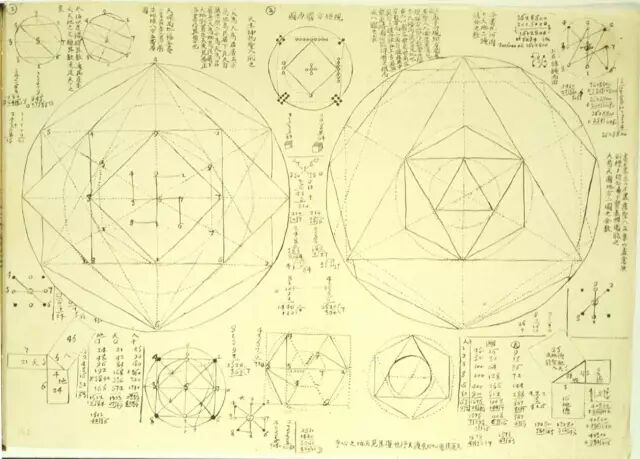
"On Loving the Lotus" — "rising unstained from the mud, washed by clear ripples yet not showy" — nearly everyone was forced to memorize it in school. Yet the author is more famous not for that essay but for the Taiji Tu Shuo. Shao Yong (1011–1077) and Zhou Dunyi (1017–1073) were contemporaries; both were said to receive Chen Tuan's transmission, both called "Zi." The He Tu and Luo Shu are ancient things.
 Classics & Scriptures
On the Zhouyi Cantong Qi (V): In Search of the Xiantian Chart
Shao Yong, courtesy name Yaofu, posthumous title Kangjie, so he is often respectfully called Mr. Shao Kangjie. He once studied the numerology of the He Luo diagrams under Li Zhicai. Li Zhicai took Mu Xiu of Henan as his teacher; Mu Xiu studied under Zhong Fang, and Zhong Fang studied under the Old Ancestor Chen Tuan.
Classics & ScripturesChatting about the Zhouyi Cantong Qi (4): Zhu Xi Seeks the He Tu and Luo Shu
Without the He Tu, Luo Shu, and Xiantian diagrams, the Zhouyi Cantong Qi is almost impossible to understand — yet by the early Song dynasty the He Tu and Luo Shu had already vanished. Zhu Xi was especially devoted to this matter. The origin of the He Tu and Luo Shu is quite mysterious. One account says Fuxi, by the Yellow River, saw a turtle surface with the eight trigrams on its back and was inspired.
 Classics & Scriptures
Chatting about the Zhouyi Cantong Qi (3): The Jingfang System
Many people believe everything in this world is random: through vast disordered motion, things undergo various changes and interweave into this universe. Buddhism, while unconcerned with where the world came from, has its own interpretation called dependent origination and emptiness of nature. In short: randomness constitutes this world, so everything should be random. Yet if you take a basin and smash it on the ground, it breaks into many pieces; smash another and the same happens.
Classics & ScripturesChatting about the Zhouyi Cantong Qi (2): Qian and Kun — Gateways of the Change, Parents of the Myriad Hexagrams
Qian and Kun are the gateways of the Change and the parents of the myriad hexagrams. Kan and Li form the surrounding frame and turn the hub on its axle. The four hexagrams of male and female serve as the bellows, covering and enveloping the Way of yin and yang — like a craftsman or charioteer, following the ink-line and string, holding the reins, aligning to the compass and square, and tracking the rut. Everything in the world does not depart from yin and yang.
Classics & ScripturesChatting about the Zhouyi Cantong Qi (1): Principle
Anyone who can earn the honorific title "Master" from the world has essentially achieved greatness — for even opponents must first acknowledge one's ability before criticizing. Master Zhu Xi was different: nearly a thousand years have passed, and any mention of the Song dynasty still requires mention of Cheng-Zhu Neo-Confucianism, which means mentioning Zhu Xi. Qi is a philosophical concept filled with wisdom in ancient China, far more abstract than the materialist four elements of ancient Greece. But Zhu Xi held that Principle precedes qi.
The Transmission of the Dharma Mind (IV)
For more articles, please follow the WeChat public account "Daoist Yin-Fu Culture." Original text: In practicing the Daoist methods, one must first receive and uphold the ten precepts. In daily use and constant practice, there is no deficiency or shortfall. Furthermore, if one can relieve poverty and save from suffering, accumulate merit and practice deeds, one will naturally move Heaven and Earth. Spirits revere and ghosts submit; sitting one can command thunder and lightning, call the wind and summon the rain. Today there is a class of later students who do not uphold the precepts, do not distinguish orthodox from heterodox, cling to words and are stuck in images, and idle in wild thoughts. With occasional momentary efficacy they become self-satisfied. They never investigate what that efficacy actually is, and so summon heterodoxy with heterodoxy and ghosts with ghosts.
The Transmission of the Dharma Mind (III)
Original text: I am a mere ignorant fool who carelessly entered the Dao methods. Once I met a person of the highest attainment who transmitted them, I came to know a thing or two within the methods. I often reflected on the ancestral masters' words: the methods operate with the prenatal one qi; generals are commanded with one's own original spirit—truly pointing directly at the mystery and subtlety, illuminating later students. Alas, students' understanding is shallow and superficial; they cannot enlighten themselves, yet they keep their minds fixed on visualization practices, imagining this to be the profound mystery. Little do they know they abandon the root and chase the branches, discard the truth and seek the false. At first I also did not understand this principle, and widely sought the paper texts transmitted by enlightened teachers. Some taught using the character "ti" to swallow down into the dantian, then drawing it up with the character "chao," visualizing golden light and operating the prenatal one qi. Others taught visualizing the heart fire and kidney water mating in the primordial sea, forming an infant, and taking this as one's own original spirit. I was not like them—I applied much bitter resolve, and luckily met a true master who transmitted the secret aperture of "thunder and lightning," and explained through these principles, waking me as if from drunkenness: all my former learning had been false. Later I also obtained a method of summoning envoys from Mr. Mo-Yueding, which spoke in detail of the wonders of the prenatal.
Heart Transmission of Daoist Methods (Part 2)
The original text: The Five Thunderbolts arise from yin and yang qi and are formed by the Five Phases. Qi rises and falls with the seasonal nodes, matching the turning of the Big Dipper's handle. There is birth and flourishing, storage and concealment. From the winter solstice, one yang is born in the Fu hexagram, two yang in the Lin hexagram, three yang in the Tai hexagram, four in the Da Zhuang hexagram. When the seasonal node reaches the Spring Equinox, xun wind stirs, earth's vapor steams upward, and after the first half-moon thunder begins to sound.
The Transmission of the Dharma Mind (I)
Original text: From childhood I loved practicing the Dao methods, sparing no toil, seeking teachers and receiving transmissions—I lost count of how many. People of the world ask about the secret aperture of the mysterious pass and the essentials of the mysterious female. They merely take the place between the two kidneys, one cun three fen below the navel, as the mysterious pass, and the bright hall of six harmonies, dantian, mouth and nose as the mysterious female. People of the world ask about the five-phase generation and overcoming, and the wonder of water and fire clashing. They say: write metal, wood, earth, water, fire, crisscrossed within a well-character, and call that generation and overcoming; cast a brick talisman into water and make a sound, and call that clashing. I thought these accounts probably had not reached the mystery. So I applied my mind for over thirty years, observing how clouds and wind gather and disperse, how climate changes and penetrates, silently comprehending in my heart, rejoicing without knowing it. In past lives I was greatly fortunate, and again met a person of the highest attainment; under a single word, I verified without doubt. For the movement and stillness of Heaven and Earth, the course of sun and moon, the ordering of the four seasons, the arising and growth of the ten thousand things—all issue from the wondrous circulation of the Supreme Pole.
Records of Swords Ancient and Modern
The one-volume Records of Swords Ancient and Modern is traditionally attributed by historical sources to Tao Hongjing of the Shangqing school of Taoism. Tao Hongjing conducted in-depth research in medicine, alchemy, astronomy and calendrics, geography, military studies, sword-forging, classical studies, literature and art, and Taoist ritual, with his greatest contributions being in pharmacology. However, this book contains many errors. First, when recording Wu generals, it places Guan Yu, Zhang Fei, Zhuge Liang, Huang Zhong, and others under the entries of Wu generals—and they should not appear between Deng Ai and Guo Huai either. Furthermore, it lists Dong Zhuo and Yuan Shao among Wei generals, appearing very chaotic. By conjecture, three characters meaning "Shu generals' swords" may have been lost during copying. Also the book says Emperor Shun was murdered by Yang Yu, yet Tao Hongjing was himself a man of that dynasty and should not have made such a mistake. Moreover, Tao Hongjing died earlier than Emperor Wu of Song, yet the imperial sword section contains Emperor Wu's posthumous name and even refers to his personal name directly—obviously rather unreasonable. It is suspected that later hands may have added these passages, rather than Tao Hongjing having written them; however textual research shows the book has a long provenance and is not a later forgery.
An Analysis of the True Immortal's Secret Transmission: Method of Fire Phases
The method of fire phases is not the empty qi of visualization held in the mind, nor is it the true qi of breath above the waist. Its transmission is of three: the heart is sovereign fire called the upper samadhi; the kidneys are ministerial fire called the middle samadhi; the bladder is the people's fire called the lower samadhi. When the three qi gather they become fire; when they disperse they are qi—hence the name True Fire of the Three Samadhis. Their rise and fall cycle like the way of Heaven: fifteen liang, three hundred sixty zhu, forming the degrees of a celestial circuit. Heavenly qi increases once every five days—the qi phase. In human cultivation, the fire advances and retreats by fives. Master Lü said: within the fire wheel nourish the Yellow Maiden. Sea Toad said: when firing the elixir, do not let the fire-dragon fly. Begin at the Xu or Hai hour and stop at the Zi hour. Sit quietly in a dark chamber, repeatedly clear away thoughts, lean lightly on the table, relax the flanks and abdomen, breathe thinly and continuously, use it without strain, and silently visualize the dantian turning like a fire wheel without ceasing.
Table of Contents of the Complete Collection of Daoist Ritual Norms (Daomen Kefan Daquanji)
Volume 1: Birthday Natal Rite, Dawn Path-Progress; Volume 2: Birthday Natal Rite, Noon Court Path-Progress; Volume 3: Birthday Natal Rite, Evening Court Path-Progress; Volume 4: Repentance Rite for Averting Illness, Dawn Path-Progress; Volume 5: Repentance Rite for Averting Illness, Noon Court Path-Progress; Volume 6: Repentance Rite for Averting Illness, Evening Court Path-Progress; Volume 7: Disaster-Averting Stellar Rite, Opening the Altar Path-Progress; Volume 8: Disaster-Averting Dao-Altar Rite, Setting Up the Jiao Path-Progress; Volume 9: Disaster-Averting Stellar Rite, Closing the Altar Path-Progress.
197 posts