Latest notes
 Feng Shui & Geomancy
Revealing the Secrets of Feng Shui Through World-Famous Cities: Overturning the Traditional Theory of the Three Great Trunk Dragons
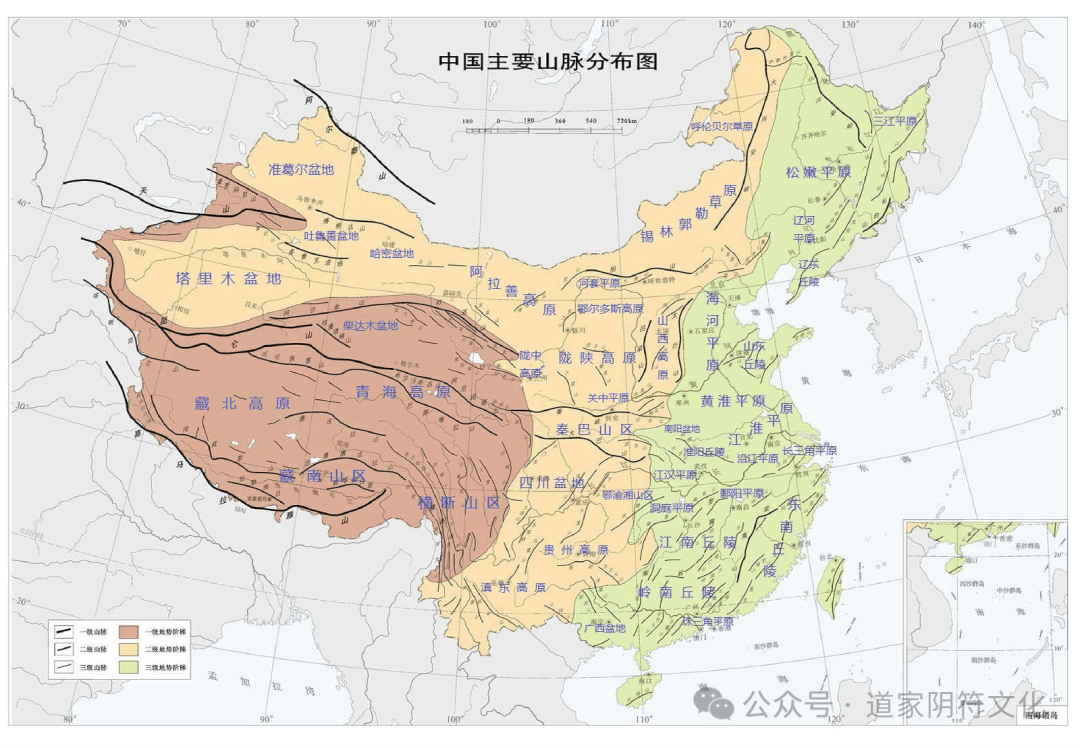
From the Tribute of Yu through the Ming dynasty, feng shui generally held that all mountain ranges under Heaven originated from Kunlun. Regarded as Mother Earth, Kunlun was said to spill energy that formed three great trunk dragon systems—northern, central, and southern. Widely elaborated in the Ming and absorbed into the state geographic framework, this theory collapses under modern geology: the mapped trends of China's ranges do not match the classical scheme, and Kunlun itself is better read as a cultural symbol than as a single mountain. Comparing the siting of famous cities worldwide—Beijing, Nanjing, Suzhou, Washington, Oslo, Stockholm, Tokyo, Kyoto, Kinshasa—reveals a common pattern of dragon and water meeting, independent of any single origin mountain.
Glimpses Through a Feng Shui Keyhole (X)
It is commonly said that the distinction between mountain and water qi involves different jurisdictions over offspring and wealth, yet one must not cling to this rigidly. In ancient times, famous masters often used sites with mountain dragons but no water dragons, and there were cases of great wealth and honor. There were also plains that had water dragons but no mountain dragons. Thus, by the doctrine of water methods, the incoming and outgoing mouths are the gates of life and death; if they are not propitious, no calamity is greater. Some sand peaks are classified as official, killing, servant, ghost, or wealth; those that meet an auspicious pattern cannot avoid calamity, and the reverse holds for the noble as well. Resolving sand and receiving water are originally one body and cannot be separated from each other.
Glimpses Through a Feng Shui Keyhole (IX)
Among the qi-principle methods of feng shui in the world, those called "star-resolving qi principle" (aixing liqi) are for the most part spurious methods derived from the Kun-Ren-Yi formula of the Secret Words of the Green Satchel. Here we do not speak of the true, only of the false; referring to the Geography Record of Forbidden Transmissions, the list is as follows: Arrange the stars of the incoming dragon to fit the facing; from the facing arrange the stars to fit the water. Using Kun-Ren-Yi, yang forward and yin reverse, skip four positions to begin at the original position, or skip four positions to begin at the parents, or enter the nine-palace palm with yang forward and yin reverse. The nine-palace palm, yang forward and yin reverse, reverses from Wenqu...
Glimpses Through a Feng Shui Telescope (VIII)
As one who studies geomancy, one should first know what makes a site false. What is meant by false? At the peaks: the star peaks stand exposed alone, swollen and steep, bearing killing force. At the dragon: at the mountain pass, wind blows and water cuts, and the sands and waters turn their backs. At the head: the more it turns, the coarser it becomes, and the dividing waters fail to separate. At the vein: the incoming vein has no ridge, withering and slack, lying broad and flat. At the waters: the four waters scatter and wander; though there is a bright hall, the source waters never arrive. At the hall: though there are converging laps, on close inspection they fail to form the five-element star forms.
Glimpses Through a Feng Shui Telescope (VII)
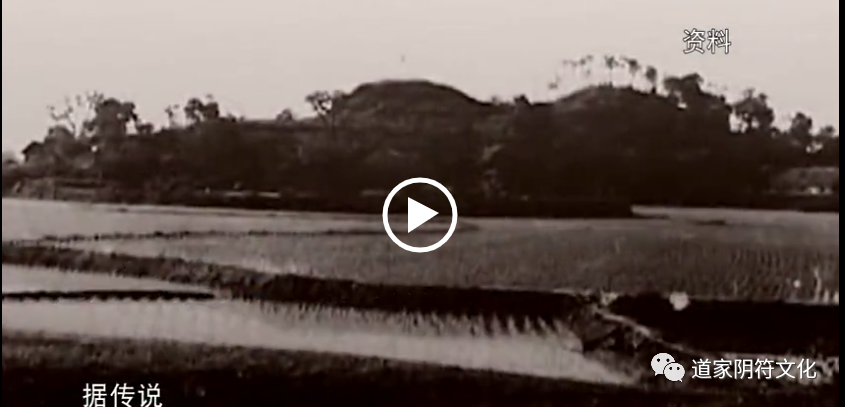
At Qilu Mountain I visited the site traditionally attributed to Master Yang's burial work for the Zhang clan, said to take the form of a swan descending into water. An old legend holds that Master Yang ordered the Zhang clan to have eighteen bare maidens carry earth to build the tomb, but when work began, Master Yang stood by laughing; the patrons thought they were being mocked, so the women stopped after carrying only one load each, leaving the site insufficient. This account is largely unbelievable, with many doubtful points; the tomb is so large that if eighteen bare women were truly ordered to carry earth, how could they simply stop at will.
Glimpses Through a Feng Shui Telescope (VI)
Broadly speaking, those with a tradition in geomancy are mostly unwilling to do feng shui for outsiders—this is the true state of affairs. Human fate is limited; even for those who possess the art, constrained by the turns of fortune, half a lifetime of striving yields at most a small site. As for great earth sites, one may be able to see them, but not necessarily obtain them. Across the vast wilderness, where no one goes, and wherever human settlement reaches, buying a plot for a tomb costs a sky-high price. Thus the ancients said that great sites can only be obtained by those with the right affinity—there is reason in this. Yet if one cannot obtain them oneself, how can one freely give away wealth and rank to others? And it is not something that a mere sum of money can measure. Therefore, for relatives and friends—one does not do it; for outsiders—one does it even less.
Glimpses Through a Feng Shui Telescope (V)
I recall that more than ten years ago, someone asked about his future fortune. I observed it briefly and told him he might make an investment four years hence, so I advised him: there will be no major gains in the next three years—simply work steadily; only after the fourth year is it worth attempting. Unexpectedly, this person later studied Purple Star Astrology and became somewhat accurate in readings, and he also self-taught Qimen Dunjia for adjusting feng shui, achieving modest results, so he grew quite self-satisfied. In the fourth year, he raised a large sum from relatives and friends to go into business with someone—but that partner was suddenly arrested; the man owed countless debts, and the funds in his accounts were entirely frozen, leaving his wealth wiped out. Later he came to ask how things had come to this; I was too weary to explain.
Glimpses Through a Feng Shui Telescope (II)
When I was once in the Guangdong region, I often heard people say that some family had invited a master whose burial site turned out truly auspicious, and someone in the family became a university student—I was left speechless. Others would claim a certain site was excellent: the incoming dragon leaves the tower and descends from the palace, escorted with power, noble and extraordinary; the dragon formation was vast and beautiful, and a site was ultimately formed. Their accounts were extravagant, yet upon examining the cave, it produced only a bureau director or similar. Such claims mostly stem from untrue arts and absurd words. Consider: the dragon travels a thousand li, rising and falling, winding and inheriting, covering thousands of miles—yet if it only produces this, why bother discussing feng shui at all? Broadly speaking, one could casually seek any site, and as long as it is not cut by wind or robbed by water, even without ever forming a cave, one could produce such results.
Glimpses Through a Feng Shui Telescope (I)
Though I have studied many schools, what I ultimately put into practice and found truly effective still comes from the Yinfu school. The various arts in the marketplace, some with rather profound principles, I have studied for years and paired with various secret formulas, yet mostly left me disappointed; those with any accurate effect were few, though some merit consideration. To assess them: Golden Lock has the power of verification but lacks transformation; Dunjia has miraculous swift results, yet rebound effects follow; the Four Great Formations of Sanhe are reliable but rarely seen in practice; the intercourse of Sanyuan is but a beginner's stumbling; Heavenly Father and Earth Mother is slightly better than blind guessing; Pure Yin and Pure Yang often conflict with the writings of clear-sighted masters; Shen's Flying Stars should never be used for yin dwellings; the Six Methods' theories are arcane yet impractical; there is also what is called Great Xuan Kong, which merely resembles Sanyuan qi reception and often fails verification—it is no more than a flying method applied through the Kun formula, seeming reasonable but yielding very slight results. There are also the Heluo water methods, whose principles are elaborate and complex, sometimes matching; further, techniques like the Pot-Ghost hexagrams, Plum Blossom alone, the Central Fire Two Stars, and constellation-based sand elimination, though commonly seen, mostly fail to match.
Brief Notes on Kanyu
In the way of kanyu (geomancy), worldly masters often speak of observing form; those slightly more advanced tend to speak of reading qi. As for the art of reading qi, some speak of five colors and seven hues, with no universal agreement. Though slightly touching on reality, most of it is mere mystification. Such masters fail to realize that observing qi is observing form, and observing form is observing qi — yet the subtlety lies in the principle (li). As the Qing Nang says: principle resides in qi, and qi is confined by form.
Doubts About the Guanyin Looking at the Sea Tomb at Sanliao
The Zeng family of Sanliao has an ancestral tomb named, by form-reading, "Guanyin Looking at the Sea." It is said that the Zeng ancestors had single heirs generation after generation; after this tomb was buried as Guanyin Looking at the Sea, the family fortune gradually prospered and there were no more single-heir generations, and they multiplied to the present. However, careful examination of the Zeng family genealogy shows otherwise...
Geographical Disambiguation: Same Sitting, Facing, Sand and Water—Yet Different Judgments
Question 69: Yesterday we toured three sites whose sitting, facing, sand and water were all the same. Why is one said to bring slow wealth and slow decline; one said to bring wealth and rank but unfilial descendants; and one said to bring wealth and rank but impure womenfolk? I asked afterward, and all were so—where does the judgment diverge?
 Feng Shui & Geomancy
A Feng Shui Orientation and Dragon-Finding Tool for Yin and Yang Residences in Urban Settings
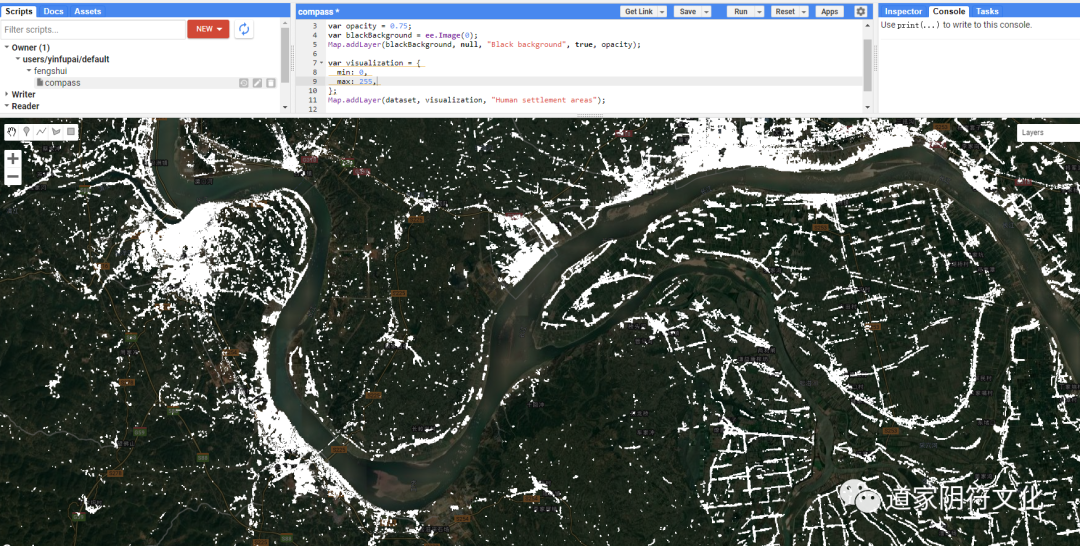
In earlier years, when studying feng shui, this Daoist priest used Google Earth Engine, which hosts large geographic datasets and can be quite convenient for research — just a few lines of code to use data already analyzed by others. For example, one can study the most frequented activity areas of a district and pair that with field surveys to uncover many interesting findings: places on a reverse-bow bend tend to attract more people — why is that, and how does living there affect them? Another application: whenever one mentions Dongguan's second-wealthiest village, one must mention the Li Clan Ancestral Hall built by Lai Buyi.
On the Placement of Toilets in Commercial Yang Residences
In yang-residence feng shui, the position of the toilet is seldom discussed; here is a brief account. In general, the Ren-Zi-Gui and Qian-Hai directions are least favorable first; Kun, Zhen, and Xun are also not considered favorable. If there is truly no alternative these may be used slightly, but the direction must be one overcome by the sitting mountain — for example, if the sitting is Mao, Geng and Shen are in a rest-and-decline state; one may place the toilet at the Geng position, avoiding the earthly branch to prevent offending the Year Spirit. In addition, the Yellow Spring Sha directions are also unfavorable for a toilet and must be carefully determined, otherwise many strange illnesses may arise.
On Prognostic Signs in Geography: The Son of Man's Essential Knowledge
Prognostic omens and signs are largely no more than the artifices of occult practitioners exploiting this supposed divine art. Gentlemen who fail to examine them often fall prey to these arts. How easily heretical doctrines beguile! It is said there are two kinds of prognostic signs. The first holds that a few feet beneath the burial point there lies some object of a certain shape and color — what are called dragon liver, phoenix marrow, orangutan blood, crab fat, ivory, dragon bone, tiger amber, cinnabar, silk red, jade green, and the like. The Jade Marrow Sutra holds that a dragon form has flame-stone, a phoenix form has red-yellow stone, a tiger form has tiger-might stone, a lion form has ball stone, an elephant form has golden-star stone; likewise a general's great seat has a sword and a beauty at her toilet has a mirror. Cui Jupo said that ordinary people who suddenly encounter this doctrine will inevitably be startled and become rigidly attached to it, yet one cannot say there is no principle in it. If one clings to it as a constant method, however, that is another matter; there is some basis for such observations.
An Example of Reading Feng Shui
House orientation: sitting Yi, facing Xin, zhou-tian 101 degrees, first line of the Decline hexagram (magnetic north). The compound has two entrances, in the Geng and Wu directions; daily use is mostly the Geng entrance. Qian: Ji-Chou. Kun: Jia-Wu. Daughter: Ren-Xu. According to the classical method, the Xin–Geng direction is the Resting Position, and the Wu direction is Heavenly Doctor. With 8 entering the center in 1992, 9 Purple reaching Dui poses no obstacle. Counting forward: in 1995 the man was tabooed as Severed Fate hanging to Dui; in 1996 the Wandering Soul again reached Dui, and the annual 6 reached Dui, hence loss of work. Also only in 1997 the 5 Yellow reached Dui, fortunately rescued by Generating Breath; in 2003 Severed Fate came again, 8 reached Dui, and the Five Ghosts and Severed Fate together...
 Feng Shui & Geomancy
The Correct Understanding of So-Called "Corpse-Nursing Grounds"
Originally published on the WeChat official account Daoist Yinfu Culture. In common parlance, places where burial leaves a corpse uncorrupted are called corpse-nursing grounds. Online, some people label places recorded in ancient feng shui books under form names such as dead-cow-belly acupoint, dog-brain-shell acupoint, hard-wood spearhead, broken-face Wen Qu, and earth-that-is-not-earth as corpse-nursing grounds. These claims have given novelists much inspiration. However, they only know one side, not the other.
 Feng Shui & Geomancy
Understanding the Principles of Xuan Kong Da Gua Feng Shui Li Qi in Ten Minutes
First published on the WeChat public account Daoist Yinfu Culture, 2019-07-11. Illustrations omitted. Xuan Kong Da Gua in feng shui li qi is modernly regarded as having little value, because its fenjin degrees are precise down to every line position — usually considered infeasible with ancient surveying. Yet infeasible does not mean impossible: fenjin precise to one degree was in fact possible in ancient times. At least as early as the Han dynasty, measurement and construction technology far exceeding this level could be achieved — a typical example is the corridor of the Guishan Han Tomb, which is perfectly straight with a north–south error of only one part in ten thousand…
Low-Key Feng Shui Guide (Part Two): Converting the Square and Circle Diagrams and Usage Tips
First published on the WeChat public account Daoist Yinfu Culture, 2019-08-08. Illustrations omitted. When a reading is taken from a compass instrument, if it cannot be promptly converted into feng shui data notation, it becomes difficult to judge feng shui quickly. This article discusses tips for rapid conversion. First, regarding mils: if a general compass uses the 6400-mil system, things become very simple — each mil corresponds to one square-and-circle hexagram. Feng shui directional notation uses the twenty-four mountains and the sixty-four hexagrams; converting celestial-circuit degrees to hexagram positions is usually the most troublesome task. Ordinary luopans mark this out, but how can one obtain it quickly from a compass…
A Low-Key Guide to Feng Shui (1): How to Choose a High-Precision Compass That Can Replace an Ordinary Feng Shui Luopan
First published on the WeChat official account Daoist Yinfu Culture, 2019-08-06. Illustrations omitted. 1. Why not use a feng shui luopan. Last time this priest's party was in Sydney, Australia, and passed a church; curious, they took their luopan and headed for the church entrance—obviously they were chased off at the door. In Australia; if it had been an Arab country, ahem... 2. Why high precision is needed. Without a feng shui luopan, how can sufficiently precise feng shui data be obtained?
Eight-Mansion Grand Wandering Years and Xuan Kong Da Gua Feng Shui Theory
First published on the WeChat public platform Daoist Yinfu Culture, 2019-09-06. Illustrations omitted. The Eight-Mansion Grand Wandering Years is a relatively common feng shui art among the people. Xuan Kong Da Gua and Eight Mansion share consistent underlying principles — in fact, the essence of Xuan Kong Da Gua can be regarded as an extension of Eight-Mansion theory. According to the Nine Palaces, the hexagram periods of Xuan Kong's grand fortunes are actually derived as: Kun is 1 — Tanlang; Xun is 2 — Jumen; Li is 3 — Lucun; Dui is 4 — Wenqu; Gen is 6 — Wuqu; Kan is 7 — Pojun; Zhen is 8 — Fuxing; Qian is 9 — Bi. Xuan Kong Da Gua's hexagram periods hold that combining to five, ten, fifteen, or generating is judged auspicious — in practice identical to Eight-Mansion Grand Wandering Years calculations…
Binary Numbers and the Secret Formula of Dual-Yuan Inversion
In my earlier article <<The Feng Shui Theory of the Eight Mansions' Great Wandering Year and the Yuan Kong Great Trigrams>>, I discussed the isomorphic operations between Yuan Kong Great Trigrams and Eight Mansions; at the core, both use the Great Wandering Year algorithm. The Great Wandering Year algorithm is also often called the Gui Zang method in Yi Jing circles; the name may derive from the late Yi Jing master Mr. Huo Feiran. In particular, determining Shi and Ying via Gui Zang is the most widely circulated on the internet. This algorithm is actually quite simple: compare the yin and yang of corresponding lines in two trigrams. If they are the same, it is Yin; if different, it is Yang. In one simple sentence: if the line position has changed, it is Yang. By the way, the six-line method for determining Shi and Ying is also relatively simple,
Forcibly Calling the Second Son “The Third”
There was a man named Yu Chengwu who chose a burial site himself for his late wife. On the left were two jade screens; on the right came a dragon of the Flowery Canopy, falling into the Three Terraces as three vein-lines like writing brushes, with an “imperial street” as the facing table. His third son passed the provincial exam in the Xinyou year and the metropolitan list in the Jiaxu year; another son was top scholar in the Xinyao year and a Hanlin academician in the Rengchen year, becoming the richest in the region. What is marvelous is that when Yu Chengwu buried his wife, the dragon was weak and the tiger tender, so he knew the third branch of the family must prosper. Though he actually had only two sons, after the eldest passed the metropolitan exam and a first grandson was born, he forcibly called the first grandson “the second” and called the second son “the third”; later they did indeed prosper. How wonderful.
Nine-Star Water Method
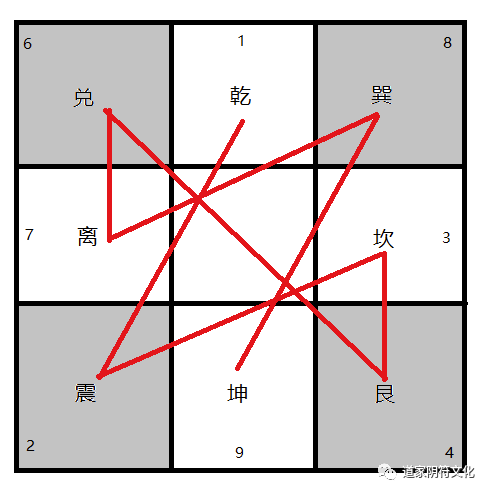
It treats Qian, Kun, Gen, Xun, Jia, Geng, Bing, Ren, Yin, Shen, Si, and Hai as yang, and all the rest as yin. For any yang, start from the sitting mountain and sequence 5, 6, 7, 9, 3, 4, 1, 8, 2, flying forward through the Nine Palaces; for any yin, fly the Nine Palaces in reverse. Incoming water is favorable only when it bears 1, 2, 6, 8, or 9; the rest are auspicious as outgoing water. The only concern of this method is water that breaks through the Pre-Heaven arrangement. Examining its principle: this method actually follows the sequence Qian–Dui–Li–Zhen–Xun–Kan–Gen–Kun; for yang mountains one advances one step and arranges forward, for yin mountains one retreats one step and arranges in reverse — in effect, running the Pre-Heaven sequence through the Post-Heaven palaces. This is close to what is popularly transmitted in He-Luo Feng Shui as the method of “spotting the dragon and spotting the peaks”; yet its error lies precisely in the advance and retreat.
Reading Qi of Life from Earth's Ocean Circulation
While the Earth rotates on its axis, it revolves around the sun; oceans and land are heated, air is set into friction, and wind arises. Under the influence of rotational force while also being affected by the sun and moon, the ocean generates tides; together with wind and differing ocean densities, ocean circulation forms. Yet every motion must grasp a root: as the saying goes, "Vermilion Bird springs forth the qi of vitality." Clearly, the hottest part of the whole Earth is the equatorial region—so naturally we begin there. From the equator as base, the Earth generates equatorial currents moving from east to west…
Master Lai’s Method of Orienting by Pure Yin and Pure Yang
In the Longchuan manuscript it is written: The Classic says: “When yin and yang are mixed and muddled, affairs are hard to fulfill; even if the Heart of Heaven is matched, the outcome is still uncertain. If one palace of mountain-and-water is correct, glory and honor will naturally come—there need be no doubt.” Here, intending the Dui mountain and facing Jia or Yi, sitting Geng facing Jia is the Life-Extinction configuration, sitting Xin facing Yi is the Wandering-Soul configuration—both are inauspicious. Though Dragon Mountain’s Silver Bottle is elegant and lofty, taking it by feeling alone is not fully correct.
On Pure Yin and Pure Yang
There are now a hundred theories of pure yin and pure yang—some confused with the yin and yang of the trigrams, some muddled with the division of stars among mountains and waters. Here we settle the matter according to Master Lai Buyi’s Longchuan manuscript: Kan, Li, Zhen, and Dui as the four cardinal trigrams are yang; Qian, Kun, Gen, and Xun as the four auxiliary trigrams are yin. The heavenly stems and earthly branches are likewise matched to trigrams—therefore Kan–Gui–Shen–Zi–Chen, Li–Ren–Yin–Wu–Mao, Zhen–Geng–Hai–Mao–Wei, and Dui–Ding–Si–You–Chou are yang; the rest are yin.
On Landform and Qi-Principle
The world often ranks landform first and qi-principle second, but this humble priest thinks otherwise: for though the landform may be excellent, if the qi-principle does not accord, it is still wasted; and though the landform may be poor, if the qi-principle accords, there will surely be auspicious response. This is not to relegate landform to a secondary role—for what takes form through obtaining principle can be discussed in terms of form and momentum. There are three hundred and sixty forms and seventy-two momenta. Principle is the substance, form is the function, momentum is the transformation: therein lies the true meaning of landform. Above form and momentum there is still the divine method, such as Master Liao's art of naming forms, where the mind joins the Dao and silently merges with the mountains and rivers. The merit or demerit of a place rests entirely on the illumination of Master Liao's single call—it can prosper or decline them; this is truly the art of the earth-immortal.
Differences of Compass Scales
Though some say the compass divides into three plates—Heaven, Earth, and Human—for their respective uses, this is nothing but the fanciful talk of busybodies. The Human plate is almost entirely imagined; occasional coincidences merely take the difference between Heaven and Human to serve the use of lunar lodge degrees. To say that the Heaven plate's Zi begins at the midpoint of the winter solstice is indeed the correct principle; but computing its difference from the Earth plate, we know that claims that Yang Gong invented it must be fabrications. There is also the sixty-four hexagram method, which differs from the twenty-four mountains, yet by computing the difference between each hexagram and the twenty-four mountains we obtain: 0.0, 5.625, 11.25, 1.875, 7.5, 13.125, 3.75, 9.375. These eight values cycle without end, all in multiples of 1.875 precision.
On Yang Gong's Twelve Steps
The so-called official step is four feet five inches to one step, measured from the gate post to the eaves. Odd steps are favored, even steps are not. A verse says: one step, the Azure Dragon brings much good fortune; two steps, the Vermillion Bird raises official calamities; three steps, uprightness attracts auspicious matters; four steps, disaster and plague are stirred; five steps, Tan Lang metal brings nobility and good fortune; six steps, disaster and trouble are stirred in equal measure; seven steps, the golden hall brings abundant fortune and emolument; eight steps, plague and consumption mean injury and disability; nine steps, flourishing prosperity brings wealth and rank; ten steps, desolation brings loss of wealth and heirs; eleven steps, great prosperity in fields and silkworms; twelve steps, again double mourning. This is used for opening gates and arranging water, for the steps of front, back, left, and right gates and the courtyard. The courtyard is measured from the walls of the yang dwelling, and the main gate from the dripping eaves—its steps may not be complete, for completeness makes it even, and again becomes inauspicious. Generally, for commoner households, one or three steps are auspicious; for somewhat nobler sites, five or seven bring joy; for wealthy and noble households, nine is best; eleven steps suit great flourishing of agriculture.
Variations of the Palm-Hexagram Turning Method
This is the common palm method of hexagram turning. Top row: Li, Xun, Kun, Dui. Bottom row: Qian, Gen, Kan, Zhen. It begins and ends at the side edges; begins and ends at the center; starts from above and falls below; starts from below and rises above. Beginning from the mountain position, start Tan at the opposite palace: 12345678. Beginning from the facing position, the auxiliary-star water method: 86751234. Beginning from the hexagram, start Tan at the opposite palace: 12345678 or 15643278. For any opposite palace, if one does not follow but returns to the home palace, one can obtain it by starting the auxiliary in reverse order. If one begins from the mountain position but does not follow by starting Tan at the opposite palace, then begin the auxiliary at the home palace, in the order 87654321. Furthermore, according to the starting-verse of the Chixing Heavenly Father hexagram: Qian begins Fu and Bi, Kun begins Lu Cun, Gen begins Wu Qu, Xun begins Lian Zhen, Dui begins Tan Lang, Zhen begins Ju Men, Kan begins Wu Qu, and Li begins Po Jun.
A Case from the Lead Pellet Geography on the Heavenly Star Method
As recorded in the Lead Pellets: In our prefecture's Eastern Hills, locally known as Bixi Hollow, the ancestral graves of the Dai residence enter with the Chen-Xun gate, and the seat rides Xun qi (the graves stand Xun sitting, Qian facing). On the Wei high peak stands a tower, steadfastly rising upon the Gui Metal degree. Hence it is said: Master Wen, styled Dongmin, passed the provincial examination in a Ji-Wei year and became a provincial governor. (After the full moon of the third month) at dusk the center dwelt in Wei; Gui overcomes Xun horn — in the end a troublesome star — and he was framed by treacherous factions. Later Emperor Huizong reviewed the case; a memorial on suppressing the rebel Xun swiftly released the master, but it was already too late. From this one sees: when the center star peak rises, great nobility will surely flourish; when the center star is a hardship, one will after all meet adversity — this is a clear verification.
Rising Stars of the Twenty-Four Mountains
You-Hai-Ren Tan Lang sought on the mountain; Gen-Jia-Yi Ju Men seen from here. Si-Wu-Wei Lu Cun gathers from here; Qian-Gui-Chou Wu Qu departs from here. Xun-Bing-Shen Wen Qu and Lian Zhen; Geng-Xu-Xin Po Jun stored within. Zi-Mao-Yin Fu Xing sought from here; Chen-Ding-Kun Bi Xing divided here. Xin-Hai-Ren one Kan water meets birth; Chou-Yin-Mao two Kun water winds within. Xun-Bing-Shen three Zhen in the water; Geng-Xu-Zi four Xun water's source. Yi-Si-Wu six Qian water's return; You-Qian-Gui seven Dui water meets nobility. Gen-Shen-Chen eight Gen water meets birth; Ding-Wei-Shen nine Li water held within. This is the outline of rising stars on the twenty-four mountains.
A Brief Explanation of Master Lai Buyi's Letter to the Ancestral Lord of Longchuan on Selecting a Yang Site
Having recently parted from your virtuous presence, I have already looked up to you with deep respect. I specially awaited your letter detailing the investigation, and received your instruction on choosing and relocating a yang site. The eastern hills are tall and elegant, and you wish to face Jia-Yi; the southern hills stand arched and proper, and you again wish to face Bing. Yet according to art, mountains have form and force; one should choose that which has feeling and face it. Though the white mountain is somewhat plain, its feeling is lush and worth viewing; even if low and small, there is no great harm — no need to take the large silver vase as the most honorable. Sanfu notes: not facing the large one, because it lacks feeling — discussed later in the text. Moreover, each of the twenty-four directions has its auspicious and inauspicious; whenever there is a good mountain form it must sit in an auspicious position. And for the eastern horizontal mountain catching water rising upward, vulgar people take it as an "upstream golden fish" — in my foolish view this is wrong. The dragon peak stands specially tall; vulgar disciples call it a "writing brush" — I too think this wrong. Furthermore, forms like fish or like seal should belong to Geng-Dui as golden fish and golden seal; belonging to Jia-Yi as wooden fish and wooden seal; belonging to the four tombs as carrying a corpse and a false seal.
The Secret Art of Jingchu Feng Shui
There is a formula known as the Jia-Wu-Hai method. Its technique divides the trigrams and the three epochs: Earth is eight; Heaven is five; Human is two — that is, 8-5-2. The Nine Stars are also entered into the center to seek their positions: if One enters the center, then Two dwells in Qian, Five in Li, Eight in Zhen. Eight takes Earth and obtains Jia; Five takes Heaven in Li and obtains Wu; Two takes Human in Qian and obtains Hai; thus One is Jia-Wu-Hai. From this one derives: One Kan Jia-Wu-Hai; Two Kun Wei Gen Si; Three Zhen Ren You Yi; Four Xun Bing Qian Shen; Six Qian Chou Xun Gui; Seven Dui Geng Mao Ding; Eight Gen Xu Kun Yin; Nine Li Chen Zi Xin. Water can likewise be derived: One Ren Xun Yin; Two Bing Mao Xin; Three Chou Kun Hai; Four Geng Zi Si; Six Xu Wu Qi; Seven Chen Gen Shen; Eight Jia You Gui; Nine Wei Qian Ding. This was regarded by Shen Zhuzhen as a false method — in truth he simply never grasped its essentials.
 Feng Shui & Geomancy
On the Lodging Degrees of the Luopan (Geomantic Compass)
According to the Xieji, the right ascension at the winter solstice resides at Chou. Ancient tradition says Immortal Master Lai Buyi added the human plate; this claim may be erroneous, as shown in the Song-drawn luopan diagram below. Also, according to the feng shui treatise Yingyuan Zonglu, completed by Observatory Director Yang Weide in the third month of the first year of Qingli in the Northern Song (1041 CE), the needle direction is said to "take between Bing-Wu and Ren-Zi as the center of heaven and earth, obtaining the correctness of north and south."
Zhang Zongdao
Zhang Dingbian (1318–1417) of Mianyang was the foremost fierce general of the late Yuan dynasty, said to have no equal under heaven in courage and martial prowess. Originally from Huxiankou, Mianyang Prefecture, Hubei, he was born into a fishing family. Tall and imposing, with a fine five-locks beard, he was dashing and handsome. He was well versed in astronomy and geography, studied the art of war, trained in martial arts, excelled in boxing, and was skilled in medicine. Later, at Huangpeng Town in Hubei, he became sworn brothers with Chen Youliang and Zhang Bixian, sharing life and death through storm and calm. He followed Chen Youliang in uprising and conquered every stronghold on the frontiers of the Two Rivers, Fujian, and Zhejiang. In the end, of course, he could not outplay Liu Bowen, and Zhu Yuanzhang naturally took the realm.
The Heavenly Plate
According to the Complete Record of Filial Piety in Upholding Principles and Harmonizing Geomancy from the Confucian School: from the third quarter after Zheng of Hai to the second quarter after Ch'u of Zi belongs to the Ren hour; from the third quarter after Ch'u of Zi to the second quarter after Zheng is truly the Zi hour; and so on through the twelve branches.
A Fallacy in Understanding Feng Shui: Is a Kind Heart More Powerful Than Feng Shui?
At some point this fallacy began to circulate, and it truly misleads the world. A kind heart may of course bring greater peace in poverty, but it can never outweigh feng shui. For feng shui is an objective effect of existence, not something swayed by subjective human intention. The story people love to tell: a feng-shui master, thirsty, met an old woman who gave him hot water with bran floated on top—but in the countryside bran is pig feed, so the master was furious. As it happened she needed to choose a burial site, so he chose an ominous one for her. Yet ten years later he returned to find her family thriving, and learned she had put bran on the hot water because he had traveled far and could not drink cold water suddenly, and hot water might scald him, so the bran let him blow and sip without burning. The story thus concludes: a kind heart is far more important than feng shui. Is that really true? The truth is harsh—the story is fabricated.
A Brief Note on a Simple Method of Setting Orientation and Collecting Water
Yi and Bing intersect and hasten to Xu; Xin and Ren converge and hasten to Chen. Dou and Niu receive the qi of Geng and Ding; the Golden Sheep gathers the numinous force of Gui and Jia. In terms of the Twelve Growth Stages, the four pairs Bing-Yi, Xin-Ren, Geng-Ding, and Jia-Gui share the same stages of birth, imperial vigor, and tomb positions. Bing and Yi form the three-combination Yin-Wu-Xu; Xin and Ren form Shen-Zi-Chen; Geng and Ding form Si-You-Chou; Jia and Gui form Hai-Mao-Wei.
Feng Shui of the Sutra on Unburial
Burial is concealment, utilizing the vital energy (Sheng Qi). The energy of Yin and Yang, when exhaled, becomes wind; when ascending, becomes clouds; when descending, becomes rain; and when moving within the earth, it is called vital energy. Vital energy moves within the earth, giving rise to all things. Humans receive their form from their parents; when the ancestral bones receive the vital energy, the living descendants are blessed. For the living are the accumulation of energy. What condenses becomes bone, remaining alone after death. Therefore, burial is the method of returning energy to the bones to bless the living. The Sutra says: 'Energy responds to sensation, and the blessings of the spirits extend to humans.' Thus, when the copper mountain in the west collapses, the spiritual bell in the east resonates. Trees bloom in spring, millet sprouts in the room; energy moves within the earth. Its movement follows the terrain. Its accumulation follows the stopping of the terrain. The ancients gathered it so it would not scatter, and guided it so it would have a stopping point, hence it is called Feng Shui. The method of Feng Shui prioritizes obtaining water, followed by hiding from the wind.
 Feng Shui & Geomancy
Common Feng Shui Mistakes That Break Wealth in Five Directions
1. Damage, holes, or gaps on the east wall The east is the position of the Azure Dragon, which governs wealth. If there is damage or a gap, it indicates that money will flow away. The greater the damage, the greater the impact. Some modern people like to pave walls with irregular shapes. If the entire wall is uneven, living in this house for a long time will result in financial loss and being plotted against. If a wall like the one above happens to be exactly in the due east, congratulations, you've hit the jackpot...... 2. A fish tank placed tightly against the wall in the southeast-by-east direction In the Earthly Branches, this is called Chen. Originally, it is the storage position for water, but adding a fish tank turns it into a self-punishment pool, indicating that money will flow away and cannot be saved, with large expenses,
 Feng Shui & Geomancy
What to Do When a Divine Statue at Home Cracks? How Should It Be Resolved?
Many families enshrine divine statues, mostly made of wood, which often crack due to dry climate or insufficient moisture when air conditioning is used heavily in winter.
The Sixth Patriarch Huineng and Feng Shui: Not Nine Generations of Top Scholars, But Ten Thousand Years of Incense
故老相传:唐武德年间,有一位不露姓名的国师,寻龙追穴来到新州,被集成上洞村某财主接待。那财主为人吝啬,招待国师不周,国师不能忍耐,因而来到龙山麓惠能母子住的山寮房,受惠能母子殷勤款待。那天晚上,在家搭一板床供国师睡眠,国师就枕因床凳高矮不齐摇动,午夜不能成眠,惠能听知,心里不安,他就潜入国师床底,以小手垫床凳使床不摇动,国师在床上睡着转身,惠能的手被床凳压得太紧,忍不住痛而泄声,被国师听到,忙起床
九星证穴
贪狼出穴是乳头,巨门出穴窝中求; 武曲结穴钗钳觅,禄廉梳齿锲鐴头; 文曲求穴平裹作,高处亦是掌中落; 破军作穴如戈矛,西边左右手背收; 辅星正穴燕巢仰,若在高山挂灯样; 弼星出穴在低平,纵有圆头亦凹象。 贪狼如乳头,鼓之土包,顶端突出,为贪狼 巨门在窝中,陷之如坑,坑边缘平缓斜下,如口之状,为巨门。 武曲如钗钳,一头见大一头见小,如钗状,又或大头处分出两支,如钳状,为武曲。 禄存廉贞如梳齿锲鐴,即
Golden Pass Jade Lock Secret Art
混飩初開立五方 乾坤日月布三綱。周天方象排星斗 天清地濁理陰陽 風雨雷電皆虛氣 山崗水闊有良方。乾天坤地分高下 置成順理送納常 排成甲子周天地 配合男女兩成雙。四時八節分晝夜 九宮八卦接天罡 五行顛倒推千轉 金木水火土中央。一百二十諸神煞 九十四位吉凶將 幾位年並月方利 幾位日吉與時良。乾山艮水人丁旺 巽上滿墀大吉昌 離上來龍臨墳位 子孫代代出文章。田莊人口年年盛 衣紫腰金佐朝綱 門前曲曲彎彎過
八风断
乾風吹過巽 白蟻吃木根 巽風吹過乾 身在水中眠 亡人受辛苦 腳下有藤纏 坤風吹過艮 人頭在腳根 艮風吹過坤 棺木亂紛紛 子風吹過午 有蟻並有水 午風吹過子 兒孫難保守 卯風吹過酉 風聲隨人走 酉風吹過卯 木板歸東倒 此是八風歌 善觀無差訛
十二支風斷
寅風吹申頭到腳 申風吹寅板木穿 酉風吹卯板歸左 卯風吹酉板歸右 若是午風吹子過 應是亡人棺中坐 若還子風吹過午 定然木棺皆頭起 假如亥風吹過巳 必應木很穿死屍 若是巳風吹過亥 主有白蟻來侵害 時師若識此風神 卜宅必不受其害
Covered Grave Severance
地師看墳先認屍 男女之墳不難知 男墳草根帶白樸 女墳草根只帶泥 男墳草根直到底 女墳草根曲漂泥 老死墳頭生硬草 少死墳頭生嫩枝 墳生曲藤有縊滇 墳上帶花多淫亂 墳中端正是官府 墳樹歪斜是賊人 墳上樹遮不生草 此墳定是牢獄人 樹木歪時是枉死 向左便是倒逆墳 向右便是傷亡鬼 吊死疾病決然真 墳拽左足是僕人 若拽右足是婢墳 紅黑白棺如何識 教君細看草和泥 紅棺蓬頭黑蓬腳 白棺原是遍身稀 如無棺木當何樣
Looking at the Mountains and Breaking Off
樹木枯兮不堪言 人丁橫死敗牛田 申酉庚上鑿小池 其家內亂少人知 孫兒卻是公公子 弟媳常為伯伯妻 當前有水流出長 子孫不敗也離鄉 龍山尖長長離鄉 虎山尖長少離鄉 乾風打來巽風吹 不損人丁便損妻 面前尖射入明堂 家不徙配必離鄉 向山尖尖蔭高官 只宜尖峰不宜歪 左有水纏男富貴 右有水纏女旺興 白虎山頭似貓兒 回頭看穴口銜屍 定主兒孫被虎咬 時師速速報人知 墳向路叉主瘖啞 墳向路弓出駝瘸 墳向墩石墮胎瞽
55 posts