On the Lodging Degrees of the Luopan (Geomantic Compass)
According to the Xieji (Collected Harmonious Annals), the right ascension at the winter solstice resides at Chou. Ancient tradition says Immortal Master Lai Buyi added the human plate; this claim may be erroneous, as shown in the Song-drawn luopan diagram below.
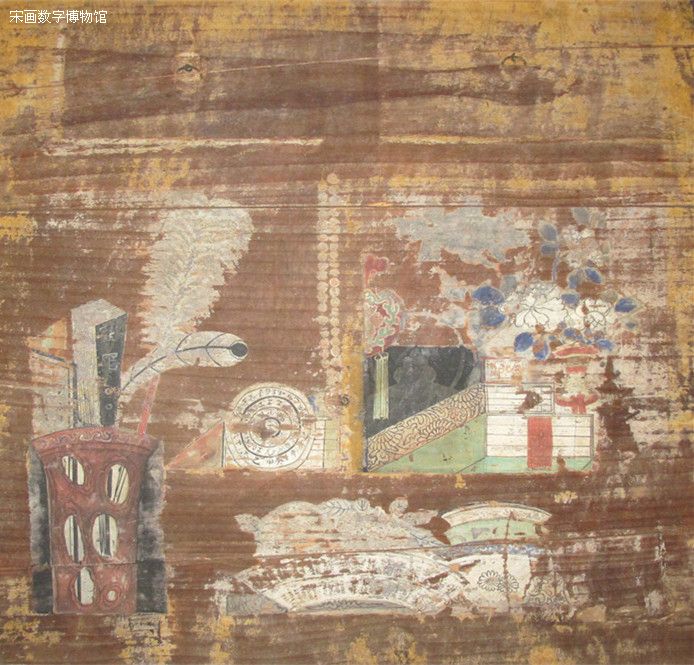
Also, according to the feng shui treatise Yingyuan Zonglu (General Records of Tombs and Fields), completed by Observatory Director Yang Weide in the third month of the first year of Qingli in the Northern Song (1041 CE), the needle direction is said: "Take between Bing-Wu and Ren-Zi as the center of heaven and earth, obtaining the correctness of north and south."
These words referred to Bianliang (modern Kaifeng) in those days, midway between Zi-Wu and Bing-Ren. People of later ages commonly interpret this as a magnetic declination of seven and a half degrees east of south; this interpretation must be wrong. Bianliang is where modern Kaifeng stands—how could the declination ever be so large?
A moment's calculation shows that in 1041, according to the celestial phenomena, the winter solstice sun-shadow stood at 266.49 fen; computing with 270 degrees as the winter solstice, the difference is 3.51 degrees.
The Zi palace spans 15 degrees, each half occupying 7.5 degrees. Ren-Zi is thus Zi's position entering 7.5 degrees into Ren; taking half gives 3.75 degrees. Against 3.5 degrees, the difference is a mere 0.2 degrees—so slight it can be neglected. Hence it is said this is the center of heaven and earth.
Yang Weide was Director of the Imperial Observatory—how could he not have known?
Therefore Wang Chai (988–1058) of the Song dynasty said: "Between Xu and Wei the needle's path is clear; in the south, three degrees on Zhang. The correct positions of Kan and Li people do not recognize; miss by a hair's breadth and it ceases to be efficacious."
The reason for taking three degrees of the Zhang asterism is likewise that the degree difference from the winter solstice point grows smaller—that is, half of Zi corresponds to three degrees of Zhang.
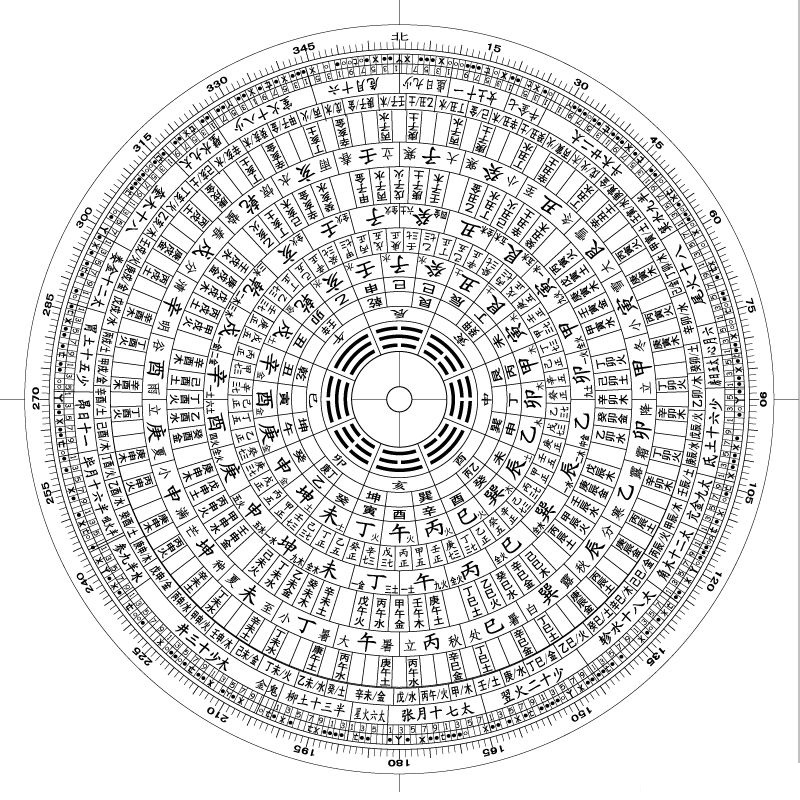
The establishment of the heaven plate has already confused the original intent: the method originally borrowed the positions of the Twenty-Eight Mansions, and needed no heaven plate to fix positions—of heaven and earth, only the lodging-degree directions were required for use. Roughly speaking, after the Ming dynasty, for the sake of convenience, the heaven plate and human plate were added with unneeded embellishment, so that later ages became confused and went astray.