Latest notes
The Submerged-Bright Stone Chicken in the Records of Gleanings
Wang Jia's Jin-dynasty Records of Gleanings (Shi Yi Ji) reports that in the third year of Jian'an, the kingdom of Xutu offered a "submerged-bright stone chicken" — scarlet as cinnabar, the size of a swallow, dwelling underground and crowing at the appointed hours, its cry carrying far. The local people sacrificed livestock whenever they heard it and dug where it cried, recovering the bird. In times of peace it flew in courtship dances and was taken as an auspicious omen, also called a "Precious Chicken." Sanfu Daozhang notes that a stone chicken crowing on schedule underground is physically implausible and likely a misreport, yet the text's own gloss about marking time suggests tidal caves that sound with the wind — and archaeological clues place Xutu in Vietnam, where red gems or cinnabar might well have been dug where those sounds were heard.
 Humanistic Reflections
Journey to Enlightenment (Part Three): The Milesian School — All Things Come from Water
Having discussed the Pythagorean school, we must again trace the Milesian thought so closely bound to it. Arising about 624 BCE under Thales, the school held that all things come from water — that water is the origin of all things — opening a new dimension of philosophical thought and influencing later ages profoundly. Why Thales proposed this view can only be understood by placing the thought in its cultural, historical, and mythical background.
 Humanistic Reflections
Journey to Enlightenment: The Pythagorean School (Part Two)
The Pythagorean doctrine that all is number long dominated mathematics, its union of theory and practice offering a new lens on the world. Then a devastating discovery: the diagonal of a unit square is an infinite non-repeating decimal — an irrational that cannot be expressed as an integer or a ratio. The crisis of irrationals, the leap to imaginary numbers, and what the school still owes modern physics.
A Journey of Consciousness (I): The Pythagorean School, Part One
The Pythagorean school is a profound philosophical tradition that offers a distinctive way of observing and understanding the world. In Masonic historical materials, Pythagoras is revered as a source of the great relief—a fact that is certainly thought-provoking. Yet legend remains legend; its truth or falsehood lies beyond the scope of this discussion. The core idea of the Pythagorean school is that 'all things are number,' meaning that everything in the world is a manifestation of number—a concept that resonates with the idea of shu (number) among xiang, shu, and li in traditional Chinese Yi studies. However, the school's founders defined 'number' rather narrowly, limiting it to integers; decimals had to be expressed as fractions.
 Humanistic Reflections
Taiyi: The Ultimate Model Core That Creates the Universe
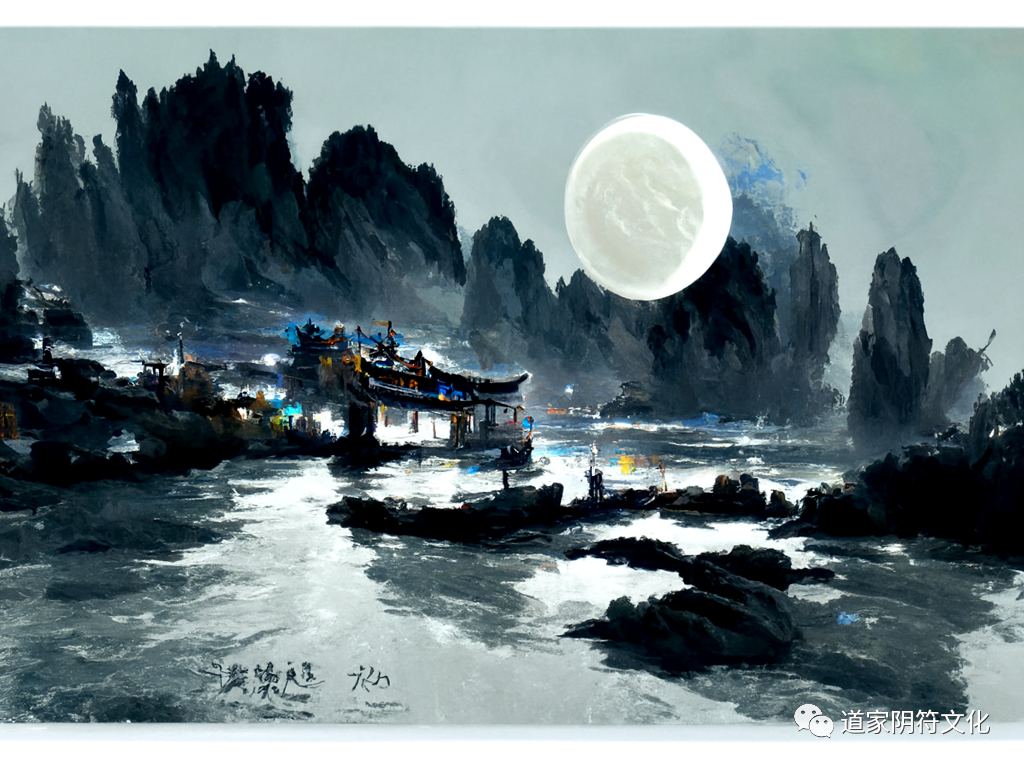
Observation shows that the reflections in the water of these paintings look quite natural; though the positions of the ink-painted buildings or reefs differ, they are still well rendered. If these were the work of an experienced painter, that would be unremarkable—but in fact these three paintings were generated by this humble priest after downloading Google's open-source AI painting project and running it on a desktop PC. The mathematics of Disco Diffusion is extremely complex; put in non-mathematical language, however, it is called a diffusion model: after learning from vast numbers of paintings, treating each painting as a whole, and then through a chain of related computations turning it into something like television snow noise—yet bridging random numbers with such noise, then reconstructing the signal—one can generate paintings from random numbers.
What Does Having No Religious Faith Mean for China?
Looking at your question, amid all that you've written, what you should really clarify is what a China lacking religious atmosphere means for the West. Chinese and Western cultures have a great point of divergence, roughly established in the Zhou dynasty era. The Chinese record — at least traceable to after the Zhou house — has always been human-centered, while shamanic currents were all pushed to the bottom. The West is different: throughout a long process of development, including before the Middle Ages, the entire West was dominated by shamanic traditions, only under a more pleasing name — "prophet." That is why you see in Western culture a deep veneration for prophetic utterance and emphasis on concepts like "revelation," widely present in the myths of various peoples.
Three Talismans on Taoism (I): Humanity and Heaven
Wenzi·Nature says: “Past and present are called Zhou; above and below are called Yu.” The cosmos represents time and space, yet the word never rolls off the tongue as smoothly as heaven and earth—so when describing the cosmos the ancients preferred to use “heaven and earth,” and when speaking of “heaven and earth” they were not merely speaking of the cosmos but of understanding the myriad things of heaven and earth—that is, systems theory. Modern science finds that an isolated system’s entropy always increases: the most basic form of the Second Law of Thermodynamics, a ubiquitous rule within the known universe.
Probability and Luck
Everything in the world manifests probabilistically, leading to the diversity of this world and others, with luck playing a huge role. Take the lottery, which everyone is familiar with, as an example. For China Sports Lottery, with seven digits ranging from 0 to 9, for all lottery buyers, it is a concept of one in ten million. Statistically speaking, less than one in a thousand is basically an impossible event, so winning the lottery is basically impossible. But here comes the problem: someone always wins. The reason for winning is simply that many people buy tickets, so someone always wins. But the question arises again: why is it always him and not you who wins?
 Humanistic Reflections
If This World Were a Computer Game
If this world were like a computer game, some religions believe that by praising the software author every day, the author will grant them eternal life. However, what they do not realize is that eventually, the computer will still be turned off. Regardless of whether it is good or bad, no matter what or in what data form one existed within the game, once the game ends and the power is unplugged, everything ceases to exist. If this world were like a computer game, some religions argue that as long as one realizes that this world is merely software and that all things are created within the software and are not real, then one can achieve nirvana, free from birth and death.
Discussing the Pseudoscientific Views of Those Atheists
The average IQ of many atheists may not exceed 100. The principle of Occam's Razor is a principle praised by many, yet in fact, it has significant misleading properties. This principle is known as 'Entities should not be multiplied unnecessarily' (Entities should not be multiplied unnecessarily), and sometimes, to display its authority, people also use its original Latin form: Numquam ponenda est pluralitas sine necessitate.
10 posts