



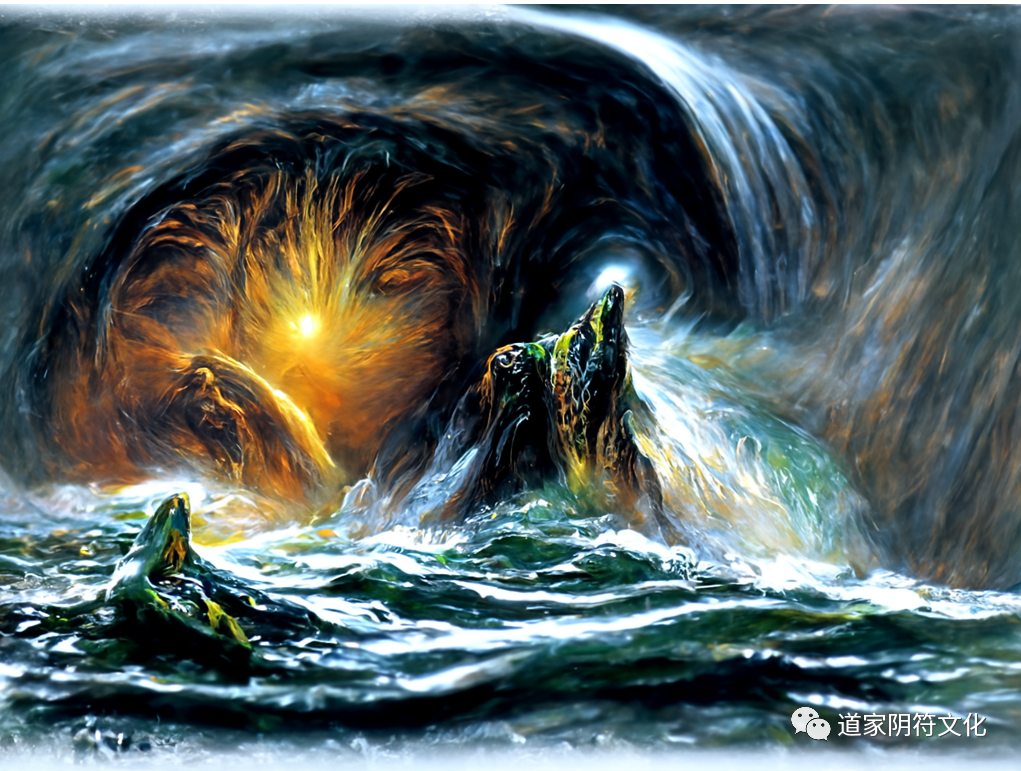
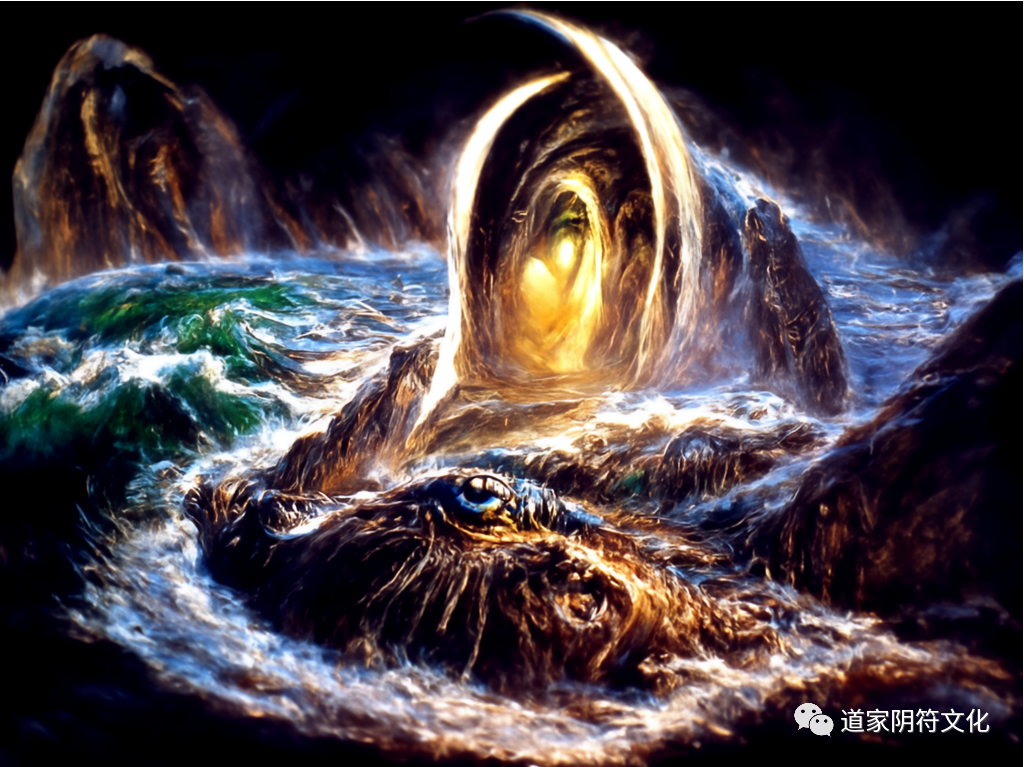
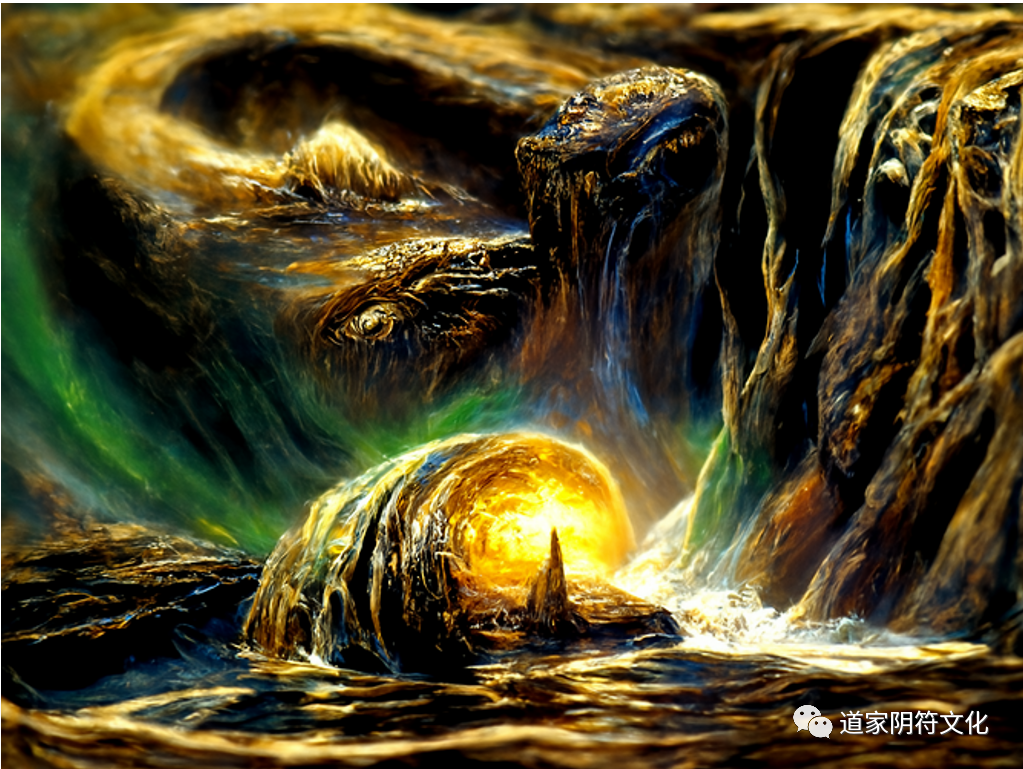
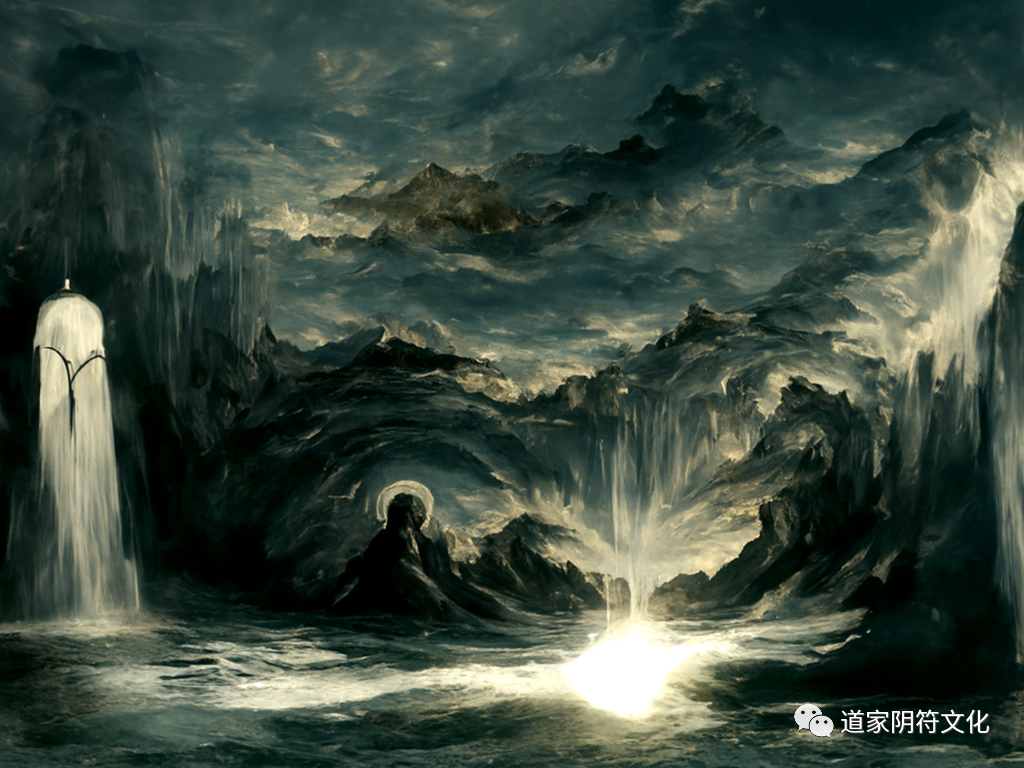
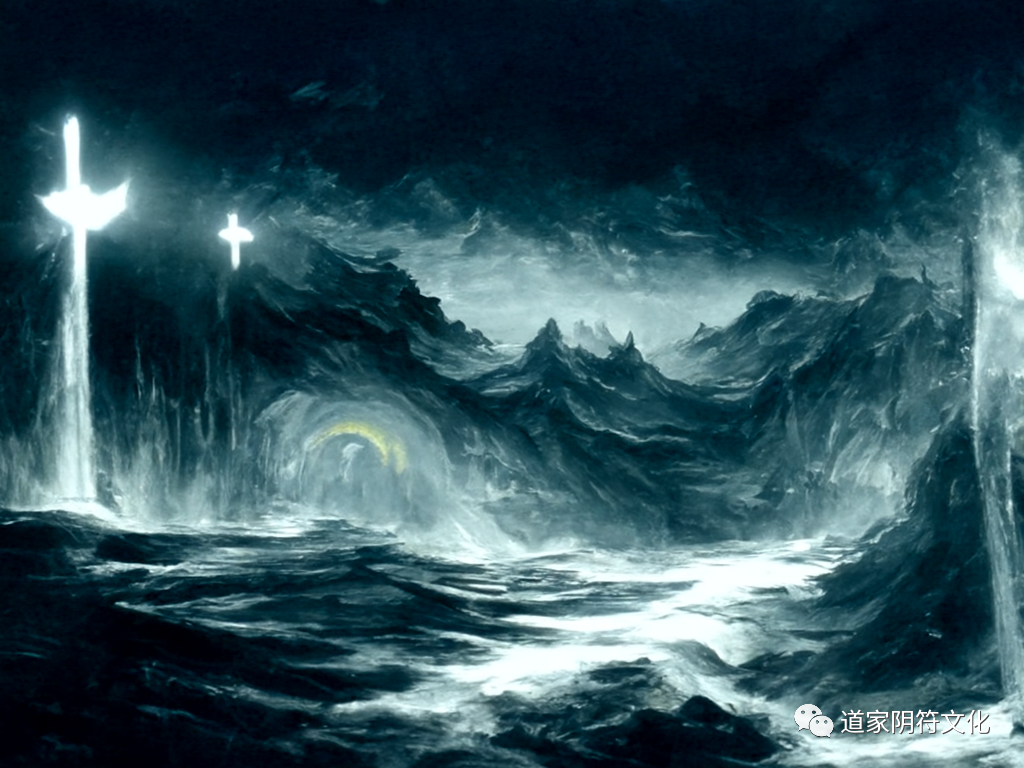
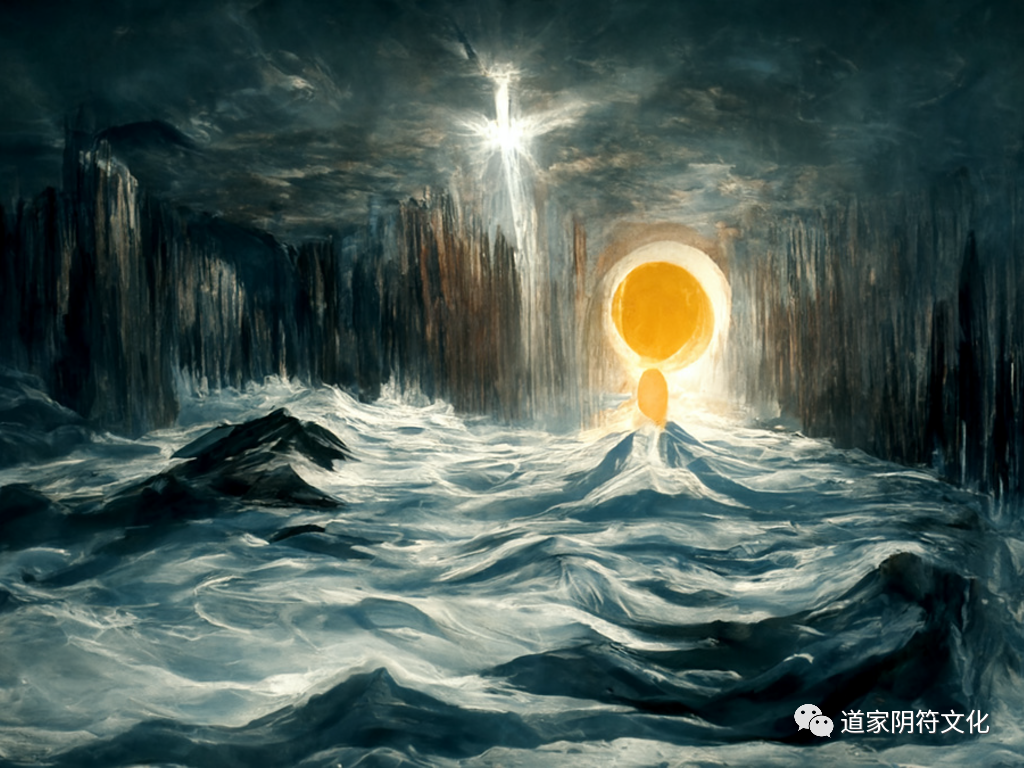
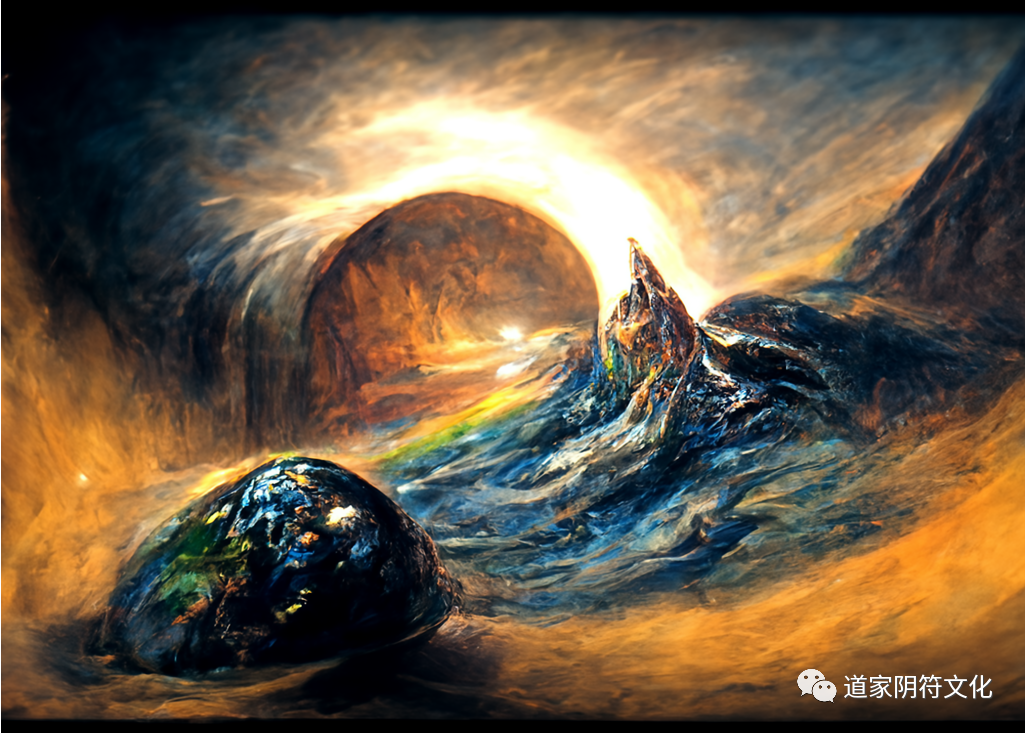
In this work one cannot help recalling the primeval mound of Egyptian myth. In Egyptian myth the site of creation appears as a sand dune in the primordial waters of chaos; the Egyptians later built pyramids to imitate it.
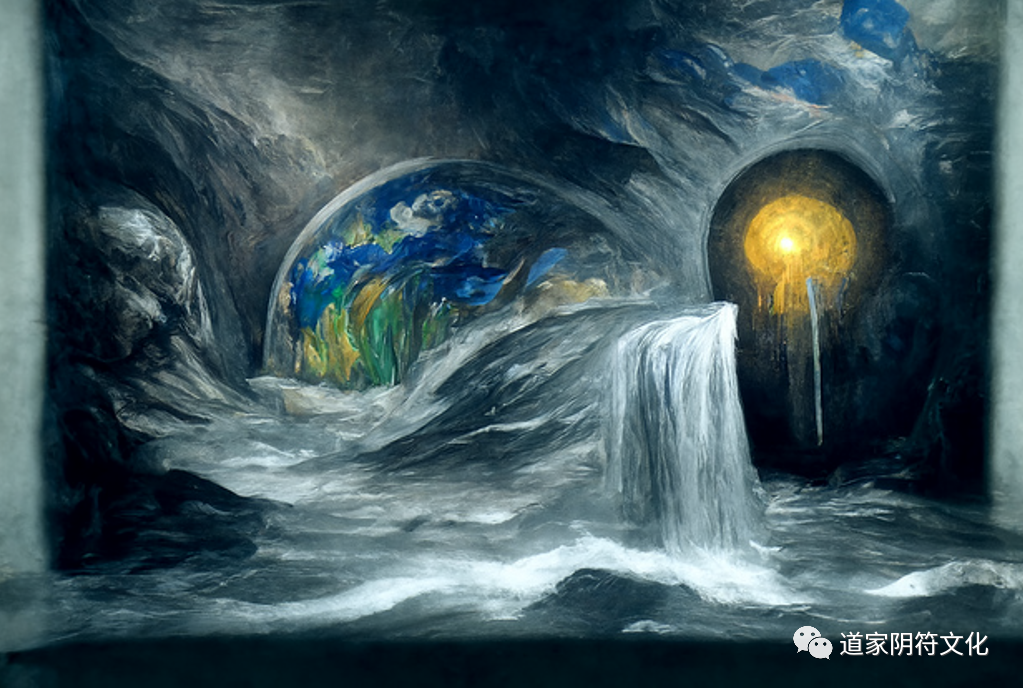
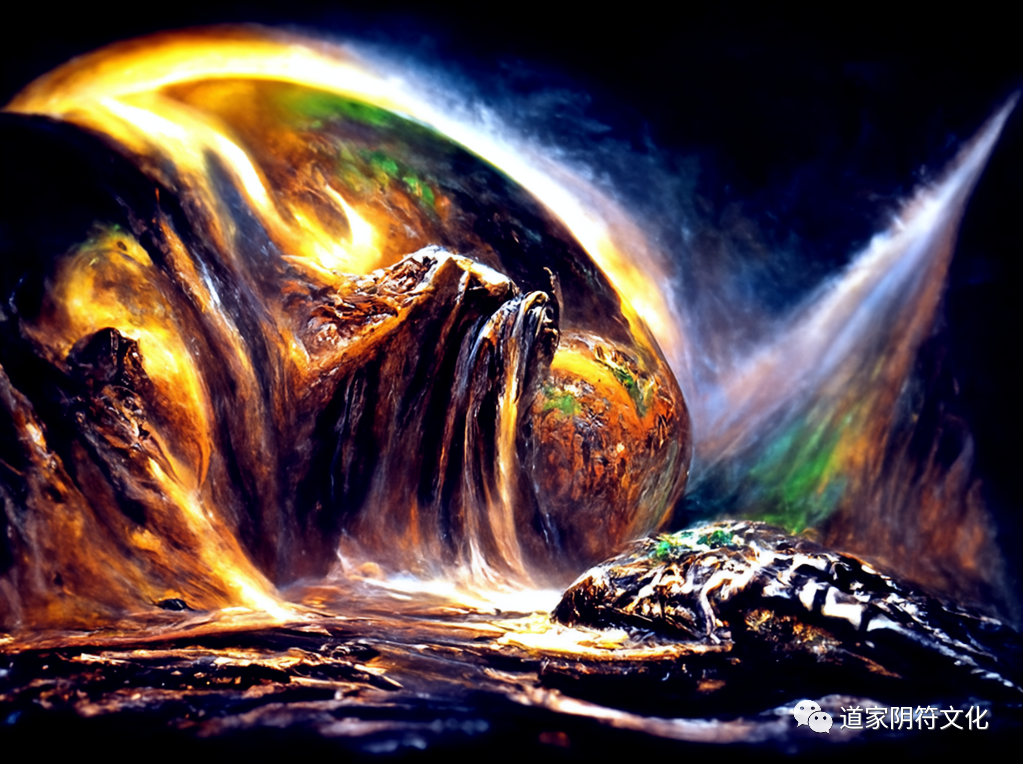
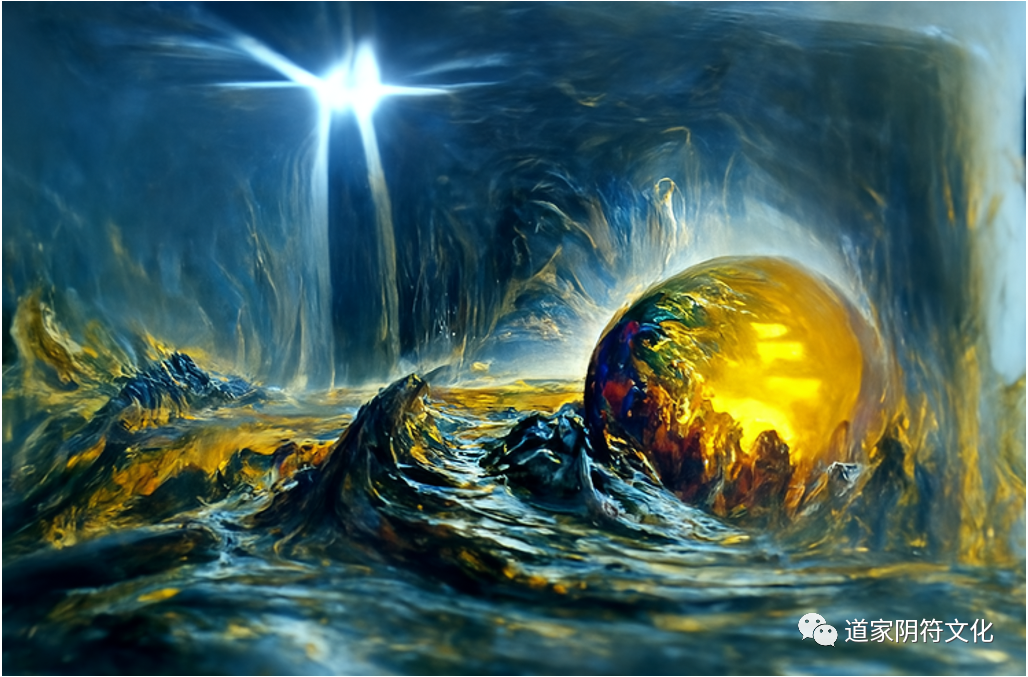
After changing the style, this painting is still more surprising—the blue planet behind looks very much like Earth.
What is interesting here is that although in the original text we did not describe any spherical concept, creating a sphere seems to become a shared feature—very likely the model learned deeper meanings in the process of converting text to image.
Therefore we can imagine: if a universe-like generative model exists, all that is needed is to describe "what kind of universe."
We can even indulge a sci-fi fancy: our universe is not the first, but one of many created by higher-dimensional beings after collecting data from multiple universes.
Thus the birth of our universe may simply have been described in one sentence: "a universe whose relative speed is at most the speed of light"—everything else randomly generated under the model's command.
Because we also call this model an artificial-intelligence model, it can be said in a sense to possess "some will": what it generates also becomes part of its input. Partial interference within it would cause the final generated picture to change.
If such a model is a priori existent, this means the universe's birth did not need so much luck. For if we explain by the current inflation theory—the so-called Big Bang theory—the probability of our universe arising is probably no more than one in several tens of trillions, obviously almost impossible. Conversely, the possibility of aliens or life of higher dimensions is far, far greater.
Like the inflation theory of the universe model, it does not actually answer where the universe came from. When scientists infer from observational data, they find that in the derived model there was originally a singularity, and suddenly this universe appeared—this is in fact deeply confusing. Hence the scientific community proposed the inflation theory: between 10⁻³⁶ and 10⁻³² seconds of the universe's creation instant, claiming violent expansion occurred. This is like a point suddenly becoming a huge sphere. How exactly it happened is unknown; even the expansion was superluminal, and how the singularity arose was also rolled by dice. Of course this still sounds quite inspiring: before the universe existed, when time and space did not exist, the void was madly rolling dice—until it rolled out this universe. There is clearly a very troublesome logical problem here: spacetime is this universe's spacetime. Before this universe arose—when the universe had not yet been produced—was there some other mode of measurement? Because the claim of "no spacetime before the universe" is like saying: if there were only one living being in the world, for that being the real span of survival would be the time awake—for whether asleep or dead, that passage has no meaning to them. Yet in reality there is more than one living being: when some sleep, others are still active. Referencing each other, a unified convention for expressing time-measurement begins to exist. In other words, spacetime is generated within this universe—this itself already tacitly assumes there is only a single unique universe. This understanding has some rationality, because scientifically speaking, reliable traces of other universes have not yet been found. In some conjectures, the universe's original singularity arose from quantum fluctuations in some kind of vacuum—like the dice-rolling mentioned earlier. In the conjecture that the singularity arises from particles emerging from the void: if particles always existed there could be no "emergence"—but they exist sometimes and not others, which already tacitly assumes the existence of "some kind of time." And emergence may create more than one universe—this also means parallel universes may exist. If parallel universes exist, then because they arose from quantum fluctuations, there must also be a "before and after" order; from this angle, governing that measure will be a higher concept of time. This is a bit like watching a video: if you wish, you can drag the progress bar to jump back and forth arbitrarily. Even in complex games you can save progress and switch back at will. Time in videos or games is human-made; its flow can be faster or slower than reality. Once outside that video or game, talking about its time loses meaning. In the scientific community there is also a conjecture that the universe's original birth did not come from a singularity, nor was there inflation—the universe itself is eternal. This can be understood this way: if the universe did not arise from some kind of emergence, and time before the universe truly has no meaning, then there is no higher-dimensional concept of time. Then, since the present is determinately existent, this universe was originally an eternal existence and will never disappear. And in this explanation, it also solves the question of the source of energy for the universe's inflation—because in the original inflation theory, why the singularity would suddenly inflate in an instant, and moreover superluminally, is unexplainable. The brane-universe conjecture is mainly to explain why, in our universe, gravity is so weak compared with the other fundamental forces of nature.Because in nature gravity is not only almost 10²⁴ times weaker than the other weak forces, yet it is also one of the extremely important parameters of this universe's formation—and this parameter is extremely sensitive: change it slightly and this universe would look completely different.
Hence membrane theory was proposed: all forces except gravity are confined to the membrane, and only gravity can penetrate the universe.
Such a popular explanation makes one feel it is a bit of cheating—obviously forcing a fit: because it cannot be explained, create a concept, give it a name, and count the problem as solved.
So in 2021 a group of researchers spoke up directly: everyone stop babbling—this thing is just an artifact of a calculation process; there is no need to consider its real significance, because the final results obtained can be independent of it.
Membrane cosmology is also called the ekpyrotic universe theory; it introduces external energy for explanation. In this theory, the universe we now inhabit is embedded in a higher-dimensional space, and thus lies between two parallel membranes. Like bed sheets hanging on a clothesline—except they also swing on their own; when the sheets collide, fire appears, and this universe is produced. This is like what was said earlier: time originates earlier than this universe, and our universe is only temporarily rubbed into being by two membranes in the great universe; then the universe slowly cools, and the next membrane collision brings energy again—so the universe is in an eternal, unceasingly cycling process. However, according to calculations, the energy from such membrane friction is actually not enough to inflate the whole universe—just as bed sheets drying at home, even colliding under the wind, do not catch fire. So to patch this hole, scientists proposed the "Phoenix Universe" concept: in this model the two outer membranes' friction only produces a spark, while the universe is like a powder keg—ignites at a touch, explodes, cools, and can be ignited and exploded again. The recyclable explosive is dark energy. Therefore, whether looking at current theories of the universe, the essence is really about building a model that can describe the universe's origin. Conversely, if there is an a priori existing model—and this model is probably not a rigid template that can only create our universe, but more likely a flexible one able to create many different kinds of life-bearing universes—then from a macroscopic angle this would have far greater significance. There is a very interesting fact here: the cosmic background noise we can detect now is very likely not some product of the Big Bang. In fact, at the so-called Big Bang instant, what truly happened is that the whole universe did not diffuse outward from a single point, but arose simultaneously across different spatial distributions—the void is like an infinite-dimensional canvas, and our spacetime was simply painted onto it. The universe itself, as a remnant generated by a diffusion model, and the redshift we observe, are also not proof that the whole universe is expanding—but merely because the universe has not finished generating completely and is still diffusing and influencing each other. This can even explain why the Planck-based ΛCDM model's calculated results match observations so closely, while the extended ΛCDM model introducing dark energy as a fifth element still finds no convincing evidence even in the latest 2018 observational results. If the hypothetical universe-creation described above is true, it would also affect some myths: the creator gods of typical myths need not be so high in status. Abstracted to reality, the Western God or the Hindu creator is actually only equivalent to an engineer who deploys and implements a model. Although they have a certain degree of operational authority, the model's complexity is very likely far beyond their grasp. Then true "omniscience and omnipotence" is impossible. Looking at reality: a creator—or an engineer—if willing, of course can freely obtain any fragment of information within the model, and also has the ability to interfere with its contents to some degree. But overly large-scale interfering operations would destroy the model, and the consequences would likely be unforeseeable. Therefore, the creator's power is also limited. This raises an even more interesting question: if there really is such a model, who created it? And it brings an even more thought-provoking question: if the universe arises through iterative diffusion like this, then the core mechanism behind it—that is, Taiyi—will be universal to any generated universe and to everything beyond them, a universal truth transcending spacetime. Then, how can one master it?Originally published on the WeChat public account (Daoist Yin-Fu Culture): Taiyi: The Ultimate Model Core That Creates the Universe