Quantum Computing and the Four Images (Part Two)
If quantum operations are regarded as something akin to circuits, since a single qubit has not only a yin state and a yang state but also mixed states, controllability can be achieved by exploiting the interactions among them.
So one can design gates for logical control, and the most fundamental cases requiring operation are four: unchanged, flipped, equal to 0, and equal to 1.
Put simply, an operation is essentially controlling a quantum state to transform into another quantum state. This process can be called evolution, and evolution is in fact a rotation in Hilbert space.
Rotations in Hilbert space can be performed with matrices, and the matrices used are unitary matrices — also called unitary transformations — so here they can be called U operations.
The defining feature of a unitary transformation is that it can transform while preserving inner product, length, angle between vectors, and shape.
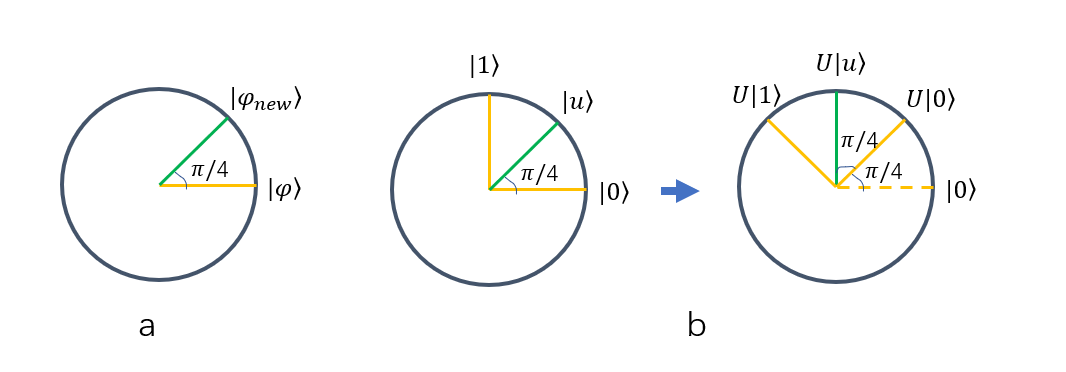
As shown in the figure, for the three states |0⟩, |1⟩, and |u⟩, after performing a U operation on them, the transformed results do not change the relationships among |0⟩, |1⟩, and |u⟩.
So for example, when ⟨0|1⟩ = 0, clearly ⟨U0|U1⟩ = 0, so one can perform U operations with complete confidence.
A single qubit can be represented by a 2×1 vector, and a single-qubit gate becomes a 2×2 matrix. The process of transforming |0⟩ into U|0⟩ is equivalent to turning [1,0] into 1/√2, 1/√2. What needs to be understood here is that the values have changed, yet the state is still equivalent — because its reference frame has changed, so the values appear to have changed. And the U operation is reversible, so U|0⟩ can equally be transformed back into |0⟩.
This is similar to multiplying both sides of a fixed binary linear equation by a constant, while the values of X and Y remain unchanged.
These details can actually be skipped without major problems; it is enough to know simply that quantum operations can be performed via matrices that conform to the proper specifications.
So what operations can be performed on qubits? The most fundamental ones are as follows:
The first is the X gate. Its function is to flip — that is, to turn |0⟩ into |1⟩, or vice versa. Expressed with the Four Images, it turns the yin state into the yang state, or the yang state into the yin state. This is realized via the matrix below, called the X gate — that is, the gate used for yin–yang conversion.
[latex]X=\left[ \begin{array}{}{0} &{1} \\ {1}&{0} \end{array}\right][/latex]
The second is the Y gate. Its characteristic is that it operates on i.
[latex]Y=\left[ \begin{array}{}{0} &{-i} \\ {i}&{0} \end{array}\right][/latex]
The vector i appears suddenly, and one may feel somewhat at a loss as to what it represents. Actually this is a kind of shorthand; in reality:
[latex]i=\begin{bmatrix} {\frac{1} {\sqrt{2}}} \\ {\frac{1} {\sqrt{2}}}\\ \end{bmatrix}[/latex]
The third is the Z gate. The Z gate is also called the phase-flip gate. It can turn |+⟩ into |−⟩, and −|1⟩ into |1⟩.
[latex]Z=\left[ \begin{array}{}{1} &{0} \\ {0}&{-1} \end{array}\right][/latex]
The fourth is the H gate. Its role is extremely important. It can turn |1⟩ into |−⟩, and turn |0⟩ into |+⟩. Its expression is:
[latex]H=\left[ \begin{array}{}{\frac{1}{\sqrt2}} &{\frac{1}{\sqrt2}} \\ {\frac{1}{\sqrt2}}&{-\frac{1}{\sqrt2}} \end{array}\right][/latex]
For example, suppose we have a |1⟩, called the yang state, and we want it to become a superposition state. We can operate on it with the H gate, after which it becomes |−⟩. If we then perform a Z operation on it, it becomes |+⟩.
So what do |+⟩ and |−⟩ represent? In Dirac notation, they are defined as follows:
[latex]|+\rangle=\frac{1} {\sqrt{2}} (|0\rangle+|1\rangle)[/latex]
[latex]|-\rangle=\frac{1} {\sqrt{2}} (|0\rangle-|1\rangle)[/latex]
Why is there this seemingly strange expression? Because waves can superimpose and interfere directionally, so positive and negative signs must appear. One can imagine superposition and cancellation, with peaks, troughs, and other parts.
To distinguish them — taking the idea of yang ascending — |+⟩ may be called the Azure Dragon, and taking the idea of yang descending, |−⟩ may be called the White Tiger state.