"The Treatise on the Mysterious Outline" by Mr. Zongxuan: Chapter 23, Entrusting the Mind to the Course of Nature
The eye finds beauty in glamour, and the heart values fame. The body desires light and fresh adornments, the mouth craves rare and exquisite flavors, the ear delights in melodious and beautiful sounds, and the nose enjoys fragrant aromas. These six are all detrimental to virtue and damaging to nature, merely destroying one's spiritual root. Therefore, if they exist, one should distance oneself from them; if they do not exist, there is no need to seek them. Only clothing and food are essential to human life, and they are also a minor flaw for those devoted to the Dao. However, one should entrust the mind to the course of nature, and there will be no lack of what is needed. Moreover, when Heaven and Earth created beasts and birds, they covered them with feathers and provided them with insects and grains; how much more so for humans? One must forget one's desires and let nature take its course.
Explanation: The eyes like to look at beautiful things, the heart likes to obtain fame, the body likes to wear beautiful clothes, the mouth likes to eat rare delicacies, the ears like to hear melodious sounds, and the nose likes to smell fragrant aromas. These six are all detrimental to virtue and damaging to nature, destroying one's spiritual root. Therefore, even if they exist, one should stay away from them; if they do not exist, one should not seek them. Clothing and food are human needs and also a flaw for cultivators. However, this should follow nature, and one should not deliberately avoid eating or wearing. Moreover, Heaven and Earth provide animals and birds with feathers and allow them to eat insects or plants; how much more so for humans? The key is to forget one's desires and let nature take its course.
Analysis: In Hinduism, some ascetics do not wear clothes. In Buddhism, these are referred to as naked heterodox sects. Their cultivation philosophy believes that everything is empty, so nothing is important. Deliberately wearing clothes is merely for modesty, but if everything is empty, why bother? Therefore, clothes should not be worn, and being naked is the only way to be free and unrestrained.
Jainism, which rose at the same time as Buddhism, also has such characteristics. It originated from the Nigantha sect, whose name means "to leave bondage," so it advocates nudity. Most people are not very familiar with Jainism, but Mahatma Gandhi is often learned about in history classes. Gandhi was deeply influenced by Jainism, which led to his proposal of the non-violent non-cooperation movement, having a huge impact in India. After Buddhism declined in India, Jainism continued to develop significantly.
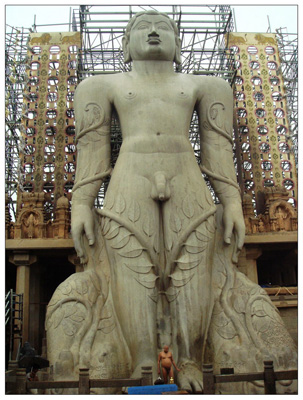
From the image above, it is clear that from the perspective of traditional Chinese culture, Jainism is considered indecent. However, it is important to note that although this sect emphasizes nudity, it should be distinguished from the Shakta sect in India. Jainism advocates celibacy, which is completely different from the Shakta sect.
Ideas determine behavior and expression. Jainism expresses its philosophy that everything is empty by not wearing clothes, which is much more thorough than Buddhism, because Buddhism cannot achieve both believing that everything is empty and摆脱 all bondage at the same time.
Daoism has its own more harmonious theoretical approach. Since Heaven and Earth provide birds with feathers and insects to eat, and animals have fur and eat smaller animals and plants, this shows that it is originally the natural way of Heaven. Whether wearing clothes or eating is in accordance with nature, and since it is in accordance with nature, one should follow it naturally.
The only thing to note is to grasp the degree. Nature is nature, but one should not deliberately pursue it out of desire.
That is to say, Daoism does not deliberately restrict or constrain human social behavior, but nor does it indulge it. Instead, if it is natural, one should follow it; if it is not natural, one should pay attention to adjust and respond.
For example, can cultivators engage in business to make money? Of course they can.
Because money is originally something that sustains life, making a profit through business is a natural thing, and this does not hinder. However, one cannot seek profit through deliberate speculation, fraud, or other means, because doing so is pursuing profit and desire, which is contrary to the mindset of cultivation.
For example, can cultivators eat meat?
This is also possible, but if cultivation requires not eating meat, one should not eat it. On the birthdays of relevant patriarchs or on the first and fifteenth days of the lunar month, if the sect's rules and precepts do not allow eating meat, then one should not eat it. Why not eat it? This is a way to express respect for the patriarchs or deities through behavior, and this expression should come from the heart, feeling it is natural, rather than forcing oneself to do it.
The Daoist way points out what should and should not be done, and whether to listen or do it depends on yourself. Once you deliberately restrict and bind, it is no longer cultivation.
Therefore, no matter what you do, doing what should be done and what needs to be done is irrelevant. The key point to grasp is the eight characters: "Forget one's desires, let nature take its course."