Explaining the Principles of Arranging Fortune Cycles in Xuan Kong Da Gua
2018-03-08 Daoist Yinfu Culture public account article
Someone left a comment saying this humble priest's public account updates only once a month—truly awkward.
Sorry for the long silence; I have simply been too busy lately, so let's talk about something useful.
When not updating, of course, one can always find a grand excuse—the New Year Tai Sui talismans have been too many, daily output is limited, and they can only be stockpiled slowly before shipping.
Some say what's so hard about a Tai Sui talisman: daub a bit with a brush, or slap on an Imperial Order plus sun and moon—or, if that won't do, just use a Tai Sui talisman shape; aren't the common Tianshi talismans all around?
Alibaba mass-produces them for as little as two jiao a sheet.
A Tai Sui talisman is neither as simple as simple gets nor as complicated as complicated gets. If you have mastered the technique, it is nothing more than borrowing the power of incense-fire to arrange things and seeking the protection of the Year Star Lord.
Yet the whole process must involve the living mage. Merely copying the outline at most comforts yourself and others; as for real auspiciousness, it is basically pure probability.
This most ordinary sort of talisman is in fact the hardest to handle. So many people clash with Tai Sui; you must try to keep them all as safe as possible—which means, on the one hand, sharply reducing the low-probability misfortunes, while also addressing the broader unfavorable flow of the year.
That is far more complex than simply boosting one concentrated probability event like wealth.
Others say, why think so much—the patriarchs will bless you and it will work. Such thinking is simply too low.
There is yet another kind who think they understand but really don't. A common case: some people believe that stuffing tabu words and flowery characters is the secret key to writing talismans, then cram them in wildly, claiming this is “sealing the sha.”
That is quite amusing, because such taboo and flowery characters only appeared after the Song dynasty—what, then, did Tang and Song Daoists draw?
As the saying goes, “Draw a talisman without knowing the knack and the ghosts and spirits will laugh.” But the trouble is here: only a few people mastered the methods, and so they all evolved into small handicraftsmen.
The weakness of small craftsmen is that they cannot keep up with industrial mass production; but the flaw of industrial goods is that everything looks stamped from one mold, lacking that spark of living qi.
That spark of qi can generally only be left inside when the artisan is fully concentrated. If small craftsmen remain limited to crude hand production, they will never touch the threshold of that mark in a lifetime.
So making talismans also requires a craftsman's spirit. Even if only for a niche audience, one should use every means to craft better talismans, so that the faithful may receive better results.
In the Dao, nothing can dispense with inner alchemy. In Daoist methods, the patriarchs put more effort into how to influence natural celestial phenomena—so a line such as “one numinous talisman summons wind and thunder” is essentially borrowing a talisman form the sages designed and completing it by summoning generals.
But inner alchemy, in this world thick with smog on every side, must be accumulated slowly over years, and will naturally be slow.
Moreover, even those with a solid general foundation in inner alchemy do not summon a general for every talisman they draw. Do not be misled by records in the Daoist Canon where methods casually summon generals as if it were nothing—if you actually played that way and drew a few a day, you would probably collapse within a month.
So outside of that, one should consider auxiliary means to refine things further.
For example, when should believers burn the talisman for better effect? That is one of many factors to consider.
Naturally, some patriarchs also said true Daoist method admits nothing else—that pure inner-alchemy strength is real Daoist method. Such sayings mainly keep beginners from being dazzled by incense-fire power, and still less from becoming infatuated with a hundred clever tricks; these show effects easily, but they are not the great Dao, and easily trap people who then forget their original practice.
It is like a phone whose most basic function is calls: calls must be clear. Other functions are not unimportant, but however important they are, calls must work and the voice must be clear first—otherwise the phone has no reason to exist.
Choosing an auspicious day to use a talisman is icing on the cake. Ordinarily this humble priest likes to use celestial-star degrees with Qimen, mixed with a bit of the Heavenly Heart True Movement grand five phases and thunder methods. In practice, this choosing works very well for erecting steles and building houses, especially when paired with good form-school feng shui; sometimes the effect even exceeds expectations.
Some may wonder: if it boosts things that well, doesn't that mean it's good?
That is thinking too simply. From of old, boosting fortune requires assessing the principal family's accumulated virtue together. If the family tends good and kind, blessings extend to descendants; if ordinary people, only a modest fortune should be boosted; if of mixed and coarse disposition, at bottom the blessing should not focus chiefly on descendants.
If virtue does not match the station, and blessings are over-applied, that violates heavenly principle. Of course these are feng shui matters; saying more is unhelpful—here we return to choosing days for talismans.
Although the effects described above can be strong in feng shui application, when reduced to a thin slip of talisman paper the force is greatly weakened: the talisman itself cannot bear it. This humble priest thinks this is largely limited by material, writing, and mode of use—after all, most numinous talismans cannot be fixed long in one place like a stele or a gate to sense heaven through earth; continuous changes of position greatly affect the bearing and discharge of such power.
How to use day-selection to give talismans stronger force is well worth studying and exploring.
Another angle: do not consider how much force to condense onto the talisman itself, but view time itself as a great river, with waves rising and falling. Find a point in favorable flow, and the talisman's force works like a small boat riding the current—thus borrowing momentum.
So we must mention Xuan Kong Da Gua—it is quite interesting.
This needs explanation: the theory of day-selection by Xuan Kong Da Gua is actually problematic for many people. The greatest problem is that auspiciousness and inauspiciousness have no fixed ground. If one merely plays by basic Xuan Kong Da Gua theory, vaguely seeking combinations like “one pure trigram,” “combine five,” “combine ten,” “combine fifteen”—no effect would be fine; once there is effect, it is either great fortune or great disaster.
As for Xuan Kong Da Gua claiming to disregard all spirits and sha, and care nothing for other taboos—just follow it—those who truly know how to play selectively ignore such advertising slogans.
For if you really try offending the year-breaker and three sha, Wu–Ji Mantian, or within the stem-branch cycle hitting lone fire, or stem-branch overcoming the mountain, and take that into burial lessons or boosting a house, you will in minutes be patiently taught what “seeking death is not living.”
In folk circles they joke:
Want to prosper? Contest the three sha—after contesting the three sha, mom and dad die;
Want rank? Contest the five ghosts—after contesting the five ghosts, you become a fierce ghost;
Want wealth? Contest the yin mansion—after contesting the yin mansion, you go to the underworld.
So ordinary day-selection first uses orthodox five phases and the like to ensure safety, then chooses Xuan Kong Da Gua. But that too is awkward: the days orthodox five phases selects for safety mostly do not fit Xuan Kong Da Gua well, so few usable days remain.
And awkwardly, even with orthodox five phases one dare not use patterns that are too auspicious, because for orthodox five phases itself that is unsafe. Following Jiang Xinquan's orthodox five-phase day-selection: one wrong step on an auspicious pattern turns it into a great inauspicious one, and you die ugly.
For example, there is a pattern called “forcing and crushing away the remnant.” Ordinarily it is said for a house full of unrest like hauntings; choose that day and all sha-qi can be driven out at once. But if your skill is insufficient and you misjudge the strength of the four pillars, it instantly becomes poking a hornet's nest and turns into “forcing and crushing the severed-gate” pattern—resulting in scattered wealth and dead people.
Whether these sayings exaggerate is hard to settle. They are said this way, but in practice it is certainly never purely day-selection alone that causes so grave an outcome—usually the feng shui also has major problems, then day-selection goes wrong too, and finally the people stir up more trouble themselves. Only with earth, heaven, and human all unfavorable together does such a situation appear.
But in general, choosing days for construction and renovation is a very cautious matter; a slight slip brings trouble. So something like Xuan Kong Da Gua day-selection, which advertises that auspiciousness and inauspiciousness have no fixed ground, demands even more caution.
Of course in some secret-lineage Xuan Kong Da Gua day-selection there are corrective and supplementary means that ensure auspiciousness and inauspiciousness are accurate—but in any case, not everyone can master this.
Some may worry: does day-selection on talismans have the same problem? Actually that is overthinking.
Day-selection of this school acts on the talisman, not on the person—it is a kind of clever borrowing. Even if an inauspicious pattern is chosen there is no harm: the gang-qi arranged on the talisman can suppress it without affecting people; if auspicious, it naturally adds fortune and force.
Back to the main topic: if one carefully studies the principles of Xuan Kong Da Gua, “auspiciousness and inauspiciousness have no fixed ground” holds for most people only because they do not understand the reasons within.
The most basic issue in Xuan Kong Da Gua arranging fortune cycles is first: “Tanlang unchanged, one fortune comes.”
No one has ever questioned this—which is the puzzling thing. “Tanlang unchanged, one fortune comes”: anyone familiar with feng shui can see at a glance that something is wrong.
For in the most basic feng shui, the interaction of trigrams can produce qi; and what qi is produced is told from the flipped-trigram Heavenly Father and Earthly Mother hexagrams.
For instance, the Qian trigram itself is latent and unmoving; the Dui trigram differs from Qian in the top line. When the two trigrams come together, yin and yang interact and produce Tanlang qi—this from the Heavenly Father perspective. From the Earthly Mother perspective, Gen and Kun differ in the top line; their interaction produces Tanlang qi.
The difference in how Heavenly Father and Earthly Mother judge qi lies mainly in the level of application—one is the Y-axis, the other the X-axis.
But whether Heavenly Father or Earthly Mother, life qi must be produced by different trigrams interacting. If two trigrams are identical, they sit in the latent position and carry no life qi of their own—they can only serve as auxiliary.
So “Tanlang unchanged, one fortune comes” in Xuan Kong Da Gua is highly suspect.
Yet if we compare Heaven–Earth trigrams with Xuan Kong Da Gua, we find the following rule:
Changing line Heaven–Earth trigrams Xuan Kong Da Gua
Top Tanlang (1) Wuqu (6)
Top+mid Jumen (2) Jumen (2)
All Lucun (3) Bixing (9)
Bottom+top Wenqu (4) Lucun (3)
Bottom Lianzhen (5) Fuxing (7)
Bottom+mid Wuqu (6) Wenqu (4)
Mid Pojun (7) Pojun (8)
Same Fubi (8) Tanlang (1)
One can notice that in Xuan Kong flipping hexagrams, Jumen is the same, while everything else is basically entirely different. If we derive an evolutionary formula from Heaven–Earth trigrams to Xuan Kong trigrams, it would be this:
F(x) = 1/8 (40 + 8 Cos[1/4 \[Pi] (-7 + x)] + 8 Cos[3/4 \[Pi] (-7 + x)] +
8 Cos[5/4 \[Pi] (-7 + x)] + 8 Cos[7/4 \[Pi] (-7 + x)] +
4 Cos[3/2 \[Pi] (-6 + x)] + 7 Cos[1/4 \[Pi] (-5 + x)] +
7 Cos[3/4 \[Pi] (-5 + x)] + 7 Cos[5/4 \[Pi] (-5 + x)] +
7 Cos[7/4 \[Pi] (-5 + x)] + 3 Cos[3/4 \[Pi] (-4 + x)] +
3 Cos[5/4 \[Pi] (-4 + x)] + 3 Cos[7/4 \[Pi] (-4 + x)] +
9 Cos[1/4 \[Pi] (-3 + x)] + 9 Cos[3/4 \[Pi] (-3 + x)] +
9 Cos[5/4 \[Pi] (-3 + x)] + 9 Cos[7/4 \[Pi] (-3 + x)] +
2 Cos[3/2 \[Pi] (-2 + x)] + 6 Cos[1/4 \[Pi] (-1 + x)] +
6 Cos[3/4 \[Pi] (-1 + x)] + 6 Cos[5/4 \[Pi] (-1 + x)] +
6 Cos[7/4 \[Pi] (-1 + x)] - 2 Cos[(\[Pi] x)/4] -
2 Cos[(\[Pi] x)/2] + Cos[(3 \[Pi] x)/4] - 20 Cos[\[Pi] x] +
Cos[(5 \[Pi] x)/4] + 4 Cos[(3 \[Pi] x)/2] + Cos[(7 \[Pi] x)/4] -
2 Sin[(\[Pi] x)/4] - 4 Sin[(\[Pi] x)/2] + 2 Sin[(3 \[Pi] x)/4] -
2 Sin[(5 \[Pi] x)/4] + 4 Sin[(3 \[Pi] x)/2] + 2 Sin[(7 \[Pi] x)/4])
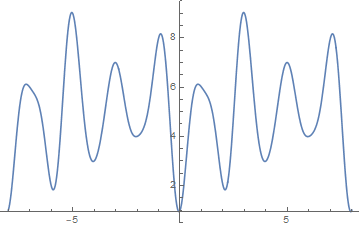
Does it suddenly feel simpler—suddenly as if you understand something?
The negative numbers on the left of the X-axis can be ignored for now; just look at the right half of the graph. The X-axis is the Earthly Mother trigrams; the Y-axis is the Xuan Kong Da Gua fortune.
Xuan Kong Da Gua does not evolve on its own; it performs a transformation on the Earthly Mother trigrams, then separates odd and even into yin and yang.
Why do this? Because odd pairs with odd, even with even—yin pairs with yin, yang completes with yang. Like the superposition of waves: crest upon crest strengthens amplitude; trough upon trough does the same.
Those who know the He Tu and Luo Shu will keenly notice: isn't this exactly their matching method? Yin with yin, yang with yang.
So Xuan Kong Da Gua arranging fortunes is really taking the originally disordered Heaven–Earth trigram evolution and processing it so it can be He Tu / Luo Shu-ized, separating and classifying yin and yang through a shift of viewpoint.
Those familiar with traditional feng shui know of something called the pure-yin pure-yang method—it seeks the same strengthening of amplitude, and so is more powerful; we will not digress into it here.
So then, which number pairings in Xuan Kong Da Gua are good? Look at which crest-on-crest gives maximum amplitude: obviously 1–3, 2–4, 7–9, 6–8. In Xuan Kong Da Gua this is called inverted ai-xing.
Why inverted? The fortune numbers are on the Y-axis; now we use the X-axis—is that not inverted?
Likewise 2–8, 3–7, 4–6 also pair yin and yang respectively, also raising amplitude, but less than inverted ai-xing.
As for generating numbers—2–7 and 3–8 both go to 4–9—hardly needs saying.
Likewise Xuan Kong Da Gua also stresses combining to five, ten, fifteen. Combine five is nothing but 1–4, 2–3; combine ten nothing but 1–9, 2–8, 3–7, 4–6; combine fifteen nothing but 6–9, 7–8.
Clearly from the graph, adding two opposite and similarly powerful amplitudes, by the principle of wave interference, their amplitudes will interact, reduce, and approach the average.
So however you combine, small with large lowers amplitude; small with small, large with large, increases.
Clever readers will have thought: this is interesting—you can use amplitude-raising to boost auspiciousness and amplitude-reducing to lessen inauspiciousness, thereby seeking good and avoiding evil.
That idea is fine, but note that once we get to trigram fortunes, the large and small just described have already changed: the one holding the trigram fortune is large, called the correct spirit; the one not holding it is small, and becomes the zero spirit.
So at the trigram fortune one mostly uses nearby large numbers to increase amplitude, and at the small positions small numbers to increase amplitude. And high mountains with low water—one inch high is sand, one inch low is water—still just crest and trough each stacking to strengthen amplitude. This is where “clearly knowing the zero spirit and the correct spirit, in a few days one enters the blue clouds” comes from.
Understand this principle and you will also understand: if you merely distribute mountains and waters by basic theory, and the site's feng shui was not good to begin with, inauspicious effects will likewise be strengthened in turn.
Conversely, even if you do not match large with large, small with small—but form small with large—you can likewise gather and mitigate harm; even a house that does not collect prosperous qi can at least have peace.