On the Application and Improvement of Modern Astronomy and Traditional Metaphysics (Part 3): Distinguishing Yin from Mao
I. The Verse
From the Determining Sunrise and Sunset:
First and ninth months—emerge from Yi, enter Geng direction.
Second and eighth months—emerge from the rabbit, enter the chicken's gut.
Third and seventh months—issue from Jia, enter Xin ground.
Fourth and sixth months—born at Yin, enter the dog's hiding.
Fifth month—born at Gen, return upon Qian.
Midwinter—emerge from Xun, sink in Kun direction.
Only the tenth and twelfth months—emerge from Chen, enter Shen; examine carefully.
Here sunrise and sunset are fixed by the twenty-mountain directions of the luopan. Compared with the Formula for Determining the Yin Hour:
First and ninth months—emerge Yi—fifth watch second mark.
Second and eighth months—emerge Mao—fifth watch fourth mark.
Third and seventh months—emerge Jia—level light.
Fourth and sixth months—emerge Yin—sunrise.
Fifth month—emerge Gen—sun three zhang high.
Eleventh month—emerge Xun—beginning of fourth watch.
Tenth and twelfth months—emerge Chen—fourth watch second mark.
In ancient times, when fixing the night watches, a flowing clepsydra was used, with a floating rod for timekeeping.
From the written records, the clepsydra was clearly used for timing. Twilight begins at You-correct; from the half-mark of the fourth ke of You-correct until the second-and-a-half ke of Mao—a total of five night watches.
Although the clepsydra was invented in later ages, this fixed counting method that does not depend on celestial phenomena is in essence still related to the heavens.
Because of Earth's rotation, taking Earth as the reference, the Dipper constantly turns in the star field. The Dipper can be taken as a natural pointer—and so became the Dipper time-giving calendar.
This time-giving system, by the ancient method, did not use 360 degrees but 365.25—equivalent to a sidereal year. Each day the Dipper advances; the celestial circuit of 365.25 is essentially projected from the equator onto the ecliptic, dividing the ecliptic by mean solar days.
Within one mean solar day, does this differ from the present 24-hour system? Of course—the key difference lies in the position the Dipper's handle points to.
Likewise it is affected by latitude and longitude. When observing in Beijing the Dipper points due north, in Xi'an it has not yet pointed north. This is mainly because Earth is spherical.
Does the later practice of using the clepsydra to equally divide the twelve double-hours accord with the ancient division?
The Yan Family Instructions of Northern Qi states: "Suppose the first month establishes Yin—the Dipper's handle at evening points to Yin, at dawn to Wu. From Yin to Wu, five branches are crossed. In winter and summer months lengths differ, but always within about five double-hours. Geng means to pass through—therefore five watches."
The five night watches differ in length between summer and winter but vary within about five double-hours. The ancients already had fixed double-hour positions. One may conclude: purely dividing the twelve double-hours by earthly branches is not a time-fixing method that observes the sky's color; it is more a coordinate system for unified reference—so dividing it equally is no problem.
II. The Distinction between Yin and Mao
We are not finished. This verse can be analyzed more deeply. The third month is the Mao month—exactly the spring equinox, when day and night lengths are equal. Starting from this, one can obtain an accurate dividing line between Yin and Mao.
Why obtain this line? Because the hour used in Da Liu Ren and the hour fixed by the Dipper establishment are two different hours.
Only at the spring and autumn equinoxes do they synchronize. Why in Daoist alchemy there must be advancing the fire and retreating the elixir, and why in the Mao-You cosmic circuit there is bathing—all connected.
Before obtaining the accurate Yin–Mao line, understand some astronomy.
First, sunlight reaching Earth is not instantaneous: about 8.3 minutes. So the visually observed Sun's position is actually about 8.3 minutes earlier.
Yet the actual situation is more complex. The 8.3-minute error does not mean that when the Sun visually rises it has already risen higher.
Because when the horizon brightens, atmospheric refraction means the sky has already brightened while the Sun is still below.
The accurate angle of atmospheric refraction is affected by pressure, temperature, and humidity; modern high-precision ephemerides include barometric pressure.
So fixing double-hour boundaries by latitude and longitude alone for true solar time is obviously very crude.
Although the intermediate calculation is complex, the correction is not—first simplify to a simple case.
The following figure is what the ancients called the level-light moment (image from the internet): figure omitted.
Therefore the verse's third and seventh months, when the Sun has not yet appeared: the level-light moment is the Yin hour.
With Yin and Mao fixed this way, it matches astronomical astrology's ecliptic calculations. One may conclude: when the monthly general is added to the hour, the Mao hour's position corresponds to the Ascendant—east of the horizon, at sunrise.
Something more interesting follows. For example, Hangzhou, October 29, 2020: Beijing-time sunrise 06:11. Roughly two hours as one double-hour: 4:11–6:11 is Yin position, 6:11–8:11 Mao.
However, Da Liu Ren or Jin Kou Jue change the monthly general at the middle qi—and the middle qi is exactly fifteen degrees from the seasonal node.
The first month establishes Yin; only after Rain Water is the monthly general changed to Hai—after the revolution covers fifteen degrees. The Sun enters Hai palace relative to Earth, corresponding to Pisces.
Fifteen degrees is one twenty-fourth of 360—exactly one hour. Deducting it: that day's Beijing time 3:11–5:11 is Yin, 5:11–7:11 Mao.
Although we have come full circle, a key point remains: the importance of correcting sunrise time.
Therefore the essence of adding the hour to the monthly general in Da Liu Ren or Jin Kou Jue is to compute by Earth–Sun rotation plus revolution the corresponding northern pole position on the ecliptic, and using this as base to circulate the cycle.
How to obtain the accurate double-hour error:
1. Beijing time uses the +8 zone; through latitude and longitude conversion obtain local civil time.
2. Compare with Beijing's sunrise time, make a one-hour correction (Beijing 7 o'clock), then deduct the error—obtaining the truly accurate corrected time.
For example, Beijing, November 1, 2020: sunrise 06:43:38. After deducting one hour—by 5:43 it has actually already reached the Mao hour.
Is this reasonable? Seek verification in ancient texts.
The Confucian School's Complete Filial Record of Geomancy, chapter thirty-five: "Now astrologers add the birth hour to the Sun and count to Mao to fix the life palace—certainly wrong. Taking wherever the Moon reaches and calling it the body is also wrong. The Sun originally turns left, each double-hour completing one palace. Therefore before and after the winter solstice, when the Sun rises in Chen, start the Sun at Chen and count forward—that is the life palace. Before and after the summer solstice, when it rises in Yin, start at Yin. At other times, when it rises in Mao, start at Mao and count forward—that is the life palace."
Thanks to modern astronomy, more accurate calculations can be made.
III. Corrections in Astrology
The matter does not end. Fixing times by sunrise now has a basis, but this brings the latitude problem: when latitude changes the horizon changes. At the poles, polar day and polar night occur—when is sunrise then?
Before solving this, speak of why house division systems arose.
The twelve houses of the zodiac, though named for constellations, are first divided as regions—only afterward named for corresponding constellations.
So although under precession zero degrees of Aries is no longer the vernal equinox position, the essential meaning of that region has not changed.
What constellations actually are does not matter—only for naming. What matters is what the houses point to. So although the vernal equinox has entered Pisces, this does not affect original astrological judgments.
Indian astrology takes precession into account—but each school uses a different value. Why?
Because equal division of twelve houses is ideal; the great model is only an outline. In verification there are always mismatches, so fine-tuning is necessary.
Precession influence in Indian astrology is also a correction technique.
Indian schools do not follow modernly calculated precession—they propose their own value and interpret with their own techniques. The degrees are explained via precession but essentially have nothing to do with it.
The Western counterpart is the house cusp.
If a planet falls one minute past the third house cusp, it is still in the second; every four minutes affects one degree; in the Ptolemaic system this reaches five degrees.
The house cusp is also a correction technique; fixing it requires careful chart-casting.
For chart-casting there are many views: some hold the first breath at birth fixes the moment; some records may have been made after cutting the umbilical cord—so even accurate records need re-fixing.
Whether first breath or cord-cutting is hard to prove. Recording birth to the minute is impossible with so many interferences. The only solution is still chart-casting.
So one reverse-engineers according to the person's actual descriptions—plainly only for determining parameters.
Even reverse-engineered times often fail to compute correctly. Astrologers try to optimize the model for one-step calculation—hence new house systems correcting house lengths.
When lengths become unequal, two consecutive house beginnings can both fall at a constellation position—called interception.
Interception arises from artificial settings, but some explain it as a sealing-off effect weakening the corresponding planet.
The origin is a belief: when astrology is inaccurate it needs correction—since stellar divination, correction must be sought in celestial motion. Once one finds a corresponding rule mapping stellar changes to reality, divination can be accurate.
But finding rules is complex. Most keep original mappings and fine-tune the model.
When ancient Greek astrology found the vernal equinox had shifted, continuing the sidereal zodiac could not reflect it—so charts needed to show all bodies progressing along the zodiac. This matched Ptolemy; after him the tropical zodiac was used.
Some find the tropical more intuitive for personality, the sidereal closer to inner traits—but Western astrology largely uses the tropical.
Yet using only the tropical, fixing the life house, equally dividing houses and examining placements still produces inaccuracy.
So another issue: houses cannot be equally divided—how to vary them? This produces the many Western house systems.
Here is a sorted mind map.
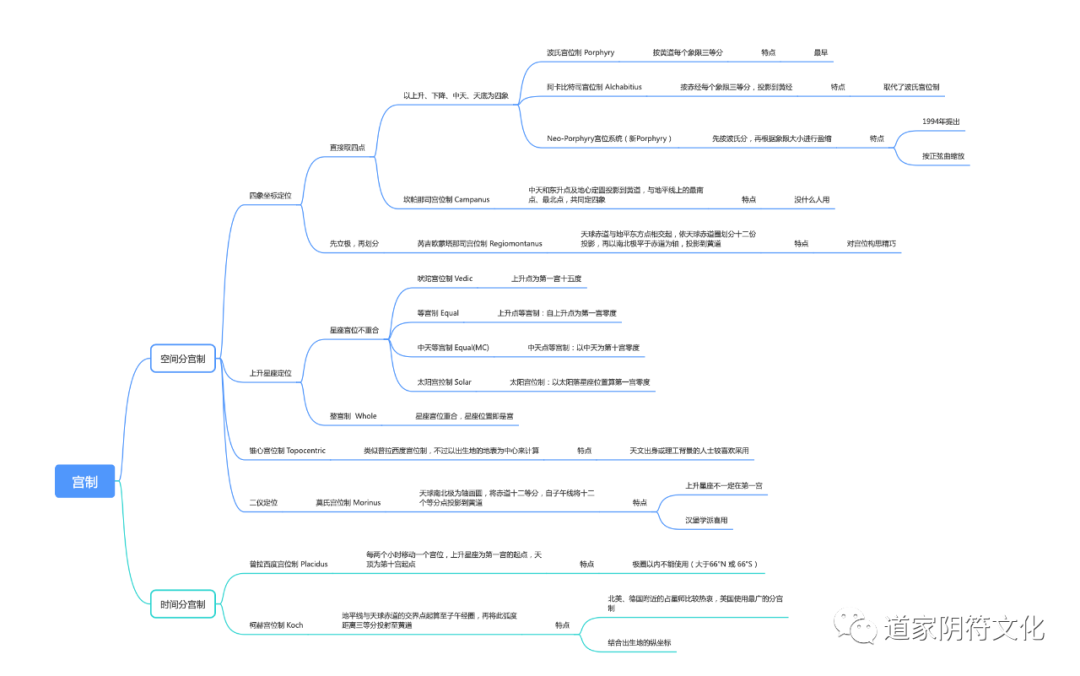
Common systems are organized here. Hard to say which is best—but several are widely recognized: Koch more common in North America; Placidus popular in Asia with good accuracy. Some Asians comment online that Koch better matches them.
Surveys of astrologers' house-system ratios: figure omitted.
Placidus's greatest feature is one house every two hours—like China's double-hours—very concise, similar to the mean-qi method.
Koch is more complex: from the birth position compute the horizon, to the meridian, equally divide into three, project onto the ecliptic—also similar to mean-qi, dividing by the celestial equator first.
These systems commonly distort extremely at the poles because they use the horizon.
The same problem exists in Chinese arts—typical is distinguishing day and night, especially Da Liu Ren's different noble-spirit methods for day and night.
Simple to imagine: above horizon is day, below is night—yet the poles have polar day and night.
The Conical house system tried to improve Placidus for polar use, but its vague algorithm did not solve the problem. Because it has a little improvement, many still use it.
Morinus divides the equator into twelve and projects onto the ecliptic—degrees equally divided, so times unequal.
There is a contradiction: if time is equally divided, houses cannot be equal; if houses are equally divided, time cannot be.
House systems generally adopt right-ascension calculation projected onto the ecliptic—but schools differ greatly: some divide the equator twelve ways from the poles' circle; some start from equator–horizon intersection; some to the meridian circle by arc thirds.
The various methods try to reconcile these contradictions by mutual equator–ecliptic projection.
This is based on a hypothesis: if a chart structure exists that can accurately divine, it can be computed through the equator–ecliptic relationship.
Is this valid?
Arts using the monthly general or life palaces are highly consistent with astronomy.
But note: ancient China's ecliptic was fixed by determination stars of the Twenty-Eight Mansions, not modern astronomy's. The starting point was those stars, not the vernal equinox—computed by right ascension, then converted onto the ecliptic: apparent ecliptic longitude.
The fixed-qi method of today's Sun position on the ecliptic does not match ancient design.
Ancient Chinese knew the obliquity. Feng Shi's History of Astronomy: "The precision of China's observational values is astonishing. As early as the fourth century BCE, errors were under half a degree; later most under three. These systematic data from gnomon and armillary provided evidence for eighteenth-century discussions of the ecliptic's inclination variability."
Why use right ascension rather than the ecliptic directly?
Because ancient China prized star observation far beyond the West. The West, needing less precision, commonly used ecliptic coordinates after the second century.
Only after the telescope: with rotation, ecliptic coordinates are troublesome; equatorial coordinates with a parallel-axis mount eliminate rotation and stay fixed on a body.
Considering ancient right-ascension divination was still accurate—and late-Ming Western astronomy no more advanced—one can reorganize by the ancients' ideas.
In practice, every house system has an accurate side and characteristic content—like interception, now common despite modern origin.
Those who learn a school mainly use its house system with satisfactory results. Mixing schools often produces contradictions—not idealism.
The celestial equator corresponds to Heaven, the ecliptic to Earth; humanity lives on Earth. Projecting the Heavenly Way onto the Earthly Way performs a conversion—different conversions extract characteristic information.
Whole-sign more easily reflects events; for finer progressions, corresponding houses extract characteristic information.
Daoistically: contradictions are yin–yang systems with a principle behind them—obtain it by jumping out of each subsystem to the mother system.
Merging methods requires systematic comparison to find each system's strength.
Finally: the above only applies to arts using the ecliptic—including Seven Regulators, Da Liu Ren, Jin Kou Jue. Other arts do not apply. Why? Next installment.