World Pilgrimage Journey — Australia (2): Kata Tjuta at Uluru, Australia
Before setting out, I saw that temperatures in Uluru often reached as high as forty degrees, which was somewhat worrying—after all, imagine sitting on scorching rock for very long.
After arriving at Uluru and disembarking, resort vehicles took everyone to the hotel, and then arrangements were made to head to Kata Tjuta, the great rock formation composed of thirty-six massive domes. On the road we already saw their majestic silhouettes and were full of anticipation.
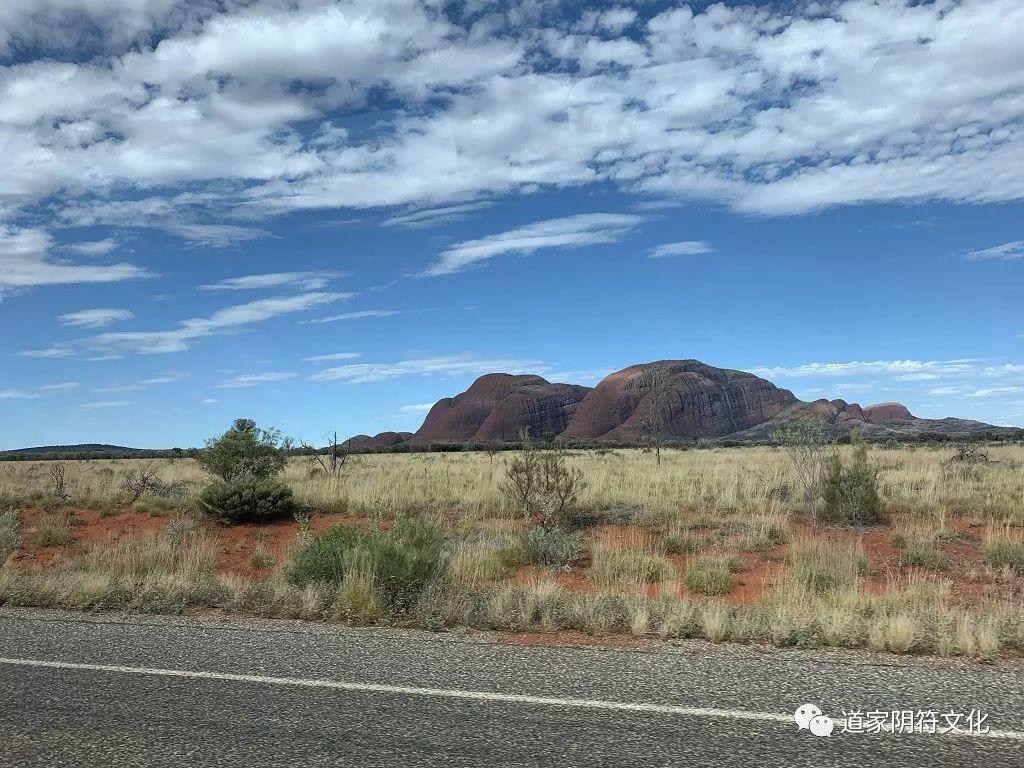
Although there were quite a few clouds in the sky, it was still unexpectedly hot. Fortunately there was a chatty guide, whose chatter eased some of the heat in the van; before long we reached Kata Tjuta.
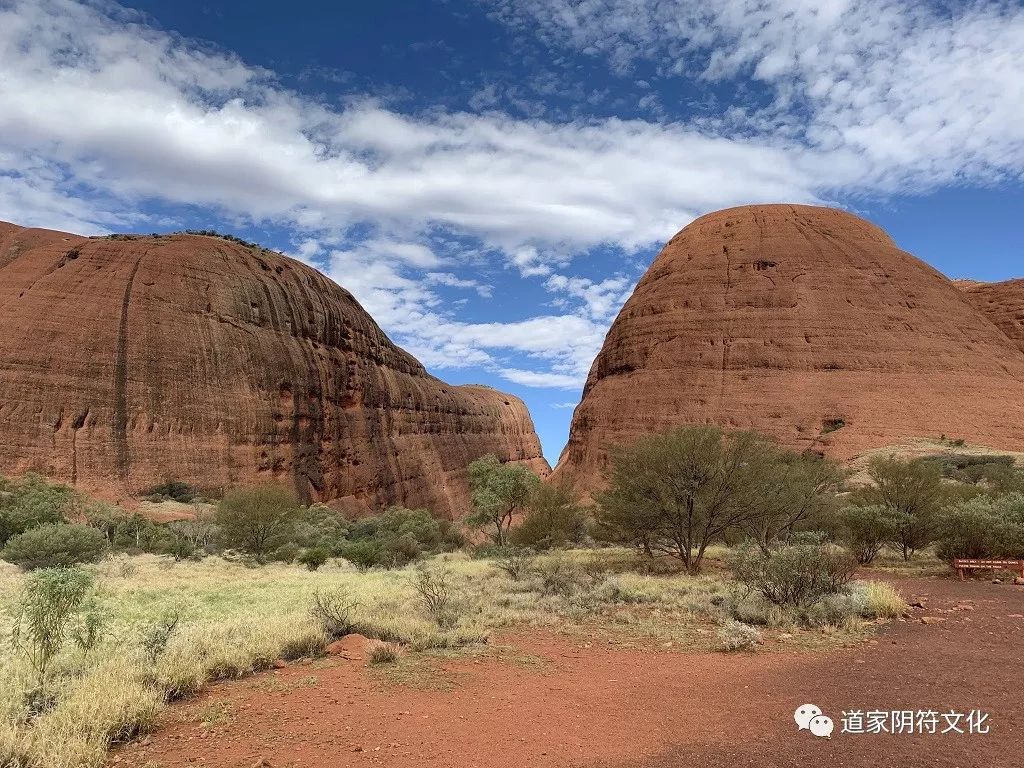
From this angle, Kata Tjuta is mainly composed of two great masses of rock. The stone bodies rise extraordinarily high, and the landform is quite astonishing. Unlike ordinary mountains, here even the ground is hard rock; reaching out to touch it casually, it was scorching hot, as expected.
Wherever in this world rocks have long been weathered, they always reveal a sense of order through the ages—as seen in the weathering marks on these rocks, where row upon row of striations neatly record the traces left when rain falls.
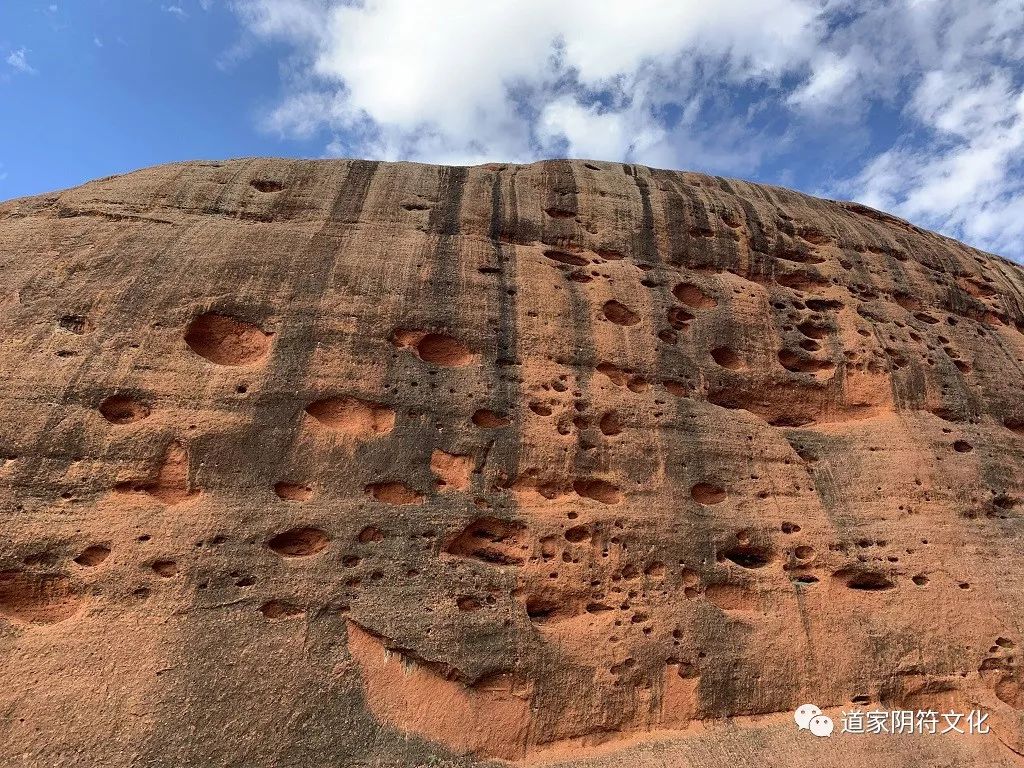
On the rock to the left, a large number of pits and hollows are clearly visible. These may result from the constant impact of small stones from outside, or perhaps from hundreds of millions of years of weathering.
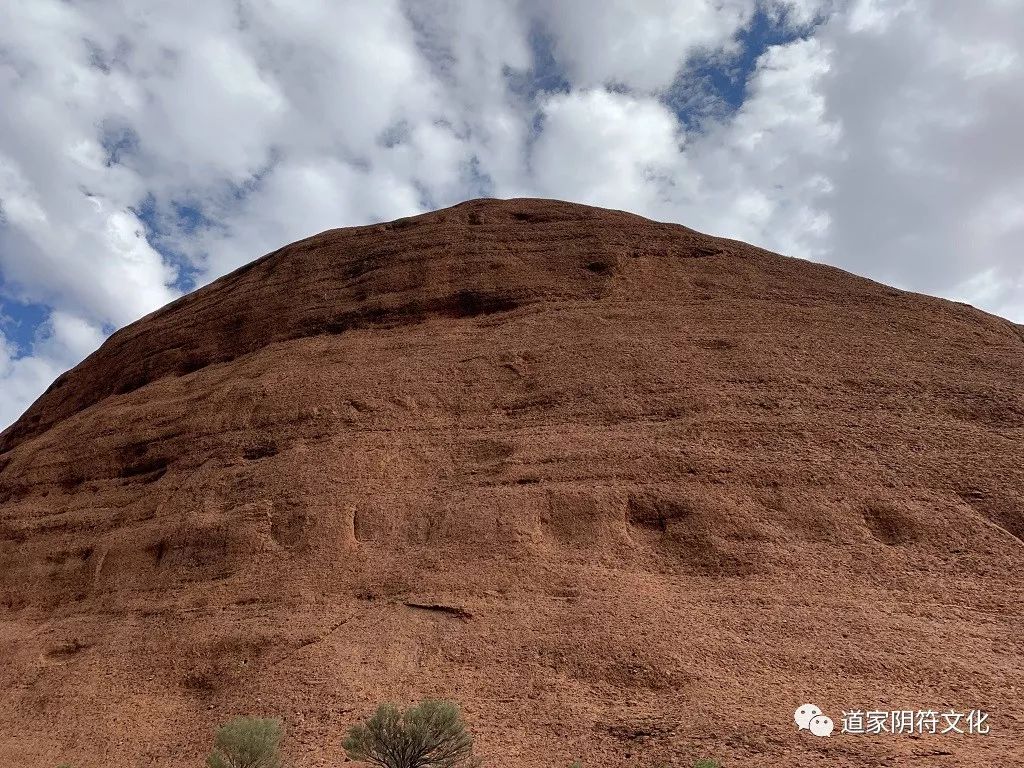
But on the rock face to the right, the surface is nearly smooth.
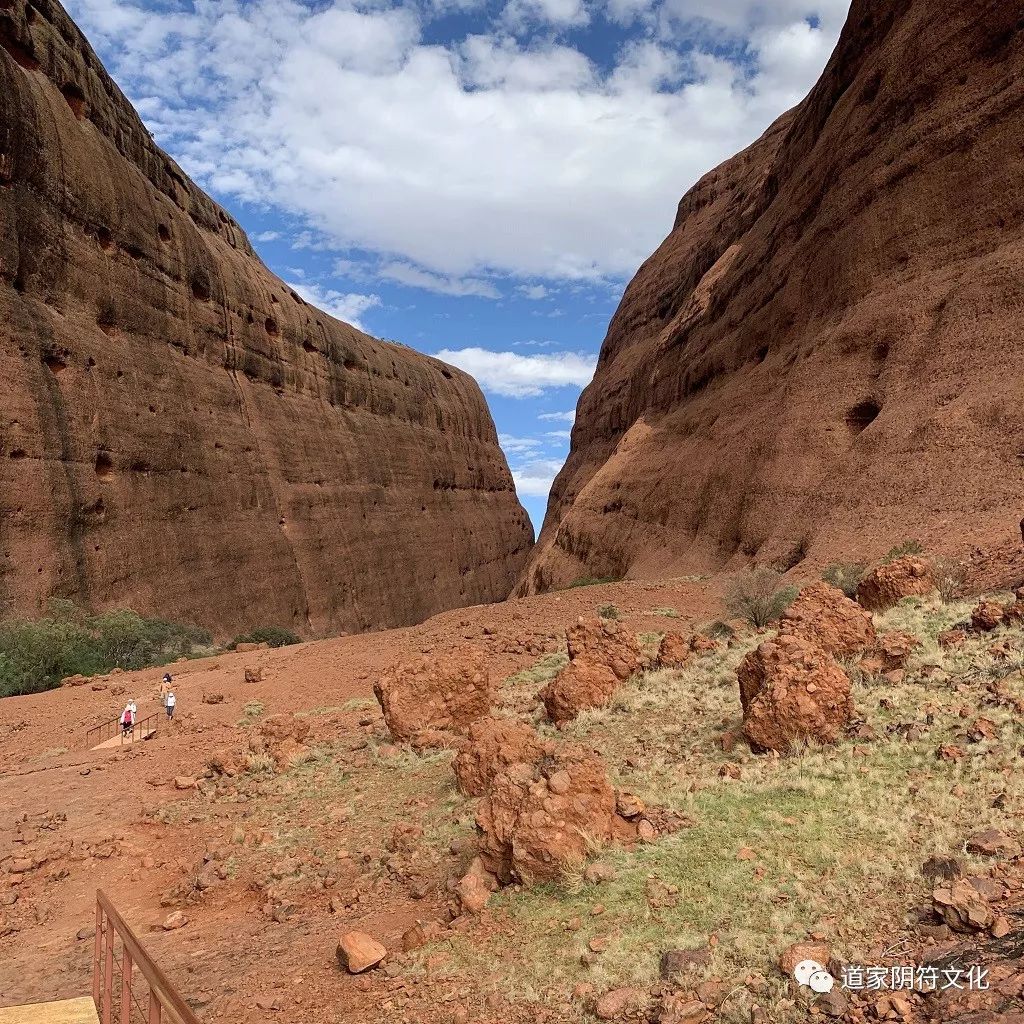
Pressing ever forward, the junction of the canyon ahead is closed off. It is said that in the distant past this place was a great river—and in truth this canyon was the riverbed.
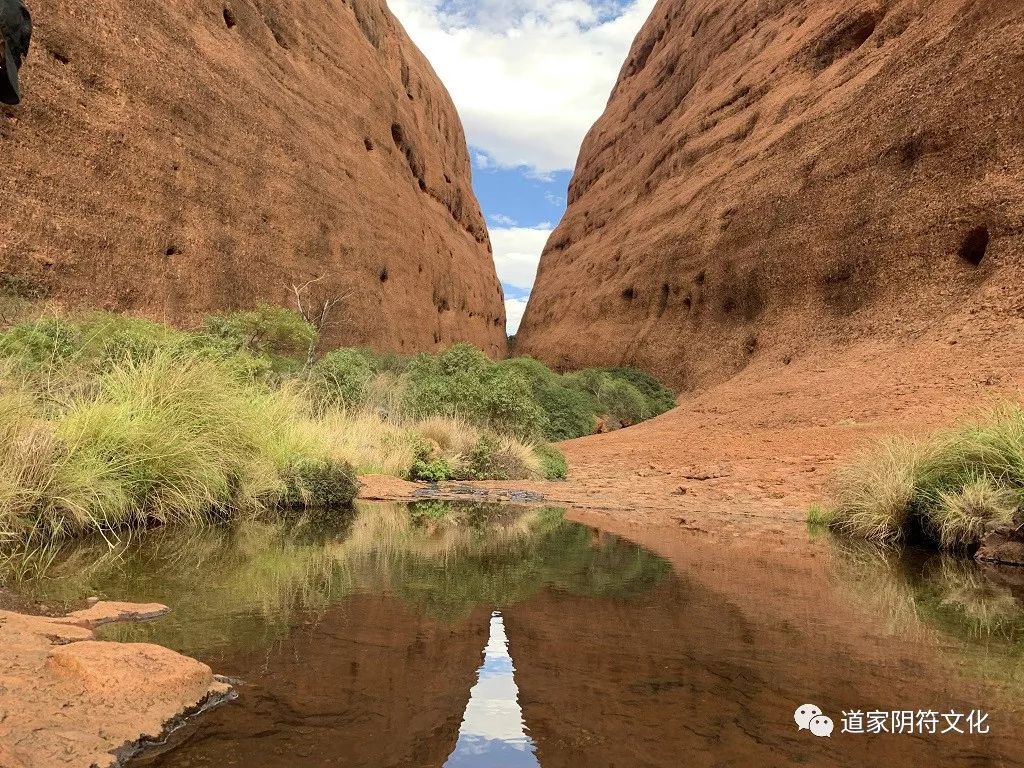
Along the way there was not even the slightest wind, so everyone felt as if sealed inside a giant furnace. Fortunately, en route we discovered a marvelous spot where natural pools of water had collected, extremely clear and reflecting the canyon; everyone stopped there to take photographs.
The path was not long, and soon we reached its end—a small platform, just where everyone could sit in meditation. Australia’s flies are truly numerous, so at midday everyone had already bought fly-net hats. We sat down here.
Once seated, there was not a breath of wind all around. Though the weather was hot, it was not quite as unbearable as imagined—indeed we did not even break into a sweat.
In the stifling heat, this humble Taoist began the experiment planned in advance for this journey. Kata Tjuta is regarded by the local Indigenous people as a place connecting dream and reality. It is quite majestic; beyond its sense of vast and ancient ages, one can almost rarely see much living thing all around, which only heightens its strangeness.
In the countries of Southeast Asia, this humble Taoist had experimented with summoning decrees to influence the weather, with mostly successful results. This was the first time in the Southern Hemisphere. Though according to this humble Taoist’s theoretical understanding, Taoist methods are not subject to any regional restriction, yet experiments had never been made.
So this humble Taoist chose to summon by decree Deng Marshal of Wind and Fire Command to call the wind. This method was transmitted by Perfected Yang Piyun in former years; its effect is the swiftest, with immediate visible results—just right for an experiment in this setting.
Summoning wind inevitably requires the Xun direction. But by measurements taken inside the canyon mouth, the Xun direction happened to be blocked by a huge rock mass. Whether this would interfere or affect things, this humble Taoist did not know.
Since neither command token nor dharma seal had been brought along, everything relied on internal cultivation skill to attempt summoning the marshal and issuing the decree—to see whether the wind could successfully be called. At first there was no response; this humble Taoist thought it seemed ineffective, so pressed several times again, still with no sign of verification. Aside from the flies buzzing chaotically before one’s eyes, not a breath of a breeze stirred; there was no choice but to give up.
By then some time had passed. Quite a few foreigners had also walked to this end of the canyon. Seeing everyone sitting in meditation and quietly in a row—some taking photographs, some standing below watching, or waiting for us to finish so they could go up to the platform to rest—
This humble Taoist’s party naturally could not impose on the place for long, so there was no choice but to call an end. Just as we finished, a light breeze began to rise; yet this slight wind could not be said to prove much.
Before we had gone many steps, the wind gradually grew stronger. Just then someone from the party behind was heard saying she was not sure if it was an illusion, but while meditating she had seen someone chanting sutras beside this humble Taoist. So I briefly asked about the scene she had seen—it was quite interesting.
Facts have proven that Taoist methods do not distinguish between nations; they are applied the same in both the Northern and Southern Hemispheres. Most importantly, the Xun direction is still southeast and remains unchanged—which agrees with the conclusion obtained from measuring feng-shui orientations.
According to the original plan, we were to go admire the stars that evening. But on the road we heard that it would depend on the night’s weather, because as conditions stood, desert thunderstorms and rain were expected that night—and so we could not go admire the stars.
At the same time, it had been arranged to go early the next morning to watch the sunrise; but the rain brought by the night’s thunderstorm made it very likely we could not even go to see the sunrise. This left everyone most regretful.
In fact it turned out that way too: thunderstorms appeared that night, and when morning came at four o’clock it was still overcast, so the sunrise plan was cancelled as well. Everyone could only choose to sleep a bit longer.
This humble Taoist was also quite puzzled. According to past experience, whenever we travelled we had the patriarchs’ protection and always enjoyed good fortune along the way—but how was it this time we ran into such problems, successively delaying two important outings?
Could the patriarchal protection we had always felt before be nothing more than coincidence imagined in our own minds?
To learn what happened next, listen to the next installment.