US Feng Shui Research: Interior Effects on Comfort in Healthcare Waiting Areas
Since 2015, after the U.S. government recognized the role of witch doctors in medical care, it began to allow faith healers formally into American hospitals; as long as they do not interfere with others, faith healing may be freely practiced.
This article, titled "Interior effects on comfort in healthcare waiting area," reports an objective experiment and evaluation by American researchers who introduced Feng Shui into medical waiting rooms. To look up the original paper, search: DOI:10.3233/WOR-162347.
The original text is in English; with the help of Google Translate, here is an introduction to the paper's content. First, its abstract reads as follows:
Background: This study compared the effects of prior experience and expectations on participants' comfort upon waking, upon arrival, and after the appointment, as well as an evaluation of properly placed Feng Shui elements in three healthcare waiting rooms.
Methods: Participants assessed comfort levels using self-report surveys. Researchers conducted interview sessions with each doctor to evaluate the design goals of each waiting area, and performed Feng Shui assessments of each waiting area with correctly placed Feng Shui elements.
Results: The waiting area designed by a Feng Shui expert was the most comfortable, followed by the doctor-designed waiting area, while the conventional waiting room design was least comfortable. The results showed effects strong enough to warrant further research.
Conclusion: Awareness of the external environment, in coordination with experience and expectations, influences people over time. Therefore, an integrated approach combining Eastern and Western concepts and ergonomic principles is encouraged, creating a sense of calm and balance that maintains equilibrium in the design of comfortable built environments. This is new research information about how the comfort experience is influenced over time, including prior experience, expectations, and the placement of elements in the external environment.
The description of Chinese Feng Shui in the paper goes as follows:
Feng Shui is an ancient Chinese system that has influenced design in many Asian countries, yet it is rarely considered in architectural design in the Western world. Linking Feng Shui with Western scientific literature and culture is difficult; it is hard to describe in scientific terms, because Feng Shui is not widely accepted as science in Western academia, so some researchers have tried to study Feng Shui scientifically. Mak used a knowledge-based expert system (KBES) approach to develop a structured framework and prototype model for Feng Shui. From the perspective that Feng Shui is a more "comprehensive" process, the linear KBES model poses a challenge; it can be compared with top-level ergonomic analysis tools used in the preliminary design process (functional requirements and allocation).
Feng Shui, developed in China more than 3,000 years ago, is a complex knowledge system that balances environmental energy, creates good health and fortune for residents, and has made a major contribution to design in the Eastern world. This ancient Chinese Feng Shui system has an increasing influence on Western architecture and design; literally it means "wind" and "water."
When introducing the Five Elements, the paper further states:
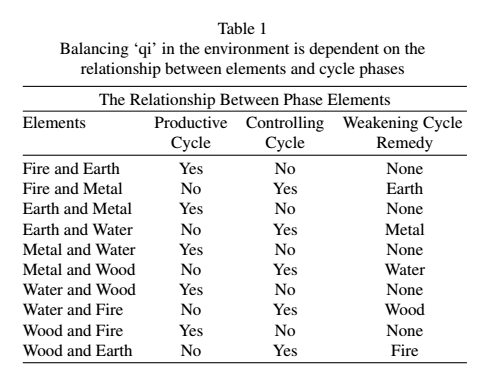
Correct use of these elements is the key to implementing proper Feng Shui. Table 1 explains the interaction of the five elements in three cycles: the "production cycle," the "control cycle," and the "reduction (weakening) cycle." It is necessary to understand the cycles of the five elements and how to balance and strengthen them.
This elaborates Westerners' understanding of the generation and control cycles of the Five Elements.
Feng Shui assessment considers the importance of timing because life is not static; change is constant and inevitable. Feng Shui studies the connections and changes among Heaven, Earth, and humanity through time cycles. Energy changes over time. Therefore, in Feng Shui practice, when evaluating or studying the energy of a space according to orientation, form, and landscape, the time scale is important. The Chinese had both lunar and solar calendars at the same time.
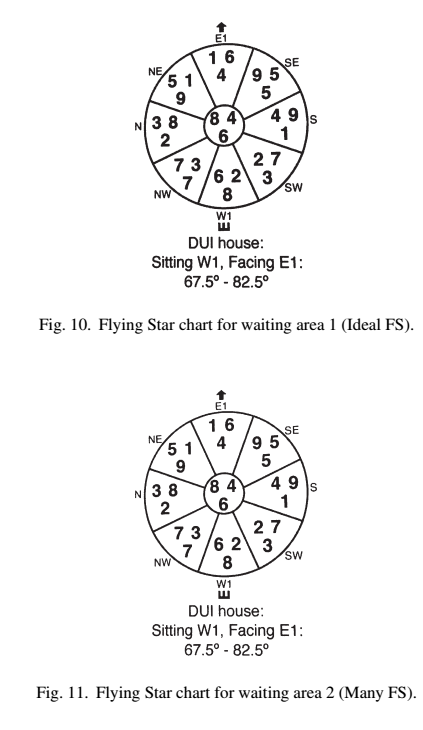
The Feng Shui method known as San Yuan (Flying Stars) uses the solar calendar (Hsia calendar) to study the time dimension. The Flying Star chart consists of numbers 1–9 filling a grid, establishing nine time periods.
Three different healthcare facility locations were selected based on the researchers' contacts; however, it was noted that all three choices had varying degrees of Feng Shui elements at the entrance and patient waiting areas. Waiting areas were named by zone, and Feng Shui (FS) elements were correctly placed within each specific waiting area. The three waiting areas were named as follows: Area 1 (ideal FS), Area 2 (many FS), and Area 3 (less FS).
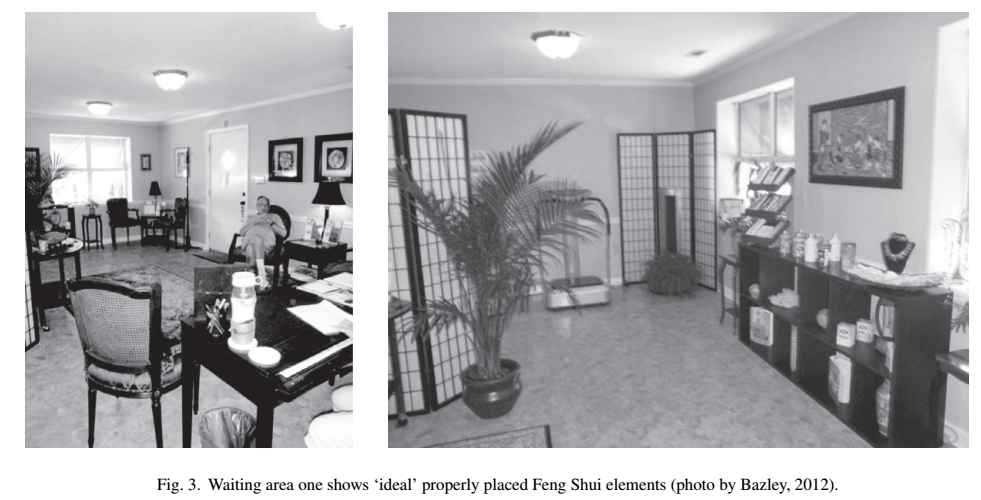
Figure 3, Area 1 (ideal FS): The entrance door is a red entrance door, opening into a space of spring green and cream colors, with a tile floor and a spacious area not broken up by walls. A decorative screen placed in the middle of the room guides visitors straight to a desk with informational literature, or to the right for merchandise and a rest area with comfortable chairs, or to the left for a rest area and refreshments (tea and water) and the reception desk. Behind the screen is exercise equipment for waiting patients to use. The air is clean, the lighting is soft but bright, though the temperature is a bit cool.
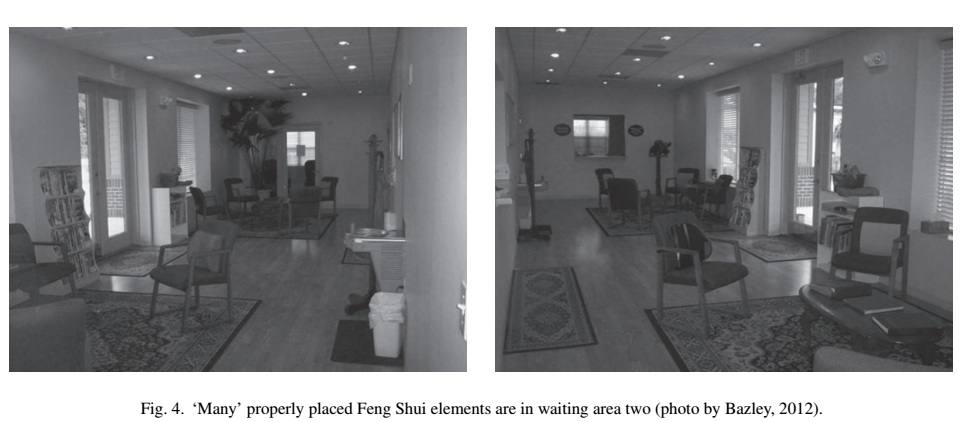
Figure 4, Area 2 (many FS): The entrance door is a French glass door, opening into a long, narrow space. On the wooden floor are blue overlapping carpets; on both sides of the door are rest areas with comfortable blue chairs and tables, and abundant literature and magazines. The reception desk is located to the left of the direct path from the door and has glass panels that reflect natural light from the windows. The air is clean and the lighting is soft. The temperature is somewhat on the cool side.
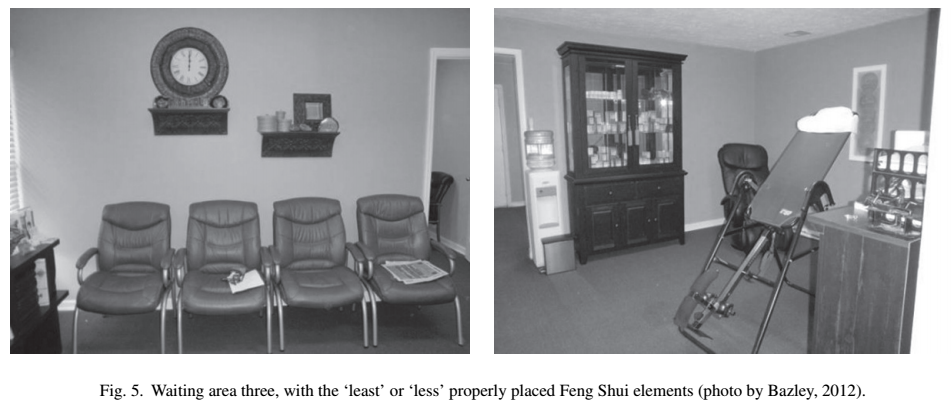
Figure 5, Area 3 (less FS): The entrance door is solid wood, a bit worn, opening directly into a room with yellow walls, a green carpet, and a large reception desk. The desk is high, and the receptionist is hidden from view. The furniture is large; the room is tight and cramped. Chairs line the walls on both sides of the door. Traffic flow or wayfinding is disorienting, and the air is stuffy. The lighting is fluorescent and somewhat harsh, though there are windows. The temperature is also cold.
In addition to the Feng Shui analysis of each location, this study also provided information on individuals' physical, intellectual, and emotional states at each location at different times (before the appointment, upon waking, and after the appointment).
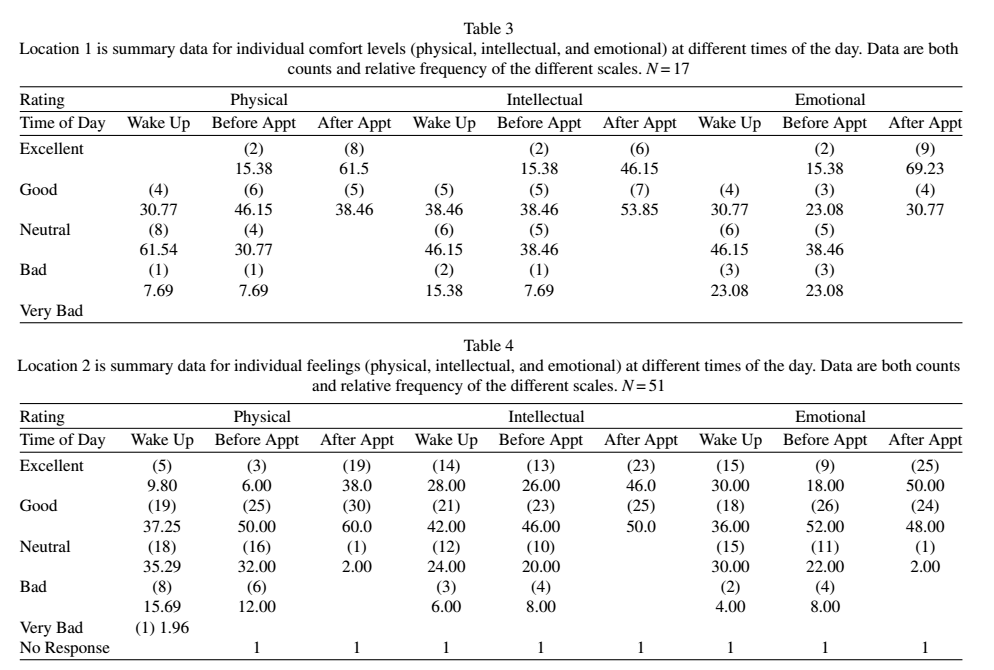
Location 1 (Table 3) showed the highest (percentage) improvement from waking to after the appointment, especially physically and emotionally. Intellectual changes were also very positive, though the pattern was not as strong in percentage terms. These descriptive results underscore the overall idea that more Feng Shui elements in an office space have a more positive effect on individuals' physical, intellectual, and emotional feelings of health and office care.
Table 4 provides the results for Location 2, which had many Feng Shui elements but not optimal ones. It appears that the health-office environment produced good improvements in physical, intellectual, and emotional health. Compared with Location 1, the reduced Feng Shui elements at Location 2 may have resulted in a smaller (percentage) increase.
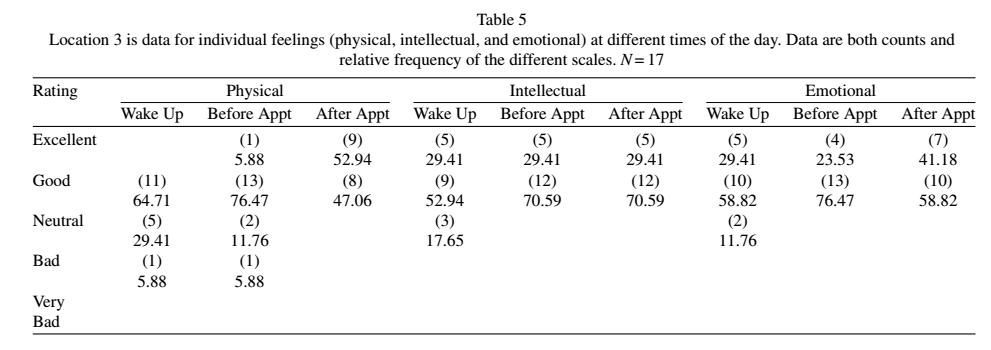
Location 3 (Table 5) shows the outcome one might expect from an office with the fewest Feng Shui elements. Although physical feelings after the appointment were stronger than before the appointment (and stronger than at Location 2), the other results (intellectual and emotional) were less positive.
The paper then summarizes:
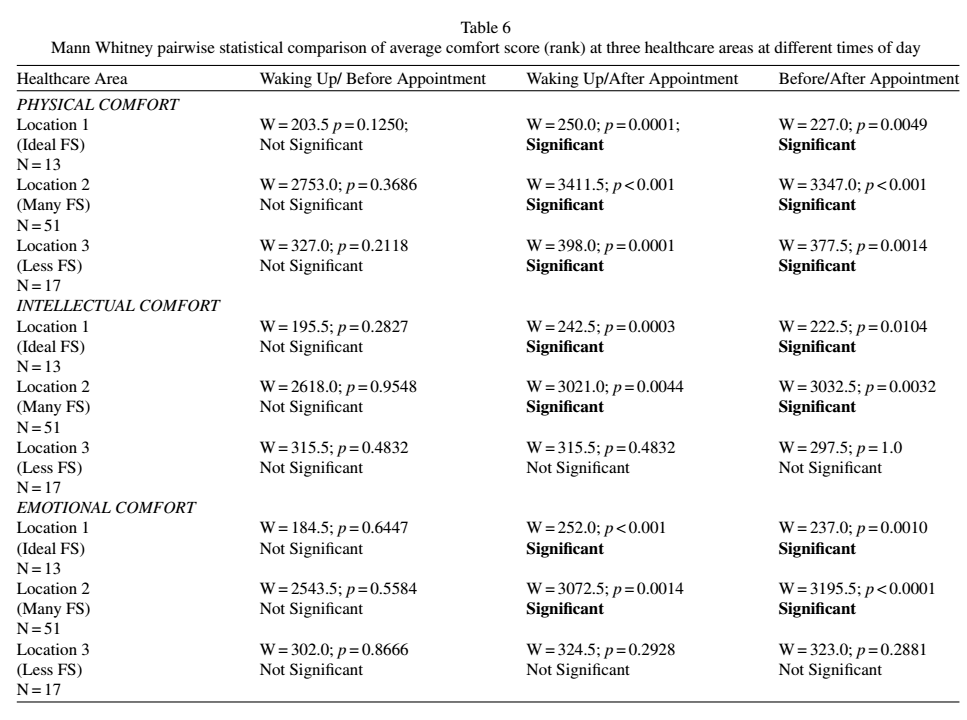
Results show that physical comfort levels were comparable between groups of participants for each phase of data collection. However, the differences in physical comfort before and after healthcare treatment were significant. A similar analysis of intellectual comfort levels showed no significant differences among the three participant groups or the three time periods. There were significant differences for emotional comfort (see Table 6). The correlation coefficients between the comfort score at the beginning of the day and the scores at the time of the appointment and after the appointment are shown in the figure. The correlations were higher between the start of the day—or upon waking and before the appointment—than between waking and after the appointment. This is especially true for physical comfort. Although a t-test showed no significant difference when comparing the comfort levels of the three waiting areas upon arrival for an appointment, it is important to show that the "ideal" waiting area had the highest comfort levels overall, and especially for emotional comfort.
The paper continues:
As mentioned before, Feng Shui embraces the concept of "flow" or "qi"—the movement of energy throughout a space over time. According to Heim [30], flow is a smooth, unimpeded movement through space-time. It is an aesthetic quality of spatial movement and occurs throughout the physical world. Of the three healthcare areas, the most comfortable was Area 1 (ideal FS). Although this study reports only a relationship, the layout, intention interviews, Feng Shui assessment, and comfort surveys indicated good "flow," comfort, and a positive, calming energy for patients, visitors, and staff. The concepts of "flow," comfort, and positive energy for patients, visitors, and staff were also reported for Waiting Room 2 (many FS). From the intention interviews and Feng Shui analysis, Area 3 (less FS) concentrated less on waiting room layout and patients' physical environmental comfort, relying instead on the quality of treatments to provide patient comfort. Physical "temperature" was the most uncomfortable factor for the Area 1 (ideal FS) and Area 2 (many FS) locations, and the second most uncomfortable factor for Area 3.
Other studies confirm that discomfort due to temperature is often the number one complaint in the workplace. The majority of scientific papers on comfort also focus on temperature [1, 31, 32]. Taking into account the responses from the comfort survey (circling a word or circling a color to describe comfort), the aforementioned waiting-area descriptions and impressions relate to the Feng Shui assessment as described in the survey results. The words participants used to describe their comfort upon arrival for the appointment were as follows: 27 circled "calm," 18 "tired," 15 "anxious," 14 "relaxed," 3 "excited," and 3 "upset." Green, blue, and yellow, in that order, were the colors circled as corresponding to the comfort level upon arrival for the appointment. This is of interest because the wall or accent colors in each of the waiting areas correspond to the color selection. Area one had a green theme, area two blue, and area three yellow. It is worth noting that the color green was chosen most often in the surveys across all three waiting areas. The word and color "relaxed" and "green" were circled most often after the appointment. Comfortable interiors have a sense of "Placeness." "Placeness" is another concept that embraces intention. The spatial features of a built environment support the formation of places and facilitate significant occupant experiences and qualities [33]. An alternative for improving the physical environment may be to design for comfort and flow first, in order to achieve flow with intention. Feng Shui establishes intention and identifies the "flow/energy" or "qi" of an environment. Another source of flow is social interaction, resulting from optimal interaction with a person or people [34]. People and their energy are constantly changing the visible and invisible flow of the physical environment [30]. The number one aspect that participants indicated made them most comfortable in all three waiting areas was "people." However, "people" was selected as the most uncomfortable factor for Area 3 (less FS).
The "people" factor may relate to the receptionist, staff, or doctor—or that patients go to a healthcare appointment because they do not feel well and anticipate feeling better after the appointment. The receptionists, staff, and doctors in offices make or break the comfortable atmosphere in the room. If patients are listened to and taken care of, the response is usually a comfortable situation. If, on the other hand, patients are ignored or given curt replies to inquiries, the response is usually an uncomfortable situation. Additionally, other patients can cause discomfort by being loud, rude, or overbearing toward the staff or other patients. Comfort in these cases goes beyond the physiological and touches the emotional aspects of comfort. These aspects, although important, are difficult to quantify [11].
The findings from this study suggest that applying some of the aforementioned principles to the design of therapeutic environments may provide a further dimension for improving the design of the built interior environment. Feng Shui is an environmental design process about which Western architects are gaining knowledge and applying to the built environment [19, 23, 28, 29, 35]. Some Feng Shui practitioners use the concept of biophilic design in their work. Biophilic design brings fourteen patterns from nature into workplaces and workspaces and purports to promote health and well-being [36–39].
In this study, after the appointment, all three comfort levels improved, with the physical level being the most significant. The physical improvement results are consistent with other medical studies showing comfort-level improvement after healthcare therapy [40–42]. For therapy treatment offices, patients generally do not feel well before treatment—that is why they are seeking treatment. Physical comfort is generally worse before treatment, and most patients feel better and more comfortable after treatments [40]. Medical studies often measure pain throughout the day and throughout the treatment series [43]. Other studies conclude that after treatment therapy, a release of physical pain causes an emotional surge [41, 42]. Participant physical comfort levels improved the most throughout the day, followed by emotional comfort. It appears that prior experiences and expectations may relate to comfort levels, since there was a significant difference between waking and arriving at the appointment, but not right before and after the appointment. Other studies [14, 44–46] found correlations between comfort before arriving at the office and being in the office. If previous experiences, such as found in studies conducted by Vink et al. [13] and Konieczny [14] explained 40% of present comfort, it is essential that prior experience be taken into account in comfort studies.
What participants saw and heard on the way to the appointment may relate to their increased emotional comfort level between waking and waiting for an appointment. The majority of participants were looking forward to their appointment, probably because they hoped to feel better after the treatment. However, the majority also heard singing and talking on the way to the appointment and saw roadway, people, and nature.
For example, if a person heard a beautiful song and/or saw a wonderful sunrise on the way to an appointment, emotional comfort may be assumed to be quite different from a case in which a person saw a car accident and/or heard a depressing news story on the radio. What participants saw or heard is possibly related to the higher emotional comfort rating between waking and before the appointment. Additionally, it may be related to what the participants did while waiting in the room before the appointment—for example, whom they spoke with, whether there was music in the room, and whether they smelled or touched something that sparked emotional comfort.
Bakker [47] concluded that people experience the environment with four physical senses, four affective senses, and four cognitive senses. An overall "feeling" or "vibration" of the interior emerges within a person, and feelings of comfort or discomfort arise. Blok et al. [48] found that if passengers lose luggage, even the best interiors do not compensate for or override the distress over the lost luggage problem. This is important because comfort may be experienced more intensively after an uncomfortable experience [12]. It is not clear whether the waiting room environment or the healthcare treatment intervention had more impact on comfort.
Some limitations of this study could have influenced the outcome: one waiting room was evaluated for each Feng Shui condition. Comfort data were self-reported, and the patient sample size was sufficient but not large. Results show a sufficiently strong effect to warrant further research. Another limitation is the use of self-reported data. On the other hand, comfort is a subjective phenomenon, which makes self-reporting the most appropriate way of studying comfort [12].
The limitation of this study is also that the same subjects report the various comfort experiences over time, which influences the correlations between the various recordings. However, other studies also report on prior-comfort influences [14, 44–46]. It is nothing new that participants' feelings are influenced by previous experiences. Park et al. [49] confirmed that after walking in the forest, participants felt more relaxed than after walking in an urban environment. The forest environment promoted lower concentrations of cortisol, lower pulse rate, lower blood pressure, greater parasympathetic nerve activity, and lower sympathetic nerve activity. Some other drawbacks of this study are possible learning effects, since the same scale was used several times in succession. Limited measures were made to ensure that participants had the same understanding of the terms emotional, physical, or intellectual comfort. There was no measure of the duration each participant spent in the waiting room and no measure of how many times the patient had been in that particular waiting room. The amount of time a patient spent in an office waiting room or the number of appointments they had in the past was not information the researcher collected. However, these are important points to take into account for future research. Human-to-human relationship influences and actions may disturb comfort-study outcomes. There is often one or several researchers conducting the comfort research, and it is possible, based on the data, that the researcher—"people"—influenced the outcome. Another limitation is that the comfort differences between areas may have arisen because of other characteristics in the interior or because of different sample characteristics. On the other hand, the interviews with the owners of the areas showed that Feng Shui was used as an inspirational source for at least two of the waiting areas. Despite these limitations, this study is a first indication that having more properly placed Feng Shui elements in the interior of healthcare waiting areas increases the comfort experience, and that prior experiences and expectations preceding the comfort recording do influence comfort upon arrival for an appointment. Further studies are recommended to assess whether other healthcare waiting-area interiors in other countries are experienced similarly.
before going to a healthcare appointment and after the appointment. The influences of prior experiences before and during the appointment were also recorded. The results indicated that emotional comfort differed between waking and arrival for an appointment. The three waiting-area layouts were different. Emotional comfort was higher when ideal Feng Shui elements were present and properly placed in the waiting-area environment. Comfort levels at the beginning of the day correlated more strongly with comfort levels after arriving at the waiting area and before the treatment than with comfort levels after the medical treatment. Comparing area settings with high and low levels of Feng Shui design elements may help elucidate the possible influence on comfort and health, and provide an additional dimension to "holistic" environmental interior design and comfort research for healthcare facilities. Although Eastern and Western disciplines do not use the same elements for design, the ultimate purpose of both is to live in harmony with nature and benefit human health. The results of this study are not to challenge conventional design principles, but rather to suggest consideration of an alternative system of analysis and design [17]. Ideally, these aspects should be tested again in a controlled case study or within a subject-design study where subjects determine whether they influence the comfort experience. Further research studies, possibly in controlled environments, are warranted to assess whether similar effects are found in other Feng Shui–influenced healthcare waiting areas and office interiors worldwide.