A Joint Analysis of the Tombs of Sun Yat-sen's Mother, Lui Lok's Ancestral Tomb, and Cen Qingqian's Tomb
In Pak Fa Lam (Baihualin), Hong Kong, there are several famous cemeteries. One of them is the tomb of Sun Yat-sen's mother, hailed as the foremost of Hong Kong's ten great tombs, an excellent feng shui site.
Mr. Sun Yat-sen needs no further introduction—his renown was illustrious—yet he lived in modest poverty; his son once held office but was also rather poor in later years; though none of his descendants achieved great things, they lived in safety and enjoyed considerable ancestral blessing.
Again, in 1913 Yuan Shikai seized the fruits of the revolution, the Second Revolution broke out, and anti-Yuan campaigns across the land failed. Sun Yat-sen fled to Japan. His brother Sun Mei—Sun Mei's daughter died in June 1913, and Sun Mei himself passed away from illness in February 1916.
Looking more closely at history: it was not until 1919, during the Constitutional Protection Movement, that Sun Yat-sen was elected Grand Marshal of the Army and Navy of the Republic of China; and on 7 April 1921 the extraordinary session of the National Assembly elected him President of the Republic of China. In 1922 the second Constitutional Protection Movement failed, and Sun Yat-sen died in 1924.
The burial at this site took place in 1910. Although the Xinhai Revolution of the following year, 1911, was of great historical significance, it was also the outcome of long gestation and preparation beforehand. To claim that a grave, interred for barely a short while, could summon forth a great man—when in all of history, past and present, has this ever been so? Such talk is nothing more than the clever opportunism of charlatans.
Beyond liqi (the principles of qi), luantou (landform) is essential; neither may be neglected. When discussing luantou: unless the dragon vein originates from Lianzhen, takes leave of the lower palace, opens its tents section by section, passes through gorges and over fields, rises and falls with breaks and leaps, and sheds sha while gathering life-force, one cannot speak of having momentum; without momentum, one cannot speak of greatness. Moreover, even with such momentum, most cases can only produce ministers and generals. How could a figure like Sun Yat-sen arise merely from this one site?
Baihualin lies almost at the very end of the dragon; ahead, the sea accompanies it. Though the azure dragon and white tiger flank it on both sides so that it is not left open and uncontained, the dragon spirit's qi is nearly exhausted—only residual qi spreads out. Wealth may well be present, rank need not be lacking, but neither is abundant. To obtain a great instrument of the nation from here is virtually impossible. Furthermore, the yang ground opens and spreads, a place of vigorous qi, so it could count as an auspicious site for a dwelling.
Even most of Hong Kong's modern notables largely came from Guangdong, Chaozhou, Shanghai, or Fujian; the places that brought them success were not in Hong Kong for their ancestral grounds.
One cannot pass judgment on all matters from a single tomb; yet since we are discussing feng shui, speaking solely from this tomb one-sidedly: though the hall layout may appear quite grand, its position is unpropitious, bringing more calamity than fortune to later generations—it cannot be counted a truly good site.
If I may venture a narrow view, it was rather Sun Yat-sen who was held back by this tomb.
Its dragon runs in and receives itself in winding turns; a horizontal dragon gives birth to stars, as the dragon turns its head. It can indeed form a site. The parent-mountain is a fire star that gives birth to a metal star. Common manuals often say that a fire-star site can never form an acupoint; yet the saying goes, “When the metal star comes winding, the fire star is also a true dragon.” It is often claimed that luantou has no falsehood and liqi has no truth—this is a great error; popular luantou manuals are likewise full of mistakes.
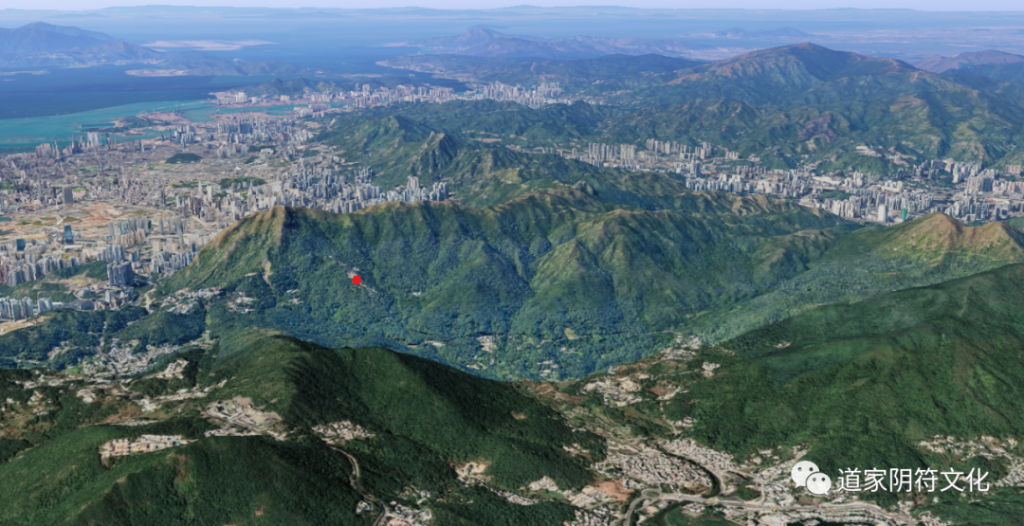
The water outlet opens to the sea; a luoxing (sea-star) guards and locks the water mouth, which can count as a completed formation, and with its embracing momentum the whole is not bad.
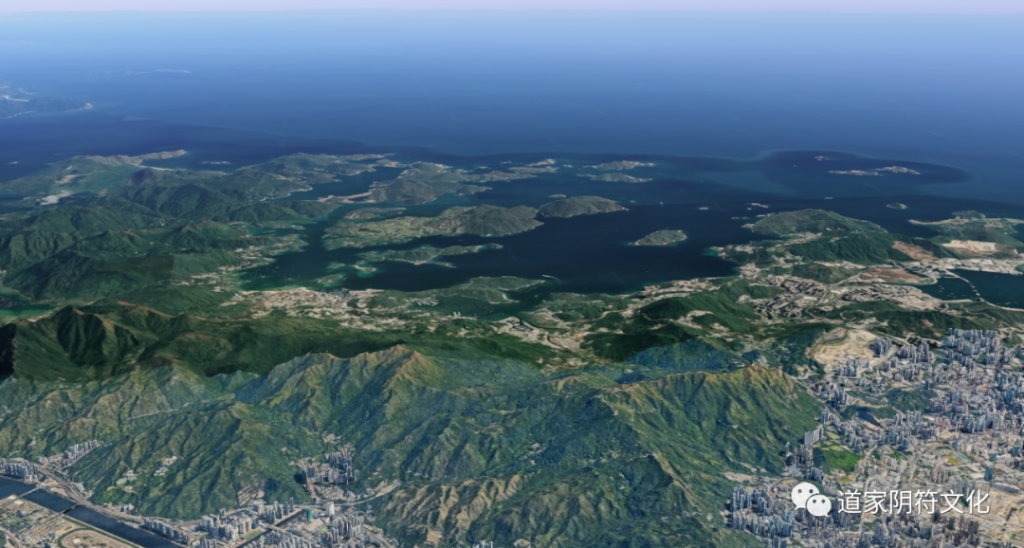
Yet on close inspection of where the hanging vein carries qi, at the spot chosen for Lady Sun's tomb—acupoints are said to form through three divisions and three confluences—but wherever there is division there must be confluence; look nearby and everywhere there is division without confluence, still less any figure-eight intersection. The qi disperses and does not gather—a sign of defeat.
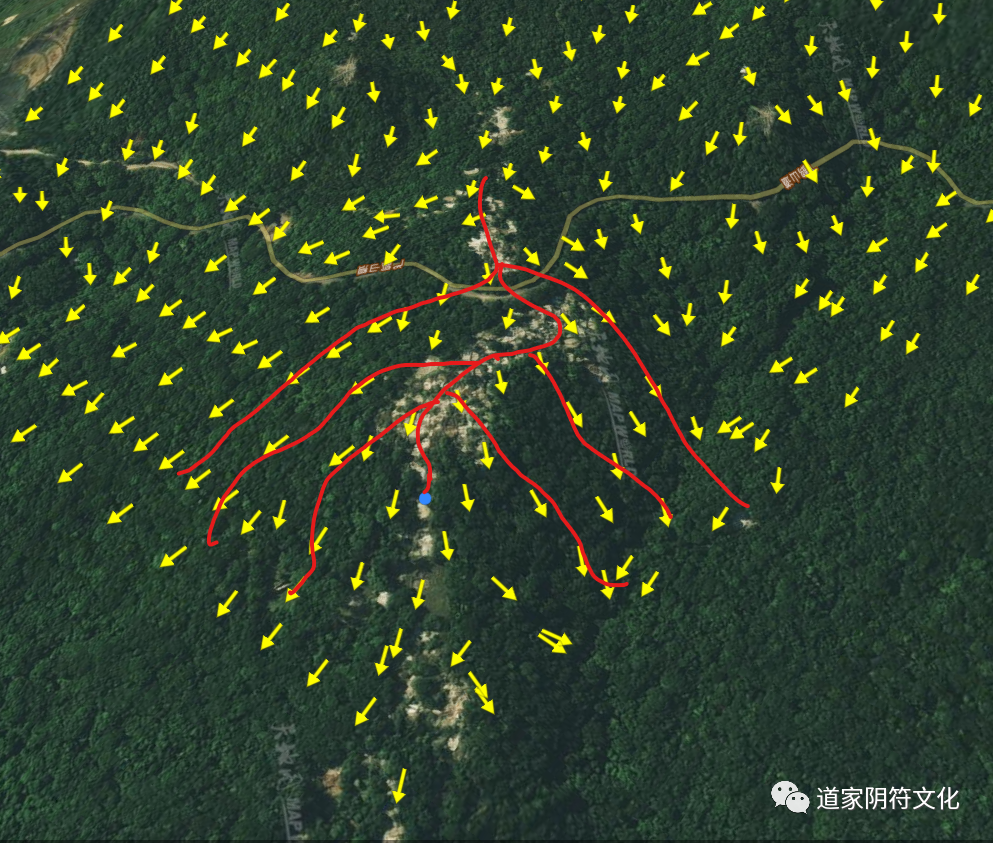
This is formed from a horizontal mountain; the star is broad and must have layers of protective belts. Where the vein forms a metal and is not filed down, the vein qi is still moving, and one must wait for the lip to appear before it stops. Here a single vein rushes straight down, so it is essential to trim and amend: block the vein and pile up the lip. The slope also piles up very steeply, so one cannot bury directly on the vein; one must offset to a place where qi is slow. Moreover, by the rules of acupoint method, when spotting a metal one must take the center. Lady Sun's tomb, first, does not conform to form-school methods, and second, does not conform to method-school rules.
With this form, the azure-dragon side is urgent and precipitous, pouring steeply downward, harming males—hence the response of his brother dying a few years later. And as the azure dragon governs wealth, here it further means squandering fortune and losing property; after the Xinhai Revolution, when the fruits of the revolution were seized, this likewise corresponded.
Looking further into liqi: Lady Sun's tomb sits on the second line of Wei Ji (Before Completion), releases water at Feng (Abundance). By vulgar doctrine Feng is timely, but this is because the true method is not grasped—in fact Feng is sha and water must not be released there.
Ahead, water exits at Ji Ji (After Completion), which would fit; but sitting on the second line, moreover Fire over Water—Wei Ji's second line transforms to the Hai direction as Fire over Earth, Jin (Progress); again by vulgar doctrine the hexagram timing fits, yet this is in truth a place of retreating qi.
Judging from the sitting and the water release, both inauspicious, calamity was near at hand. Hence the verification: after the burial, first a niece died, then a brother; also the verification of dissipated wealth. Without this tomb, though setbacks would still have been unavoidable, things would not have gone so far.
What Sun Yat-sen achieved lay in his indomitable perseverance and never giving up; he became a pioneer of the Chinese nation's revival. If feng shui had any influence, it was rather from his family's ancestral line.
Sun Yat-sen's father was named Sun Dacheng. His tomb was built in the fourteenth year of Guangxu (1888) and restored in 1926; the stele records the original orientation as Geng facing Jia,兼 with You-Mao.
The Sun family ancestors were quite devoted to feng shui. Going further back, one can even trace it to Lai Buyi; legend says Lai Buyi once passed by Cuiheng Village and left behind a feng shui riddle, and so the Suns came to believe in it deeply.
In the autumn of Jiaqing twenty-second year (1817), Sun Yat-sen's grandfather Sun Jingxian buried Sun Henghui at Huangcaogang. The stele that year was inscribed: “Erected on an auspicious day in mid-autumn of the Dingchou year of Jiaqing. Tomb of the显 fourteen-fifteenth generation ancestor-tutor Dianhou Henghui. Chosen and relocated by the earth-master Zhong Shengyang of Longchuan County, Huizhou. By Sun Guande, Guanlin.”
As for Sun Dacheng, he too was quite devoted to feng shui. Evidence: Sun Yat-sen's elder sister Sun Miaoxian once said: “All the ancestral burial grounds were found by our father. The earth-master said that ten years after the burials, a great man would surely arise—and twelve years later Mr. Sun Yat-sen was born.”
According to records, in 1932 when Tang Shaoyi served as magistrate of Zhongshan County, some of the Sun family's ancestral graves had to be relocated for the construction of Sun Yat-sen Memorial Middle School. Sun Yat-sen's son Sun Ke invited a feng shui master surnamed Yang to survey the various Sun ancestral graves. The survey concluded that the graves under the bamboo-high dragon below the summit of Litoujian Mountain had excellent feng shui and should not be moved—especially Grandfather Jingxian's grave at Huangdi Tian and Grandmother Lady Huang's grave at Huangcaogang, which had the best feng shui of all.
Mutually corroborated across sources, the father's ancestral grounds are all the more reliable; coming as they do from his own elder sister's account, they are naturally more credible. Moreover, the method of using multiple graves to summon power—gathering the small to make the great—was not something vulgar masters of that era understood.
Lady Sun, Sun Yat-sen's mother, died in Kowloon, Hong Kong, on 19 July 1910. Sun Yat-sen was then shuttling between Singapore and Penang, Malaya; funeral arrangements were handled by Tongmenghui members including Luo Yannian. Judging from the situation, this site in Hong Kong is certainly not a site that brings success. Though hailed as the foremost of the ten great tombs, that reputation is somewhat inflated—but there are still things worth pondering.
Beside Lady Sun's tomb on Baihua Hill lies the tomb of the mother of Lui Lok—Hong Kong's famous “Inspector of Five Hundred Million”—from those years.
Lui Lok is an extremely notorious negative icon; he has been referenced in a great many Hong Kong films. To list them:
To Be Numbered (跛豪) — Zeng Jiang
Four Great Families: The Dragon and Tiger Brothers (四大家族之龙虎兄弟) — Zeng Jiang
Hong Kong Tragedy: The Black Money Era (香港奇案之黑钱年代) — Deng Haoguang
Lee Rock (五亿探长雷洛传) — Andy Lau
Lee Rock II: Father and Son (五亿探长雷洛传II之父子情仇)
The Lan Jiang Story: Anti-Flying Squad (蓝江传之反飞组风云)
Twelve Youngsters of Temple Street (庙街十二少)
The Four Great Inspectors (四大探长) — Simon Yam
Looking Back in Anger / The Greed of Man (大时代) — Zeng Jiang
A True Gangster: Three Banners (一代枭雄之三支旗) — Wang Xiao
Fellow Dudes (新难兄难弟) — Jin Yanghua
King of Detectives (难兄难弟之神探李奇) — Law Ying-kwan
O记三合会档案 (A True Mob Story / Tsui Sing Triad Archives) — Francis Ng
Rulers of the Underworld (纵横天下) — Lee Tze-hung
Gold Empire (金钱帝国) — Tony Leung Ka-fai
南国有佳人 (A Beauty in the South) — Yang Sheng
Chasing the Dragon (追龙) — Andy Lau
Chasing the Dragon II: Inspector of One Billion (追龙之十亿探长) — Wong Hei-sun
Gold Empire: Chasing the Tiger, Catching the Dragon (金钱帝国:追虎擒龙) — Francis Ng
What made him famous, according to hearsay, was embezzling nearly five hundred million—though this too is only popular rumor; the actual figure is unclear. In any case, Lui Lok was extremely shrewd. In his early years he colluded with the underworld; after earning enough money, he emigrated to Canada in 1967. Only when Hong Kong's Independent Commission Against Corruption was established in 1974 was he wanted; he then relocated to Taiwan to evade extradition, purchased a mansion there, and died in Canada at the age of 89. He left a large posterity—seven sons and one daughter.
Popular in Hong Kong is the Three-Yuan school of feng shui, arranging the sixty-four hexagrams as Xuankong great hexagrams, discussing hexagram timing and hexagram qi—“Misalign the gold division by a single thread, and wealth and rank will never meet.” Yet while many study it, few obtain the true transmission.
Lui Lok's tomb sits on the center line of Wei Ji and Kun (Oppression). There are those who say that whenever a line rides a hexagram it must be judged inauspicious—but this comes from incomplete learning. Under heaven there is emptiness everywhere; when has it always been all inauspicious? The marvelous secret of emptiness is worth a thousand gold; the fire-pit and the jewel-treasure are not freely spoken of.
Yet though by feng shui Lui Lok's mother's tomb seems quite fitting, judging solely by his mother's tomb is inherently unreliable. Over the long run, feng shui rests chiefly on the patrilineal graves. To ignore the state of his father's tomb entirely and judge all from the mother's tomb alone is to generalize from a partial case.
Further down from Lady Sun's tomb is a grave that tends to escape notice. From the stele, it holds a man named Cen Qingqian; after his wife, Ms. Li Baolin, passed away, she was buried with him.
By the twenty-four mountains, all three tombs sit on the Shen mountain facing Yin, with water also exiting at Yin; the incoming dragon is of course the same. Truly, as the saying goes, “Same mountain, same facing, same flowing water—yet fortune and misfortune judged differently.”
Some feng shui masters say that here the true acupoint was buried, that this is where feng shui is supremely good—but in their descriptions they only mention that this Cen was a relative of the Cen newspaper-magnate family or something of the sort. Such talk is utterly meaningless.
Therefore, in the appendix below I have done a deeper investigation. This turns out to be a remarkably positive legendary figure; a detailed investigation follows at the end.
The three tombs share the same overall sitting and facing. Feng shui has the saying: “When I bury, a prince-marquis is produced; when he buries, a bandit chief is produced.” At this place, the saying finds considerable verification.
Incidentally, beside Lui Lok's tomb there is also the ancestral grave of Yan Tong from the same era, for which no data yet exists. His contemporary Yan Xiong transferred to Police Inspector in 1972, later became a wanted criminal in 1977, and finally fled to Thailand. Not as famous as Lui Lok, his experience was similar.
Broadly speaking, however, the landscape configuration here is quite peculiar. The water mouths at this place are all formations that prosper through ill-gotten wealth.
Like Sun Yat-sen's revolution in those years: revolution required funds. Beyond soliciting donations from patriots, more was raised from wealthy merchants and gentry, usually by promising official posts in advance—something that, at the time, was naturally not entirely proper.
The Guangzhou Uprising and the Wuhan Uprising both followed this model. So too did the various amusing anecdotes of Sun Yat-sen raising funds—these fit as well. Though a thousand gold came and then was all scattered away, even so he remained a great man of his age.
Lui Lok's ancestral tomb was indeed buried in the true place; yet though a thousand gold was acquired, what was gathered was ill-gotten wealth. Though later generations want for no sons—and one might say both wealth and descendants were complete—what remained was a bad name.
The Cen descendants' fortunes were relatively moderate. What was taken was the place where the vein dissolves and spreads into level ground. Some feng shui masters say that a high-ridge dragon must open, disperse, and level out for the position to be correct—there is some reason to this. But what is gained by burying here is merely residual qi; it cannot bring rank, yet plenty of wealth remains.
Appendix:
The most complicated case here is Cen Qingqian's tomb. Investigation as follows: Cen Qingqian was originally from Xinhui, Guangdong, and was a traditional Chinese medicine doctor. The name is not especially famous—but his other name, Cen Richu, is another matter entirely.
The famous Hong Kong heritage monument King Yin Lei (originally named Xi Lu), located at 45 Stubbs Road, Hong Kong, was built by him and his wife, Ms. Li Baolin.
There is also a very interesting story here. In 1907 Cen Richu married Florence Keen. Later, in 1909, Cen divorced, and before 1911 married Ada Elizabeth Mahlook, a mixed-race woman of Chinese and Irish descent. They later had six sons and two daughters, one of whom was named Cen Zhuoguang.
According to research by someone online called June Fung, Cen Zhuoguang turns out to be the illustrious Roy Goon.
In his early years Roy Goon joined the Kuomintang, fought side by side with Garnet Malley, and together with the Flying Tigers shot down three aircraft. He later returned to Australia to devote himself to the anti-fascist war, having trained more than eight hundred pilots—the legendary story of that Chinese-born-in-Australia man who served in World War II.
Roy Goon was an outstanding stunt pilot and received lifetime membership in the Australian Stunt Flying Club. One of his students was Royal Air Force fighter ace Keith Truscott, Australia's second-highest-scoring ace of World War II, with 20 confirmed and 5 unconfirmed victories.
Another son, Cen Zhuoqin, was born in Hong Kong in 1929. He graduated from the University of Hong Kong in 1954, practiced as a barrister and judge for many years, once served as secretary of the Reform Club, and in 1961 married Lu Lizhi (Rosanna Loke), daughter of Lu Rongzhang. However, it can be found online that in 2002 he and his son Michael Shum (Cen Rongxi) were both pursued for debts by Lu Rongzhang.
Here a note on relationships: Lu Rongzhang was the grandson of Lu Yun (Loke Yew), the “King of Silver Mines,” a Nanyang tycoon who rose from nothing in the early twentieth century. Lu Yun died in 1917 with an estate estimated at ten million pounds. Because he frequently donated to the University of Hong Kong, the university's main building was named Loke Yew Hall in commemoration of his contributions.
Lu Rongzhang studied at Lingnan University in the early 1930s, later settled in Hong Kong, and ran business independently there. He erected a twelve-story building on Queen's Road Central named Loke Yew Building. A well-known Hong Kong industrialist and philanthropist, he served as president of the Hong Kong Heshan Fraternity Association from 1971, donated over forty million Hong Kong dollars cumulatively to his hometown, and built more than thirty projects including hospitals and primary and secondary schools.
Lu Rongzhang's father was Lu Yuntao—but according to Lu Rongzhang's divorce legal documents of the time, Lu Yuntao was Lu Yun's adopted son, with no blood relation.
In 1964 Lu Yuntao met Hong Kong businessman Yau Tak-kan and planned to collaborate on film development. In June, with Yau's wife Qiu Jinqiu and others, he visited Taiwan to attend the 11th Asian Film Festival in Taipei. After the festival closed, they were received by President Chiang Kai-shek and his wife Soong Mei-ling. After the meetings, some delegates boarded CATC Flight 106, an island-hopping service from Taipei to Taichung, originally intended to visit the National Palace Museum treasures at Wufeng, Taichung County; the plane crashed en route, killing them all.
Later reports indicated that the flight was hijacked en route from Taipei to Taichung and crashed and exploded in a paddy field in Sancun Village, Shengang Township, Taichung County. All 57 passengers—including 20 foreign passengers and the crew—perished. The Taiwanese government concealed the truth of the hijacking, and it was not reported until many years later. The deaths of Lu Yuntao and his wife sent shockwaves through Taiwan, Hong Kong, Singapore, and elsewhere; the Golden Horse Awards were suspended that year as a result. After Lu Yuntao's death, Motion Picture and General Investment (MP&GI) was inherited by his brother-in-law Kwok Kwok-leung. In 1965 Kwok reorganized MP&GI as “Cathay Organisation (Hong Kong) Limited.” Cathay Organisation (Hong Kong) Limited formally closed its production department, handing the Yonghua Studio over to Golden Harvest.
According to unofficial reports, from then on the Lu family kept a very low profile; all of Lu Rongzhang's children were overseas. In 2011 Lu Rongzhang died at the age of one hundred and four.
Li Kitong (Li Jitang, 1874–1943), a Hong Kong tycoon worth tens of millions. Though born into wealth, he had none of the habits of a dandyish heir—his nature was chivalrous and righteous. In 1895 he met Sun Yat-sen. In 1900 Li joined the Xingzhong Hui and threw himself into the revolution, supporting Chen Shaobai in founding the China Daily, subsidizing it with several hundred silver dollars a month. That summer Sun Yat-sen came to Hong Kong from Japan to plan the Huizhou Uprising, appointing Li financial director to safeguard the accounts and funds. Li immediately donated 30,000 yuan for uprising expenses. When the uprising failed, sixteen or seventeen thousand yuan in dispersal and relief costs were also borne by Li. In 1902 he single-handedly shouldered 500,000 yuan in expenses for an uprising. In 1905 he joined the Chinese Tongmenghui, continuing to give money and effort for the revolution—donating 20,000 yuan to support the Cai Nan Opera Society for expenses and staging revolutionary plays. To promote education, he spent 100,000 yuan founding the Li Sheng Science School. In 1907, after the Huanggang Uprising in Chaozhou failed, revolutionary Yu Jicheng fled to Hong Kong and was arrested; Li hired lawyers to secure his release, covering costs of over 20,000 yuan. After the Qinvihu Uprising in Huizhou failed, revolutionaries who fled to Hong Kong hid at the Qingshan farm, all settled or supported by Li. During this period he was also responsible for liaison and lodging points for revolutionary comrades. In 1908 he went bankrupt from debt, yet his revolutionary will was not extinguished. Afterwards he spared no effort purchasing and smuggling weapons for the revolutionaries in the Gengxu New Army Uprising and the Yellow Flower Mound Uprising. After the Wuchang Uprising he also labored to engineer the defection of Guangdong Admiral Li Zhun. After the Republic of China was founded he successively served as director of the Transportation Bureau of the Guangdong Military Government, director of the Guangdong Local Transportation Administration, and in 1921 as director of general affairs of the Grand Headquarters. In 1923, when Sun Yat-sen reorganized the Marshal's Government in Guangzhou, Li was appointed preparatory committee member of the Ordnance Bureau of the Grand Headquarters. In May 1941 he went to Chongqing to serve on the Overseas Chinese Affairs Commission of the National Government. He died of illness in 1943.—quoted from Baidu Baike
In 1920 Cen Richu faced assassination danger in Australia, so he returned to Hong Kong and married Li Baolin (born 1899, thirty years his junior).
Some sources indicate that Cen Richu was extremely charitable, of high skill in Chinese medicine, and grew wealthy by selling herbal tea in Australia. One account holds that Australia then suffered a plague of influenza, which allowed his business to scale up considerably.
Another account points out that he invested in real estate in Australia, established branch firms in Sydney, San Francisco, the Nanyang, and Hong Kong, and invested in and operated real estate, hence his considerable fortune.
In Hong Kong, the usual story is that Ms. Li Baolin was a daughter of the family of Li Sheng (Loke Yew), the Hong Kong tycoon—of Li Baochun, some say; others say she was his younger sister. Investigation shows this is actually problematic.
According to research by some obituary scholars, Li Sheng's daughters belonged to a generation with the character “E” (娥) in their names. Some therefore infer that Li Sheng simply had no such daughter, but rather a son named Li Baolun—and this Li Baolun, through similar pronunciation, got confused in the telling. And in fact Li Baolun is Li Jitang.
Moreover, according to some accounts on Facebook, Ms. Li Baolin's nieces and nephews once clarified this matter in newspaper interviews; but because it had already spread across the internet, it could not be corrected. And someone writing as “Wei Cheng Chu Ji” (维城触迹) says they met descendants of Ms. Li Baolin's maiden family, who said she was actually a descendant of Li Yutian—and Li Yutian had grown wealthy running gambling in Macau.
All in all, when Cen Richu and Li Baolin funded the construction of King Yin Lei, it appears to have been entirely by their own means.
It should also be noted that Cen Richu died in 1963. Baidu Baike says he died in 1959—this is clearly wrong. Confirmation from his obituary in the 1963/02/01 issue of the Overseas Chinese newspaper establishes that it was definitively 1963.
By 1971 Ms. Li Baolin had sold Xi Lu to Mr. Qiu Ziwen and his son Mr. Qiu Mucheng, renaming it King Yin Lei. By other accounts, they later moved into Wei Li Court. And the Cen Commercial Building at 268 Des Voeux Road Central, Sheung Wan, also belonged to them. In 2010 their son Cen Zhuoqin sold a unit in Wei Li Court—bought in 1980 for 1.7 million—from Hop Development (directed by his wife's fourth sister Lu Liquan), for over a hundred million, setting a record price per square foot for Mid-Levels East property. Hong Kong was then in the heat of a property-speculation boom; this move was probably aimed both at settling the Lu family's debts of more than forty million and at riding the property wave. In early 2010 Cen Zhuoqin applied through an agent to the Guangzhou municipal government to reclaim properties his father had owned in Guangzhou before liberation (he had also invested in the Aiqun Hotel and the Nanguan Cinema in Guangzhou back then); the application was rejected.
All in all, what established the Cen family fortune was Cen Qingqian himself. Since he was originally from Xinhui, Guangdong, by feng shui reckoning it was the Cen ancestral graves that brought the family prosperity—his children included. As for this burial ground in Hong Kong, it shows signs of retreat.