Several Key Points of the San He School of Feng Shui
Regarding the use of the Heaven and Earth plates, the San He school has long had many disputes. For example, some say the facing direction must be set with the Earth plate, others say with the Heaven plate — this stems from not having properly clarified the concept of the plates. The Heaven and Earth plates are actually two different coordinate systems.
San He feng shui takes four major mnemonics as its guiding principles, namely:
Xin and Ren meet and gather at Chen; Yi and Bing cross and hasten to Xu.
Dou and Niu receive the qi of Ding and Geng; the Golden Goat gathers the numinous of Gui and Jia.
Take "Yi and Bing cross and hasten to Xu":
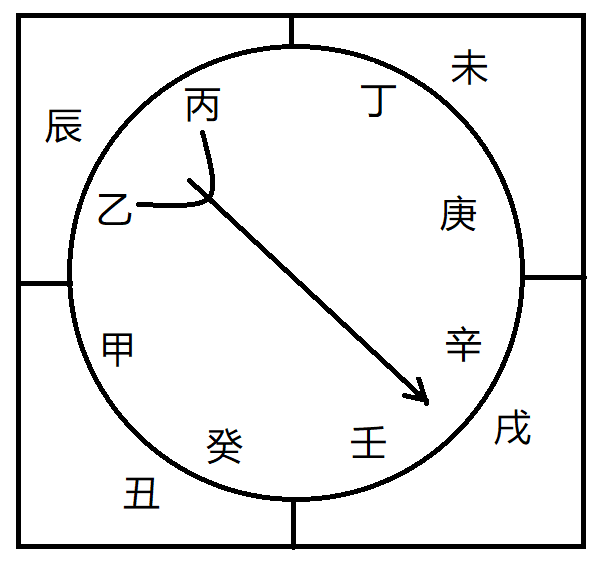
From Dou/Niu and the Golden Goat, this is clearly a concept of the Twenty-Eight Mansions. Many people therefore associate the Heaven plate with this — but that is not actually the case. As shown in the diagram, if one follows the traditional Twenty-Four Mountains, for example the midpoint of Zi is where Ren and Gui meet; such a description is extremely awkward.
So when describing the region governed by Xin and Ren, corresponding to the Earth plate from mid-You to mid-Zi, having to describe it that way every time is really troublesome.
Therefore one can rotate the original Earth plate by 7.5 degrees, so that Zi to Mao, Yi to Wu, Wei to You, and Xin to Hai are much easier to describe — this is also why the San He school uses the Heaven plate. Setting the facing on the Heaven plate is therefore extremely convenient, and this is the reason the data seen on many ancient tomb steles also use Heaven-plate facing.
The Huangquan (Yellow Springs) mnemonic says:
With Yi and Bing, beware of Chen water arriving first; with Ding and Geng, Wei marks the Yellow Springs; the Gui and Jia facing fears seeing Chou; the Xin and Ren water course dreads a Xu source.
There is much dispute over what constitutes Huangquan water. It is usually explained as the relation between the facing and the water mouth, but whether Huangquan is violated by both arriving and departing water, or only by arriving water, or only by departing water, has always been disputed.
This is because another mnemonic has influenced the discussion: Xin entering the Qian palace fills ten thousand estates; Gui returning to the Gen position produces literature; Yi facing with flow to Xun brings pure wealth and honor; Ding with Kun will always fill ten thousand chests.
Conflicts arise between the two mnemonics. For example, "Xin entering the Qian palace fills a million estates" — what is this Qian palace? Does Xu count as the Qian palace?
Common San He feng shui generally fixes the formation according to the orthodox five elements of the Twenty-Four Mountains; what fixes the formation is however highly contested. For instance, some fix it by the facing, some by the water mouth, and so on — but the fixing is usually rigid. Actually, if one has watched the content of this poor Daoist's public lecture "A Correct Treatise on Chinese Feng Shui," one would have a clearer understanding of fixing the formation.
Besides fixing by sitting mountain or facing, there is also fixing by the vein. A typical example is the method of Qingjiang Zi in the Qing dynasty: if the incoming head is from the north, clearly north is up, south is down, west is left, east is right; coming from the east it is a Gui-water yin vein turning clockwise; conversely, if it turns from the west, it is a Ren-water yang vein turning counter-clockwise — thus fixed as a Water formation.
For example, one interpretation of the Huangquan water method is that the formation is fixed by the facing. Establishing a Jia facing makes it a prosperous facing of a Wood formation; water arriving from the Gen direction at the Lin Guan position (left water to right) is called the poverty-saving Huangquan, because water arrives exactly from the Lu position and is therefore considered auspicious. But if water also arrives from the Mao direction, this forms Lu-and-Blade water, and thus results in the opposite — misfortune.
Conversely, for example, establishing a Jia facing with right water to left exiting toward Gen on the left of the facing, breaking through the facing's Lin Guan position, is called the murderous great Huangquan — because the flow breaks the Lu position of Lin Guan. So one interpretation of Huangquan is that breaking the Lu position through flow is inauspicious.
For example, Xin mountain Yi facing combined with Xu-Chen division metal: Yin and Bing water arrive and exit the Heaven plate Xun, while at the Gen direction there is a concave wind shooting the tomb. In such a situation, "Yi facing with flow to Xun," left water to right — because the mountain is Xin-Yi-Chen, it is treated as the tomb facing of water, and Xun is the Jue position. Tomb facing with flow to Jue is in principle consistent with this reasoning, yet this site is greatly ominous — so this line of argument is clearly problematic.
For example, the ancestral site of Wang Hanlin: a Jia vein turns to Yin for the incoming head, Chou mountain Wei correct facing; the inner hall water is seen at Shen, the outer hall arrives from Wu and exits at You. This grave was buried in the Renchen year of Daoguang twelve (1832); in the Renyin year of Daoguang (1842) grandson Xianqian was born… who attained the offices of chief examiner, educational commissioner, and Libationer at the Guozijian; the family was also prosperous.
In cases like this the correct formation is a Fire formation; exiting water at You exits at Lu Cun. When Ju Men water arrives and Lu Cun water flows away completely matching golden fish, therefore Chou mountain Wei facing would be chosen.
Although the San He school of feng shui is quite ancient and widely transmitted, it likewise shares a characteristic similar to other feng shui schools: most of the methods handed down never truly hit the essential points. If one rigidly fixes the formation by facing, water mouth, or vein, the coverage of the model will not be satisfactory.
This unsatisfactoriness is mainly a root-level problem. The principal reason is that ordinary San He methods employ the Twelve Growth-Stage water method based on paired mountains, causing the continuous sitting-mountain coverage range to be far too wide — accuracy naturally drops as a result.
To trace the root, one really needs to start from "Chen, Xu, Chou, Wei — knock on the golden dragon; once it moves, it never runs out." Some discuss "first observe whether the golden dragon moves, next distinguish the blood vessel to recognize the coming dragon," understanding it as examining the coming dragon and the mountain passes — this is actually incorrect, because the golden dragon's blood vessel is the true meaning.
Although San He's core theory is not problematic, later generations added too many things, so that it lost its original appearance. In essence, it is the same as the Sima Toutuo water method.
In San He feng shui judgments there are in fact other more critical points. For example, it is pointed out that Po Jun water can actually run straight out. Many people make a mistake when learning, for example assuming everything should be curved for goodness — that is not so. What is meant: declining water is auspicious and should be stored and gathered; prosperous water is ominous and should exit straight.