Retrospective Analysis of the Sources of Popular Photos of Posthumous Marriages on the Internet
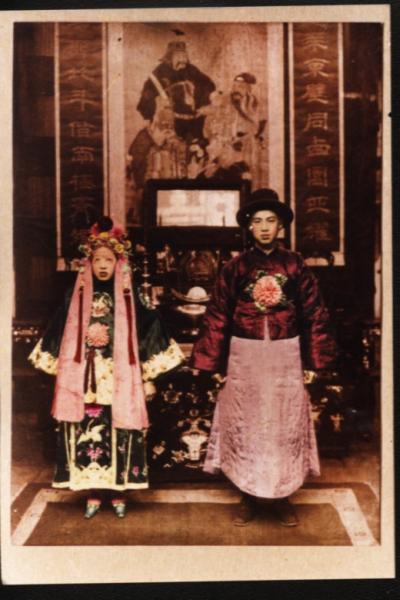
The earliest version of the story goes like this: the photo was taken around 1930-1933 in Guangdong. The woman on the left was the only daughter of a wealthy family, and the man was a famous handsome guy in the local area, but his family was not well-off. The wealthy young lady unfortunately died young. About ten days after her death, a matchmaker arranged for this man to marry into her family and inherit the estate. According to old customs, it was considered unlucky for adult men and women to die unmarried. Wealthy families would find living people to marry, while ordinary families would find deceased men and women to marry, a practice known as a posthumous marriage. This woman had been dead for some time, and a wooden frame was used to prop her up for the ceremony, which is why her legs were suspended in the air.
This version might be the earliest one, but it wasn't sensational enough. So, someone else posted online with a different story, claiming that the people in this photo were from a village in Yuhang! The woman was named Ye Zimei, 17 years old, from a very wealthy landlord family at the time. The young man was 19-year-old Wang Haide. They got married, but before she could move into his home, the woman died of a fever. They had been engaged for one year! In 1922, the young man refused to follow the local custom of marrying a dead person and ran away to join the army. Later, he was caught and brought back by the woman's family. This photo was taken in the late afternoon. The woman had been dead for six days, and a wooden frame was supporting her from behind; her feet did not touch the ground! Later, the man went to Shanghai, opened a small teahouse, and died in 1988. He later married a local woman from Shanghai and had one daughter and one son. At the time, the man was not willing because he was a handsome young man in the local area but had little money. The woman liked him and used her family's power to force him to get engaged to her. Poor man.
In this version of the story, the man becomes a tragic figure, and the story spread quickly. However, not long after, someone discovered that this photo had appeared in Chinese Geographic magazine.
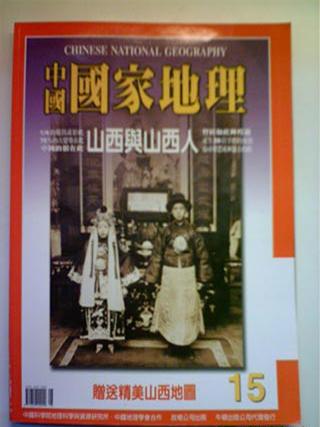
Thus, many debunking posts appeared, claiming this event was fake because it clearly mentioned Shanxi. Based on research by some people, it was found that the background of this photo is actually a place called Wang Family Compound. The introduction to Wang Family Compound is as follows:
The East Fortress Courtyard of Wang Family Compound, also known as the Gaojiya architectural complex, was built from the beginning of the Jiaqing reign to the 16th year of Jiaqing. It is fully enclosed; covering an area of 11,728 square meters, it has 26 courtyards with 212 rooms, arranged in six parallel lines. The middle three lines are the main courtyards, the west two lines are Guixin Academy and the Flower Courtyard, and the Flower Courtyard's south house has a secret tunnel connected to each household for emergencies. The east side is the kitchen. The brilliance of these courtyards lies in their combination of being a whole yet relatively independent; there are as many as 65 doors between the front, back, left, and right courtyards, making one feel like entering a maze. The compound extends east to Jingsheng Town and west via a stone bridge to the West Fortress Courtyard. Behind the building are 13 cave dwellings, the highest point of the entire compound, used for watching and living. The West Fortress Courtyard of Wang Family Compound, also known as the Hongmenbao architectural complex, was built from the 4th year to the 58th year of the Qianlong reign. Covering an area of 19,800 square meters, it is 105 meters wide from east to west and 180 meters long from north to south. It has 28 courtyards with 834 rooms; with the main central axis as the center, it runs through three horizontal alleys, forming a huge character 'Wang' (王), showing unique craftsmanship.
But at this point, another huge problem arose. If you compare the two photos, you will find that although the cover of Chinese Geographic magazine featured this image, the picture on the magazine cover had text blocking it, while the earlier online photo did not have this obstruction, and it cannot be restored solely by Photoshop.
So interestingly, the background of this story changed from Yuhang to Shanxi in the debunking versions, and some people posted claiming that this issue of Chinese Geographic magazine specifically described posthumous marriage, but in fact, this issue did not mention posthumous marriage at all.
So, some debunkers asked if this photo appeared in this magazine. The answer is indeed it did, but it might disappoint the debunkers because this photo looks like this:
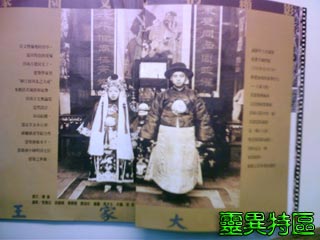
If you try to use it to restore the earliest online photo, it is basically impossible because assembling the pages there is laborious and prone to errors. The person who originally uploaded the image probably did not have much energy to specifically create this image.
So some people raised the question: Did Chinese Geographic magazine use a posthumous marriage photo and then write about something else?
Some doubts were disappointed at this point. It seems this rumor cannot be debunked. However, some people persisted until the end and finally discovered the truth. It turns out that the main reason this photo is hard to find information on domestically is that it was not originally common in domestic online materials.
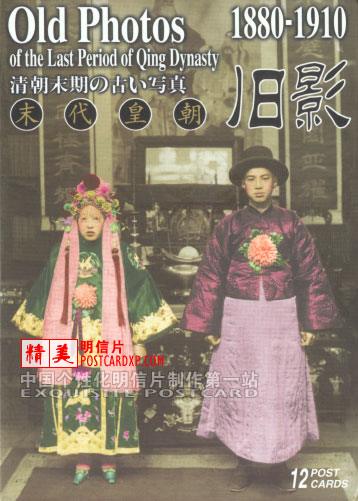
This postcard album comes from a photo collection called "Old Shadows of the Last Dynasty", taken between 1880 and 1910. The albums above were colored later, and the total number is 2,607.The detailed description of this photo describes how men and women in old society got married through matchmakers without having seen each other before, and it mentions nothing about posthumous marriage. This album should be the earliest source.
Currently, most debunking posts online only go as far as mentioning Chinese Geographic magazine and consider the rumor debunked, without considering the complexity of Photoshop techniques. Drawing conclusions without careful research is not advisable and does not reflect a rational attitude or spirit.
So, does posthumous marriage really exist? The answer is yes, but ordinary posthumous marriages usually use photos of the deceased or spirit tablets, not directly using corpses. Even if bones are used, they are not publicly displayed at the wedding.
Posthumous marriage has many special customs. For example, the sedan chair containing the spirit tablet cannot be red but must be green, indicating it is a posthumous marriage, distinguishing it from others. Also, generally, in posthumous marriages where a woman marries a man, a piece of wood is usually placed on the bed to represent the deceased. This custom is more common in backward areas.
A few years ago, news reported that many people dug up graves to steal bones to arrange posthumous marriages for others. Even worse, some used monkey bones to deceive people. Posthumous marriage is mostly driven by the deceased's family's unwillingness, serving as a寄托 for grief, and believing that this will make the deceased live better. It is a manifestation of treating the dead as if they were alive, but this behavior is distorted and unacceptable, and should be firmly opposed. Since the Zhou Dynasty, the official government has banned this behavior, which is not without reason, as posthumous marriage brings many troubles to the living.
In some regions, there are similar posthumous marriage phenomena, but they are more distorted and insidious. Most of the time, someone drops a bag or some items on the road. Then, an unsuspecting passerby, out of curiosity, greed, or other reasons, picks it up. Suddenly, some burly men, mostly relatives of the deceased or villagers, will rush out and force the finder to undergo a posthumous marriage. The reason is sufficient: you picked up the dowry of a deceased person, indicating a destined connection. If you refuse, you will be kidnapped and tortured.
Although such people exist in reality, they should not intentionally exaggerate or create bizarre rumors on the internet. This album must be in the hands of many media professionals, but many who know the truth have not come out. Watching these spread while secretly smiling is unacceptable.
Because turning a blind eye is also a sin.