Tales of Old Shanghai through a Case from "New Cases of House Destiny": The Mysterious Incense and Candle Shop Owner
In "New Cases of House Destiny" there is a case:
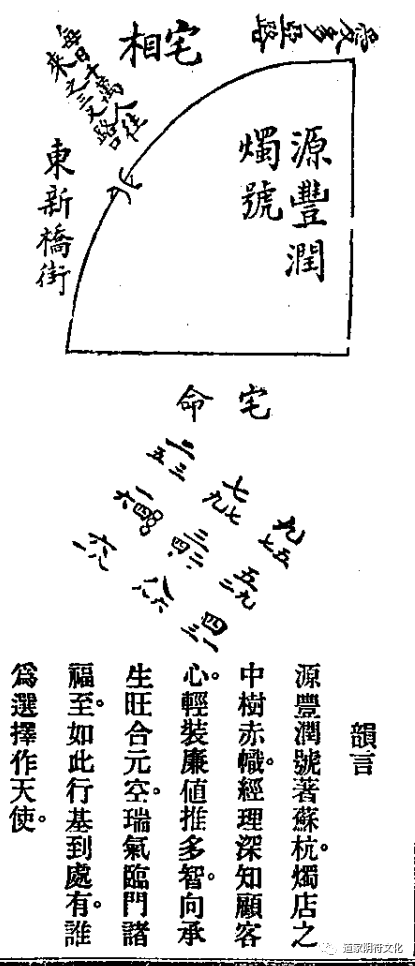
The case itself is quite simple: the Yuanyuanfeng candle shop was built during Period Three, received the prosperous qi, and therefore flourished. Yet the story behind it is anything but simple.
First, the Yuanyuanfeng candle shop did very well in old Shanghai. It was extremely well known — virtually a landmark.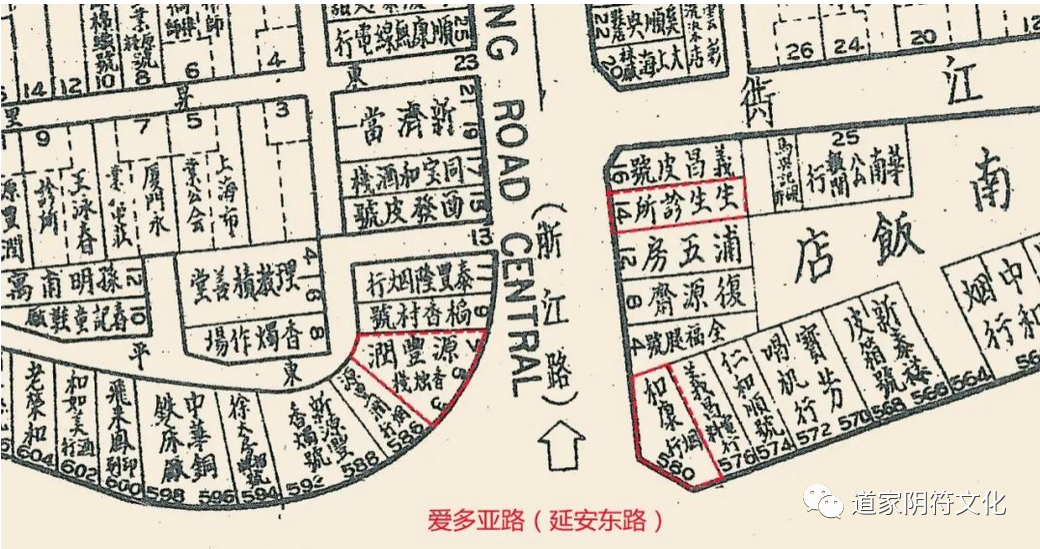
But this "Yuan Feng Run Incense and Candle Shop" had nothing whatsoever to do with Yan's "Yuan Feng Run."
The owner of the Yuan Feng Run incense and candle shop had originally been a worker at a glass factory in Hubei. He later came to Shanghai and first made money trading traditional Chinese medicine.
Later, the owner believed it was his Buddhist faith that had brought him such good fortune, so he opened an incense and candle shop at the then intersection of Avenue Edward VII and Zhejiang Road. With a wide range of products, decent quality, and a knack for advertising everywhere, the shop took off easily. He later opened a silk shop called "Jinxiu," which also prospered. He was, you might say, a born businessman.
In 1935, the owner bought a pleasure cruise ship. At its launching ceremony, Shanghai's famous tycoons Du Yuesheng and Zhang Xiaolin both came to offer their support — his moment in the spotlight was unmatched.
Returning to the Yuan Feng Run candle shop: according to Xuan Kong flying star theory, because its facing star was the Green Four, a prosperous star, the shop thrived.
The cruise ship's business model was to carry cargo on one side while setting up mahjong tables on the other, complete with opium smoking. Tourists joined its "Pilgrimage Tour Group" — much like today's package tours — taking visitors around Hangzhou and then to Mount Putuo to burn incense. The participants were almost entirely celebrities, wealthy merchants, rich wives, and young masters; it was truly something else.
Yet it was precisely this ship that capsized just a year later. Though the tourists were unharmed, all the cargo aboard was lost.
The direct result was that the courts and police seized all of the owner's properties. Only after the investigation did it emerge that the candle shop owner was also a victim.
First, the Jiangnan Shipyard had taken advantage of his ignorance, selling him an old ship refurbished to look new. Second, his Shanghai wife, wanting to help out a relative, had lied and gotten that relative aboard as first mate — and when the emergency hit, the man didn't know how to handle it.
With the cargo lost and all his shops sealed, his capital couldn't circulate. Creditors swarmed in to demand payment and seize goods, and the candle shop owner was instantly bankrupt.
As this calamity struck, Zhang Xiaolin suddenly appeared and proposed a deal with the candle shop owner: the owner would declare that all these shops actually belonged to Zhang Xiaolin, and they would continue operating under Zhang's name — but the real earnings would still go to the candle shop owner.
The candle shop owner was naturally extremely grateful and agreed.
Why? Because his relationship with Zhang Xiaolin was genuinely good.
Here it is worth mentioning that Zhang Xiaolin's birth chart was Ding Chou, Bing Wu, Wu Wu, Jia Yin — and his name was related to this chart.
As a child, Zhang Xiaolin's original name was Zhang Xiaolin (Zhang Little Forest), and his childhood nickname was Ah Hu (Tiger). Later, his family consulted a fortune teller to choose a new name. The fortune teller noted that his nickname was "Tiger" and his chart showed "a tiger in the forest," so he should change his name to Xiaolin. He later took the name Zhang Yin, with the sobriquet Xiaolin.
This chart clearly has excessive Seal (Resource) star, which corresponds to his poor performance in studies. He accordingly dropped out midway and ran off to become a yamen runner. What puzzles people is that, reading the chart further, Zhang Xiaolin would find it very hard to have a biological son.
According to common accounts, everyone knows Zhang Xiaolin initially had no children and had adopted two sons. Later, he suddenly did have a son, named Zhang Fayao.
So where was the problem? Herein lies a secret.
The candle shop owner's female cousin was Zhang Xiaolin's first wife.
According to the family's later descendants, Zhang Fayao was actually not biological either. When the candle shop owner went to burn incense at Tianzhu, he picked up an abandoned infant and brought the baby back to give to Zhang Xiaolin.
So, by this account, there was at least some real bond between them.
After all, he had once been a major figure on the Shanghai scene. As soon as Zhang Xiaolin stepped forward, the police lifted the seizure, and all the shops were uniformly renamed "Linji Stores."
What happened next could be predicted with your eyes closed.
At first, Zhang Xiaolin still let the candle shop owner's family take a little living money. Later he simply denied the arrangement, claiming all the shops were his, and seized them for himself.
What followed: Zhang Xiaolin became a traitor and was assassinated by Lin Huaibu, sent by the military intelligence bureau (Juntong). The shops then passed to Zhang Fayao — who, it is said, squandered the entire estate and eventually disappeared without a trace.
From the perspective of the birth chart, Zhang Xiaolin's shortcoming is quite clear. The Lu (prosperity) star of Jia sits at Yin, and this tiger is his Lu; the Lu is most vulnerable to harm. What damages Yin most severely: above are the heavenly stems Geng and Xin, and below is the earthly branch Shen. Xin is hidden in Chou at the year position, so once Chou opens, the person must die. Jia symbolizes the head; when he was later assassinated, he was shot in the head. During the Zi period this image was particularly strong: Xin emerged from Chou, and the image of Ding-fire and Xin-bullet was plain to see.
If we set aside the question of ownership, this candle shop had indeed always been prosperous — prosperous enough for its owner to rub shoulders with titans like Du Yuesheng, Zhang Xiaolin, and Huang Jinrong.
From an analytical standpoint, during the Fourth Period, 1924–1943, this shop did conform to feng shui deductions.
But external influences cannot be ignored either. One of the key reasons this candle shop made money was that it stood in an excellent location — a precondition above all.
This area had always been one of the most heavily trafficked districts of old Shanghai. Even after Liberation, commerce and services here remained prosperous — hotels, restaurants, food shops, and other businesses continued to thrive.
It was only after reform and urban redevelopment that this district gradually began to decline.
Looking back across the changing years: in old Shanghai, besides this district, Tilanqiao was also very prosperous. It had originally been the site of the American-led concession; after Liberation it became the commercial center of the northeastern district. After reform and opening up, it was a hub of docks and transport, and commerce grew rapidly.
However, after the 1990s, as the population aged and redevelopment took hold, Tilanqiao slowly declined. Today, when people mention the place, they probably only remember Tilanqiao Prison.
Other places — Baxianqiao, Laoximen, Nanxi Xieqiao, Caojiadu and so on — all once thrived in the 1980s and 199s, but have since declined with the changing times.
Of course, there are also districts whose fortune continues to prosper — places growing ever more flourishing, such as Xujiahui and Jing'an Temple, which still serve as core commercial centers.
On the big picture, the changes of the city itself are the primary influence — and those changes are closely tied to human planning and design. This is a point contemporary researchers should note.