The Folding-Corner Centipede: An In-Depth Analysis of a Legendary Feng Shui Site
From the stele at the Folding-Corner Centipede site, we can see it is inscribed "Tomb of Li Boshun" — and Li Boshun was in fact a descendant of Li Shimin.
Back then, after Wu Zetian took power and replaced Tang with Zhou, she persecuted the Tang royal clan. Li Shimin's youngest son, Prince Cao Ming, was killed while being banished; his descendants were also demoted to Lingnan. It was only later, when Emperor Xuanzong of Tang overthrew Zhou and restored Tang, that these descendants recovered their royal status.
By the late Tang, the lineage had developed into the branch of Li Chong. However, Li Chong, while serving as governor of Hongzhou during Emperor Zhaozong of Tang's reign, died in a mutiny.
The family of Li Chong's branch then scattered across Jiangxi. From Li Shu, a cousin of Li Chong, down to the fourth-generation descendant Li Gui, this line developed into the Luotian Li clan of Fengcheng. Li Chong's son Li Peng, and the second-generation descendant Li Cong (courtesy name Boshun), developed into the Humang Li clan (also known as Lower Li), also called the Prince Cao lineage.
The Humang Li clan produced many notable figures throughout history. For example: Northern Song's Li Bing, Director of the Bureau of Personnel and Governor of Suzhou, one of the celebrated "Three Directors of Fengcheng," along with the brothers Li Mian (Judicial Inspector) and Li Kang (Assistant Magistrate of Linchuan). Southern Song's Li Xiuji (Assistant Prefect of Chengdu) and Li Yishan (Hunan Intendant), a father-son pair. Ming Dynasty's Marquis of Fengcheng Li Bin and his son Li Xian; Li Huan, Vice Commissioner of the Songpan Guard; and the Ming Jiajing-era Minister of War and anti-pirate commander Li Sui and his son Li Cai.
The Folding-Corner Centipede site is said to have been chosen by the elder Zhutuo at the invitation of the Li clan; the one buried there was Li Cong (Boshun).
According to the Li clan genealogy's record of Li Cong:
The second son of Zi, courtesy name Boshun, known in his time as a retired scholar. Born in the Dingyou year of Tianfu under the Later Jin. Married Lady Huang, one son, who died young; then married Lady Zhang, with three sons: Gui, Cong, and Xu. Died in the Yi-chou year of Tiansheng (Song), at the age of eighty-nine. Buried in Qilong Mountain in the local parish, in the Folding-Corner Centipede form, Geng mountain Jia facing. Lady Huang buried at Shantouzui; Lady Zhang buried on Hulang Mountain. Mr. Chengming composed the epitaph stele; a biography exists.
At the time of the burial, three sons were still alive, and there were already thirteen descendants in the grandson and later generations.
In his lifetime, Li Boshun was not only generous and charitable, but also donated heavily to build Daoist temples and Buddhist monasteries, including: Feihuang Temple, Zhengfa Monastery, Linggui Temple, Longan Cloister, Chongdao Temple, Zhaoxian Temple, Daode Temple, and Chaoxian Temple — of which Daoist temples were the majority.
We can see that the so-called "Longan Temple" in the legend should actually have been Longan Cloister.
According to historical records, after the Li burial, the junior branch rose rapidly through the examinations. The middle branch prospered next; only the senior branch did not prosper, because the Azure Dragon side near the acupoint was too open and empty. Later, a skilled master pointed out the remedy: an Azure Dragon sand ridge was built up — giving rise to the name "Folding-Corner Centipede form." After this, fathers and brothers rose through the examinations in succession, producing the Minister of Rites Gong Ji, the Minister of War Gong Sui, and others — all from the senior branch.
The Li clan of the Fengcheng branch numbers more than twenty thousand. But outside Fengcheng, the descendants of the Humang Li clan are estimated to number at least several million.
Many people have studied this site, but most only speak shallowly about it. Here we list a number of questions for analysis.
Q: The actual location does not match what is recorded in "Geography Essentials for Sons and Heirs." Why?
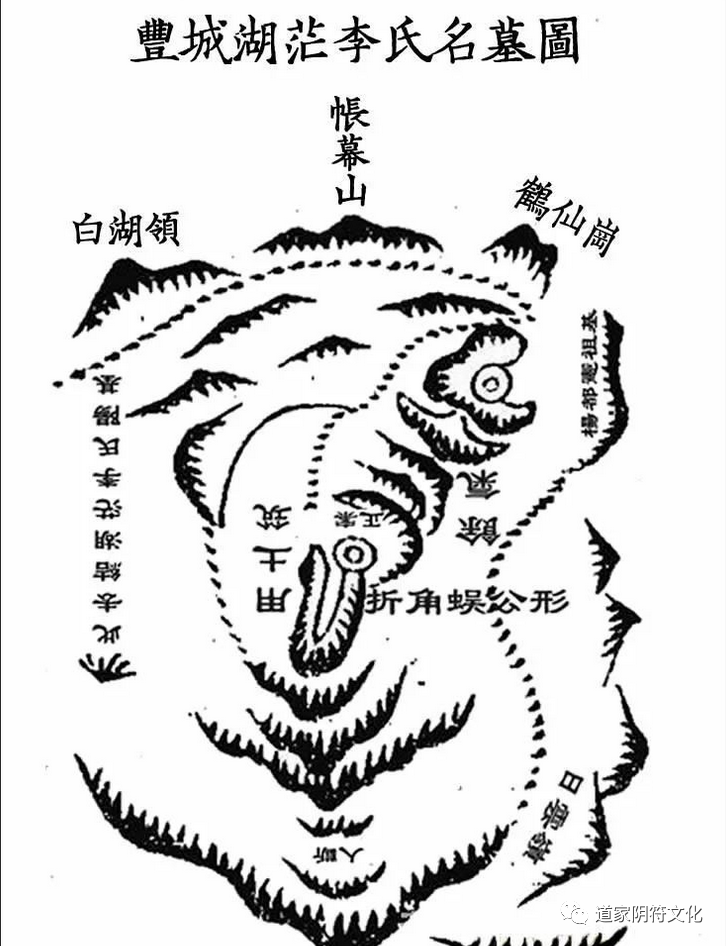
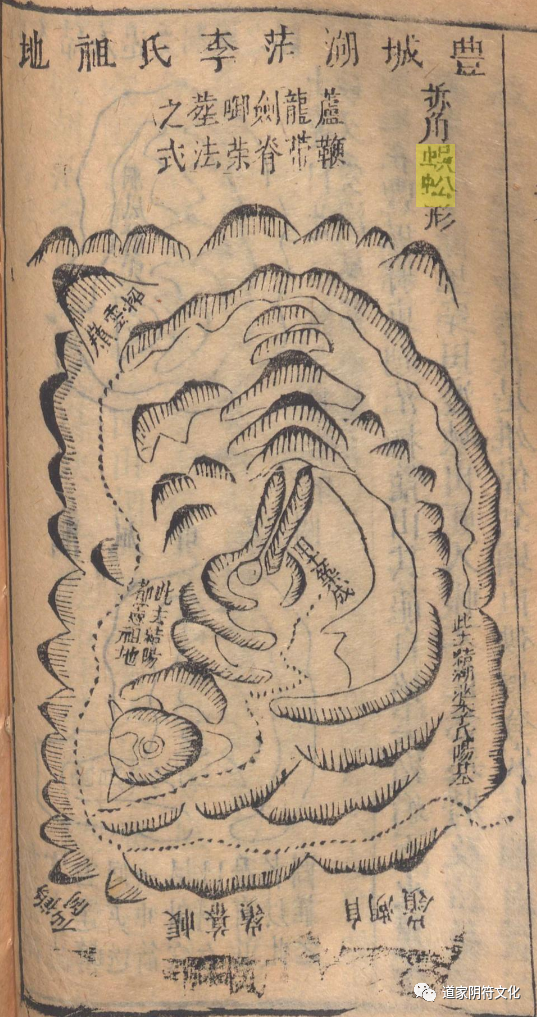
The acupoint drawn here is relatively closer to reality; however, the mountain veins in the illustration are drawn as a double-vein delivery — deviations of this sort are common in ancient texts.
Now looking at the specific description in "Geography Essentials for Sons and Heirs":The site on the left is forty li east of Fengcheng County, locally called Hulang Qilong Mountain. Its dragon originates from Zhaoyun Ridge, with the Blazing Heavenly Fire Star as the ancestral source. It travels more than thirty li, piercing through fields and crossing gullies, emerging from and entering tents — impossible to describe fully. Near its terminus, star peaks rise suddenly, leaping and surging, truly majestic. The head is straight and hard like a sword's spine; at the acupoint the face is taut, with a slight nest-like hollow. The coffin is laid horizontally — this is called the "carrying firewood" burial method. Ascending to the acupoint is cramped; it will not please ordinary eyes. Inspecting from outside, waters and mountains gather and meet. Moreover, after the acupoint forms, the White Tiger star peaks plummet and rush away, forming Grand Censor Yang's ancestral site. Though the branch feet go on, they still look back. The left side near the acupoint is somewhat empty; the outer Azure Dragon also turns far around to become the proper table.
Clearly, this textual description conflicts sharply with the accompanying illustration. If the position drawn in the figure sits atop the White Tiger's head, then it becomes a "riding the dragon" site — but in that case, the outer Azure Dragon cannot turn to become the proper table. The table shown in the figure clearly comes from the White Tiger side, which plainly does not match the text's description.
Referencing satellite imagery as well:
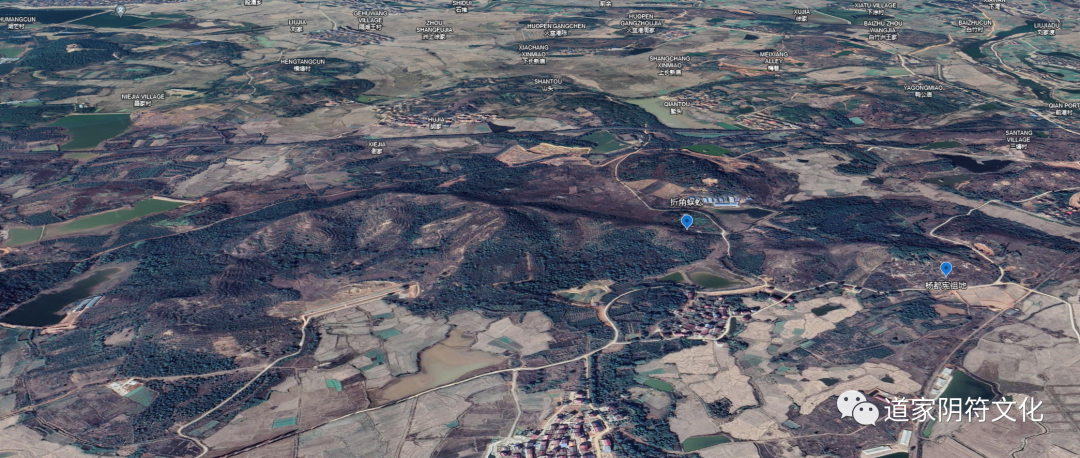
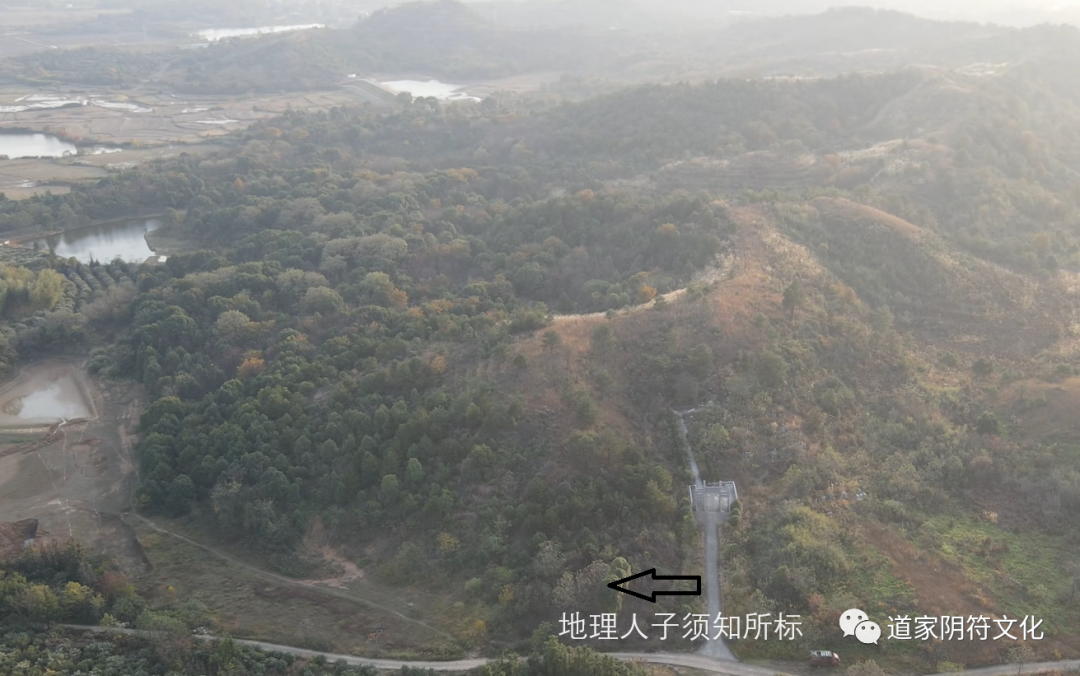
Clearly, the acupoint's location cannot be far from the top of the mountain range — otherwise there would not be the description of "crampedness." At the same time, the White Tiger is explicitly described, so the acupoint cannot possibly sit on the main ridge of the mountain.
In "Geography Essentials for Sons and Heirs," since the textual description is correct, we can confirm they actually visited this place — but why would the illustration be so far off?
It is very likely that later people, when re-engraving and revising the text, altered the original illustration according to their own ideas.
Q: Was the elder Zhutuo really struck dead by lightning? This site is a sword-spine dragon; as a "master-killing" site, the elder Zhutuo could not have failed to understand it — so why would he still have pegged this site for the Li descendants?
In考证, the Gu clan to which Zhutuo belonged and the Li-Tang royal house actually shared deep origins.
The ancestor of the Gu surname did not originally bear the surname Gu, but Lin. During Emperor Taizong of Tang's reign, there was an official named Lin Zheng. Because he opened the government granaries on his own authority to relieve famine victims, local gentry colluded to frame him. Taizong was furious at first and had him imprisoned; but after investigating clearly, he reversed the case, summoned Lin Zheng, and bestowed upon him the new surname Gu — to honor his "toil and hardship" virtue.Later, the Gu clan, grateful for imperial grace, took this as an honor. When Chai Rong of the Later Zhou attacked, the Gu clan once led ten major clans to resist — with the great general being Zhao Kuangyin. After three months without success, Zhao Kuangyin, upon ascending the throne, declared that the Gu surname could not be admitted into the Hundred Family Surnames.
If the Li descendants had mistakenly interred the site too early, causing Zhutuo to be struck by lightning, they certainly would have gone searching for his body — yet no such record exists. The claim stays only at the level of village folklore, and so is doubtful.
Furthermore, this site stands as Geng mountain with Jia facing. Zhen receives Geng; Zhen represents thunder. Inverting the Zhen trigram gives the Gen trigram — thus forming the "Heaven Over Mountain: Retreat" hexagram, corresponding to Geng on the Heaven Plate — the meaning of "thunder retreating."
Q: This site lacks Azure Dragon — why can it still be used?
Reconstructing from images the appearance of the wide-open Azure Dragon side:
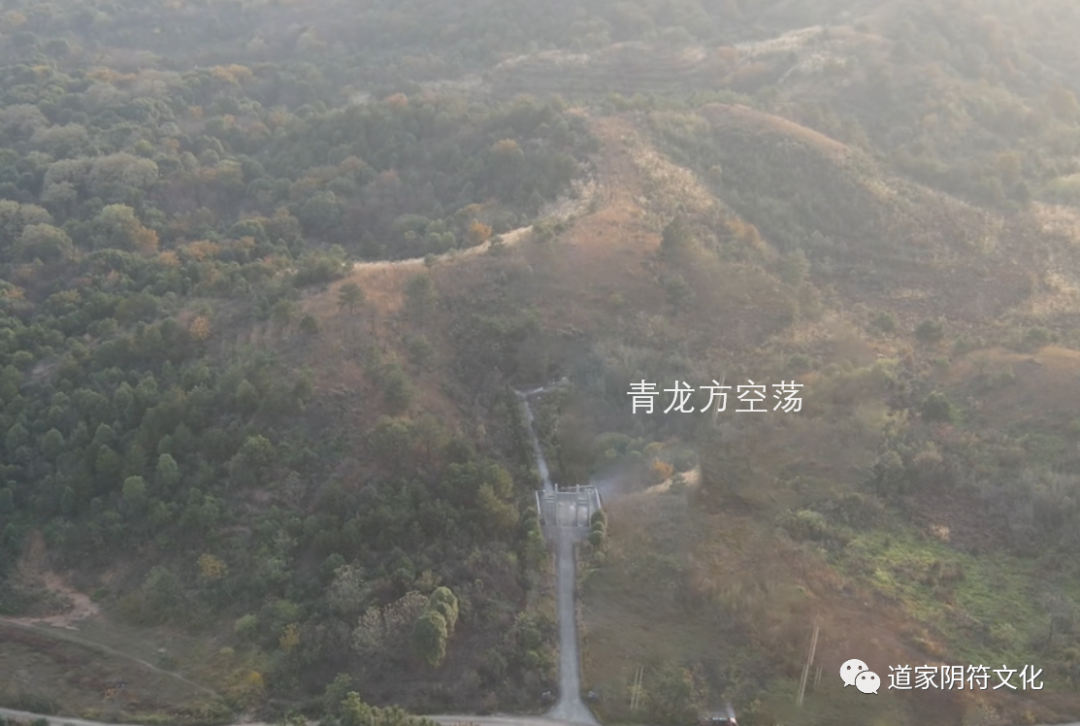
The local Jiang's "Head of the Ranges Mental Method" states: "Those who follow the ancient method will surely not please ordinary eyes; those who please ordinary eyes surely do not follow the ancient method. Whenever one sees great earth, more often than not one side turns in — either dragon without tiger, tiger without dragon, one side short and one long, bridging left or bridging right, or outer mountains circling around. None of these are unacceptable."
Of such sites — where the dragon body twists and forms, missing either dragon or tiger is extremely common. Naturally one cannot refuse to use them simply because they are incomplete. As for how to determine the acupoint when one side is absent, there are separate methods.
Roughly speaking, bizarre dragons and strange acupoints only seem incomprehensible because people have not grasped the true method and instead apply rigid formulas. So they are at a loss amid the ever-changing terrain.If one better understood the secret transmissions of acupoint method, judgment could be made at a glance. In "Geography Essentials for Sons and Heirs," the Xu brothers did not make it public, but later also received transmissions; in some chapters there are slight clues — the careful can seek them out.
Q: After this site was interred, the third branch prospered first, then the second branch, but the senior branch did not prosper. After the Azure Dragon sand was built up, why did only the senior branch prosper, far outstripping the second and third branches?
This site seems to follow the "begging-branch" pattern, hence the bias in the palatial positions. After building up the sand and changing the facing, one can also discern from the qi principles that this site favors the senior branch — but in ancient times the senior branch was paramount, so favoring it was acceptable.
Q: If it is truly a master-killing site, aerial photos show many recent new graves in front of the founding ancestor's tomb. If there really were a master-killing effect, no one would dare be interred again; if there is no such effect, does this site not bear a false name?
New burials at this site have not killed — only because this Azure Dragon does not kill.
Q: What basis establishes that the acupoint is here?
The principle: when the dragon turns left, the left is life; when it turns right, the right is life — and the reverse is death. Embrace life, abandon death. As with a person standing with palm forward, what moves is the wrist. The dragon travels like the sinews and bones of the human body, linked together — this is the naturally formed location.Q: Is the current facing the ancient original orientation?
From the epitaph, we know that at the time the site was pegged, the orientation used was Geng mountain with Jia facing.The existing stele reads Wei mountain with Chou. Modern practitioners say that Wei mountain Chou facing is the outer orientation, and Geng mountain Jia facing the inner orientation — this may have its reasoning.
However, if one knows the acupoint method, one can understand that the current facing — Wei mountain Chou — was established after the Azure Dragon sand was filled and built up. This accords with "Geography Essentials for Sons and Heirs"'s theory of the outer Azure Dragon turning to become the table. Thus the Xu brothers' record already reflects this orientation.
This explains why, in the Humang Li clan diagram, the proper table is the White Tiger turning to become the table, while the Xu brothers recorded the outer Azure Dragon as the table.
Q: Though this site is said to be a horizontal burial, it is not truly horizontal — yet with Geng mountain Jia facing, it is in fact a slant burial. Why is that?
This site is cramped, so it is determined by combining the dragon method, the acupoint method, and the burial method. The original text's statement that the coffin is laid horizontally as the "carrying firewood" burial method is not wrong, but it is misleading.
Lai Buyi's "Seventy-Two Burial Methods" merely offers the horizontal burial as one example — and it is not of the kind called the "carrying firewood" burial method. The so-called carrying-firewood burial method arises precisely because the convergence is uneven. Therefore, one takes another vein descent as the standard of the "Heavenly Heart Cross," placing the coffin like firewood within the "dou-mouth" — hence the name carrying-firewood burial. With this method, the second, fifth, and eighth branches prosper first, followed by the elder and younger. If there is no dragon, the junior branch prospers first; if there is no White Tiger, the senior branch prospers first. Horizontal, slant, and straight all appear within it — it is not what mediocre masters call simply "a horizontal coffin equals carrying firewood."