Exploring the Principles of Cultivation (Part One): Correspondence Between the Pre-Heaven and Post-Heaven Bagua and the Laws of Thermodynamics
This article describes a correspondence between the pre-heaven and post-heaven bagua and various thermodynamic equations. Further discussion is welcome (if no one discusses it, this article will not be continued).
First one must understand a concept in thermodynamics: if a spontaneous process occurs in a system, that process is irreversible.
For example, when two objects at different temperatures are brought into contact, with no other interference, heat flows from the higher-temperature object to the lower-temperature object—this process is irreversible.
If external force is used—such as forcibly transferring heat from a low-temperature object to a high-temperature object—this is possible, but a certain cost will inevitably be incurred.
Take a refrigerator for example: the cooling process is really a process of absorbing and removing heat; this process is paid for by consuming electrical energy.
If no other energy is consumed—for instance when a gas absorbs heat and can be completely converted into energy—it may look like a lossless conversion, but the cost is that the gas's volume will expand.
Thus there is an implicit sense of equivalent exchange involved.
It is especially important to note that the second law of thermodynamics is only an empirical description. What is widely recognized is that it holds under macroscopic conditions; under microscopic conditions it does not necessarily hold.
Next, the concept of entropy must be discussed. When thermodynamics first appeared, it did not really have a precise definition—only some measure used for calculation. Only later did people gradually clarify its meaning: it refers to the degree of disorder of a system.
And this concept leads to the second law of thermodynamics: in an isolated system, any process that actually occurs always tends to increase the entropy of the whole system.
Therefore, the higher a system's temperature, the greater its degree of disorder may be; and how disordered a system is can be expressed using entropy.
Boltzmann's original definition was: S∝lnΩ. By Planck's time a coefficient k was introduced, and the formula became: S=klnΩ,
Here k is the Boltzmann constant, S is the entropy of the macroscopic system—a measure of the disorder of molecular motion or arrangement—and Ω is the number of possible microstates. The larger Ω is, the more disordered and chaotic the system.
Boltzmann proved an important thing back then: the macroscopic physical properties of a system can be regarded as the equal-probability statistical averages over all possible microstates.
This concept is especially interesting. For example, in deep learning algorithms there is a softmax process applied to data. Softmax can map the values of multiple neurons to between 0 and 1, and the sum of all values adds up to 1.
Because a system has temperature, if the temperature keeps rising, the entropy value will rise accordingly; if the temperature is infinite, the computed result becomes ever more random, so every term's probability in the result will be equal. Conversely, if not every term's probability is equal, this means its temperature is not infinite; the total probability is 1.
This process is computationally equivalent to the entropy defined in thermodynamics, so what Boltzmann proved is very useful.
If, through some transformations, we can treat the feature of a sentence represented by a text as its meaning, then representing a sentence's meaning as a softmax vector, one need only compute its statistical average to obtain that sentence's feature.
The Boltzmann constant is 1.380649×10⁻²³ J/K. This quantity is essentially the thermodynamic temperature corresponding to 1 kelvin; for example, absolute zero corresponds to 0 K.
There is a troublesome aspect to this definition: it always assumes an isolated system, and reality is not always like that. Therefore in practical calculation, changes of both the system and its surroundings must be considered at the same time.
Hence a somewhat more complex formula is needed. In an isothermal process with constant particle number, the work done by the system on the outside can only be less than or equal to the decrease in its free energy.
Divided into two parts, then, one can view it as: part of it participates in external exchange, while another part does not.
So within the internal energy one can separately define a concept called free energy—that portion of energy can be converted into work during a reversible isothermal process.
Such a description can be realized through the defined concept of “capacity” or “volume,” and can therefore be expressed using a state function: this is the Helmholtz free energy.
A very obvious truth is that the decrease in the system's free energy is the maximum work the system does on the outside during an isothermal process.
In a thermodynamic system, judgments of spontaneous states and equilibrium conditions can be expressed by the Helmholtz free energy, whose expression is F=U−TS, where U is the system's internal energy, T is the temperature, and S is the entropy.
The description reads: Helmholtz free energy = internal energy − temperature × entropy
Its differential form is: dF = −SdT − PdV + μdN
P is pressure, V is volume, μ is chemical potential.
Therefore, for a thermodynamic description of chemistry, another expression must be introduced—the Gibbs free energy formula.
Its definition is G = U − TS + pV
The description reads: Gibbs free energy = Helmholtz free energy + pressure × volume
Since enthalpy can equal internal energy plus pressure times volume, i.e. H = U + pV,
it can also be described as G = H − TS
where U is the system's internal energy, T is the temperature (absolute temperature, in K), S is the entropy, p is the pressure, V is the volume, and H is the enthalpy.
Enthalpy here refers to the sum of internal energy and the product of pressure and volume. Why define the concept of enthalpy? Because clearly, although enthalpy cannot be measured precisely, the change in enthalpy can be measured directly by experiment.
The most typical example: the internal energy of a gas may be hard to measure, but the heat released when a gas burns is easy to measure.
In chemistry, the average Gibbs free energy per particle equals the chemical potential. Chemical potential is the counterpart in chemistry of the concept of heat—because particles always transfer from regions, phases, or components of higher chemical potential toward those of lower chemical potential, until the two equal and reach chemical equilibrium with each other. This process is the same as in thermodynamics.
Some concepts in physics and chemistry are mutually connected, especially as reflected in thermodynamics.
In physics, temperature characterizes a system's energy's tendency to transfer as heat; pressure characterizes energy's tendency to transfer as work.
In chemistry, chemical potential characterizes the tendency of particle transfer between a system and its medium, or between phases of a system, or between components of a system.
Now let us count: the variables involved are as follows:
Internal energy U, volume V, entropy S
Helmholtz free energy F, volume V, temperature T
Gibbs free energy G, temperature T, pressure p
Enthalpy H, entropy S, pressure p
Setting aside the complicated derivations, we can obtain the following results directly via differentiation:
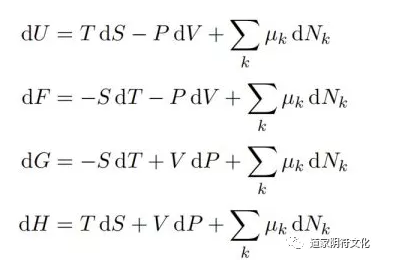
U: internal energy
H: free enthalpy (product of entropy and pressure)
F: Helmholtz free energy
G: Gibbs free energy
Then, treating the product TdS—that is, temperature times the change in entropy—as the first line, and VdP—that is, the product of volume and the change in pressure—as the second line, it can be expressed as the four images.
dU is Shaoyang (Lesser Yang), dF is Shaoyin (Lesser Yin), dH is Taiyang (Greater Yang), and dF is Taiyin (Greater Yin).
Further evolving into the eight trigrams:
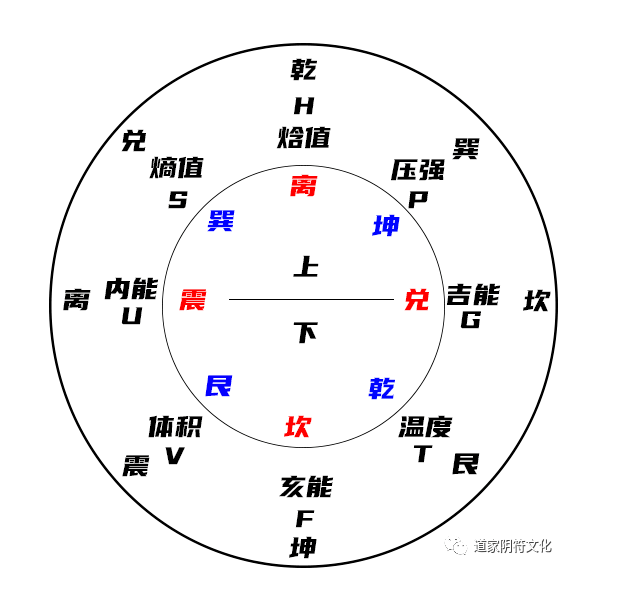
In this diagram the center line is the dividing boundary; Helmholtz free energy and Gibbs free energy are too long to write out fully, so they have been abbreviated.
In the pre-heaven bagua, Qian, Kun, Kan, and Li are the four cardinals; the four corners are Dui, Xun, Gen, and Zhen. In calculation, multiply directly with the opposite palace; if the path goes from bottom to top, it is addition; if from top to bottom, it is subtraction.
Taking the meanings of the post-heaven bagua: the Li trigram is fire, standing as energy; the corresponding enthalpy value—the change in enthalpy (ΔH)—equals the heat absorbed or released by the system.
For Kan, the meaning of free energy is somewhat clearer. One can likewise observe that another free energy also corresponds to the Kan trigram of the pre-heaven bagua.
The characteristic of Gibbs free energy is that, in a isothermal, isobaric closed system, without non-expansion work, any spontaneous reaction always proceeds in the direction of decreasing Gibbs free energy (G). When ΔG=0, the reaction reaches equilibrium and the system's G drops to its minimum—like water flowing downhill, always reducing and reducing again, until there is nothing left to do (wuwei).
If one notes that on the diagram the two conditions of isothermal and isobaric exactly sandwich Gibbs free energy.
Whereas in an isothermal, isochoric closed system, what is exactly sandwiched is the expression of Helmholtz free energy. Helmholtz free energy describes the system's capacity to do work; therefore under isothermal, isochoric conditions, however much work the system does on the outside, Helmholtz free energy decreases by that much—like how much soil has been shoveled out of a mound.
Why does the post-heaven Qian correspond to temperature? Because Qian is Heaven, which can represent the timeliness and environment—it corresponds to the pre-heaven Gen, and also carries the meaning of describing temperature's high or low.
Post-heaven Gen is volume; this image is also very clear. Pre-heaven Zhen represents that it can change. Unlike temperature—whose description is high and low—volume is expansion and contraction.
Post-heaven Zhen is internal energy, because of Li's place in the pre-heaven bagua; and one manifestation of internal energy is particle motion, the flow of energy, and similar concepts.
Post-heaven Kun corresponds to pre-heaven Xun. Only gas has the concept of pressure—naturally this is wind pressing upon the earth, quite vivid.
Post-heaven Xun corresponds to pre-heaven Dui; here it corresponds to the concept of entropy, with the subtlety of Zhongfu (Inner Truth) and Daguo (Great Exceeding).
If the operation is clockwise, one must keep going clockwise throughout; if counterclockwise, one must keep going counterclockwise throughout.
If we put it in terms of the post-heaven bagua—for example, knowing Dui, and wanting to find Zhen:
First compute Dui→Qian→Xun, then turn clockwise to get Li, and only then Kun→Gen→Zhen, arriving at Zhen.
From Qian to Xun is bottom to top, so it is addition.
From Kun to Gen is top to bottom, so it is subtraction.
And for the four corners' relationships, a meeting is a multiplication. Therefore:
Zhen = Dui + Qian·Xun − Kun·Gen
For another, simpler example:
Dui = Kan + Zhen·Xun
i.e.: Gibbs energy = Helmholtz energy + volume × pressure
Li = Dui + Qian·Xun
i.e.: enthalpy = Gibbs energy + temperature × entropy
Therefore: Li = Kan + Zhen·Dui + Qian·Xun
i.e.: enthalpy = Helmholtz energy + volume × pressure + temperature × entropy
And: enthalpy = internal energy + volume × pressure
Therefore: internal energy = temperature × entropy + Helmholtz energy
So, if either the temperature or the entropy value is zero, enthalpy can equal Helmholtz energy directly.
One can then discover an interesting analogy: cultivation strives to reduce the product of temperature and entropy, and the most common method—entering stillness in meditation—is a way of lowering both temperature and entropy.
As for deriving Maxwell's equations, simply count three steps forward, then reverse.
For example Qian→Kun→Xun: three have been counted; the next would be Gen. Starting from Gen, reverse three: Gen→Xun→Kun. The final positions of the two path segments—Kun and Xun—are both on top, so they are directly equal.
Therefore one obtains TPS = VSP; and so:
The others can be verified in the same way.
So the Maxwell equations can be understood as descriptions specifically of four-corner relationships.
If, according to the ideal gas law, C = PV/T (C is a constant), this shows that the product of Kun and Gen always maintains a stable constant-ratio relationship with Qian.
Then there is something more interesting: Xun and Li correspond to four and nine on the Luoshu (Luo River Writing), which are a generation relationship. Do they therefore have some corresponding relationship?
Entropy increases and enthalpy decreases—the reaction is spontaneous;
Entropy increases and enthalpy increases—the reaction is spontaneous at high temperature;
Entropy decreases and enthalpy increases—the reaction is spontaneously reverse;
Entropy decreases and enthalpy decreases—the reaction is spontaneous at low temperature.