In a previous post, someone asked in a comment whether generative adversarial networks could be used to simulate she fu (a divination method of guessing hidden objects). I experimented with this briefly before, and the results were less than ideal.
There are reasons for this: the implementation of an ordinary GAN is essentially a transformation or mapping from a latent space to a sample space. When learning high-dimensional data, it often exhibits certain deficiencies — intuitively, it usually cannot well simulate the concepts of cycles and periodicity.
For example, suppose we try to learn such a clear distribution:
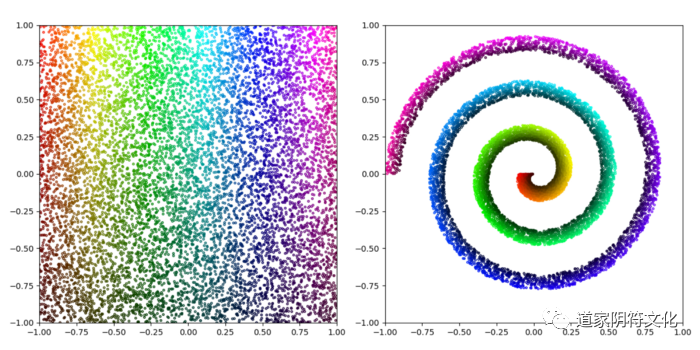
Yet the actual trained result looks like this:
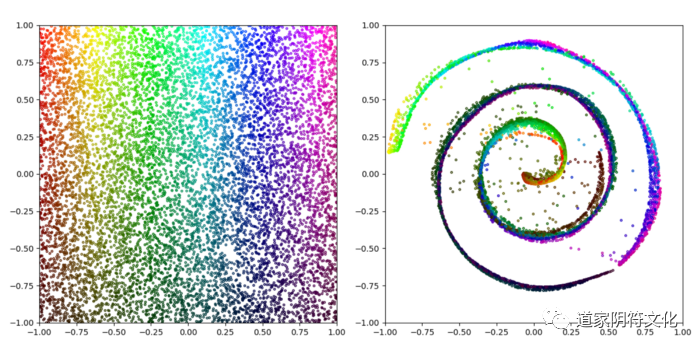
And this cannot be further optimized.
Originally I hoped it could be as beautiful as this:
In reality, it instead does this:
#For the video, see the original post on the WeChat public account
Another example: if we assume all things can be divided into eight categories, then in an infinite space, finite vocabularies can each cluster into eight groups. Representing them with eight Gaussian blobs would look roughly like this:
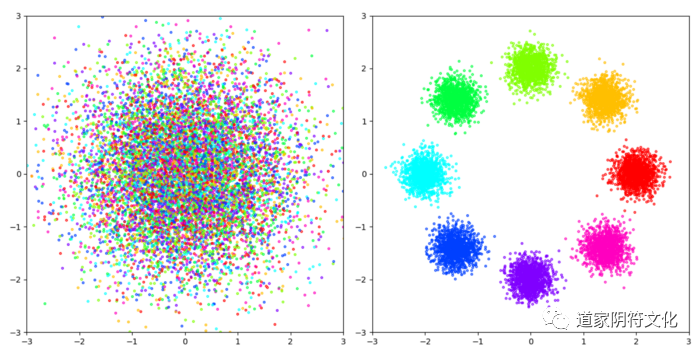
The left side can be understood as various things mixed together, while the right side can be understood as a classification similar to the eight trigrams, where each blob follows a Gaussian distribution and is colored differently to represent its category.
The ideal classification process should be something like this:
Therefore, the generated result can only look like this, and the classification effect is clearly not ideal enough.
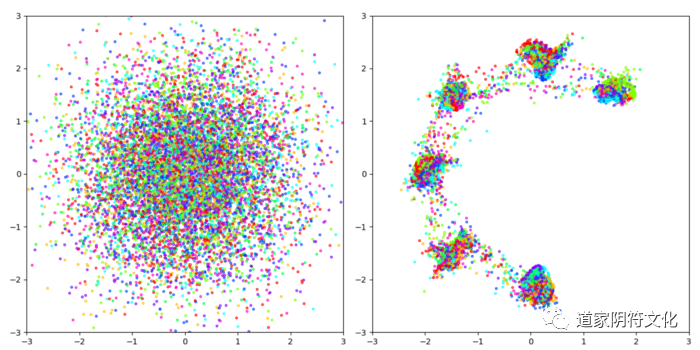
This also gives us some meaningful insights: although adversarial approaches can perform well on certain tasks, they themselves have many problems. Abstracted to reality, it is like how war cannot solve every problem.
If we extend this further, a more interesting discovery is that the GAN is like a Dui (Joy) trigram. Dui not only carries the meaning of opposition, but also exchange, migration, and transformation — and the GAN network also seems better suited to style transfer and transformation rather than creation.
With certain methods, the above problems can be overcome, though that would require more complex research; here it is only briefly mentioned. Interested researchers are welcome to discuss.
Originally published on the WeChat public account (Daoist Yin-Fu Culture): Exploring Why Ordinary Generative Adversarial Networks (GANs) Struggle to Simulate the Operations of Metaphysical Divination